"0% instalments", "partner mortgage from 2.99% under the bank's programme", "10% off for full payment": three formulas selling apartments in Kyiv new builds in September 2026. All three are true, and all three mean something other than what the large print says. Below are the real terms of ten developers, "zero" translated into an annual rate, and the contract clauses that decide what happens to the buyer's money if the construction or the income stops.
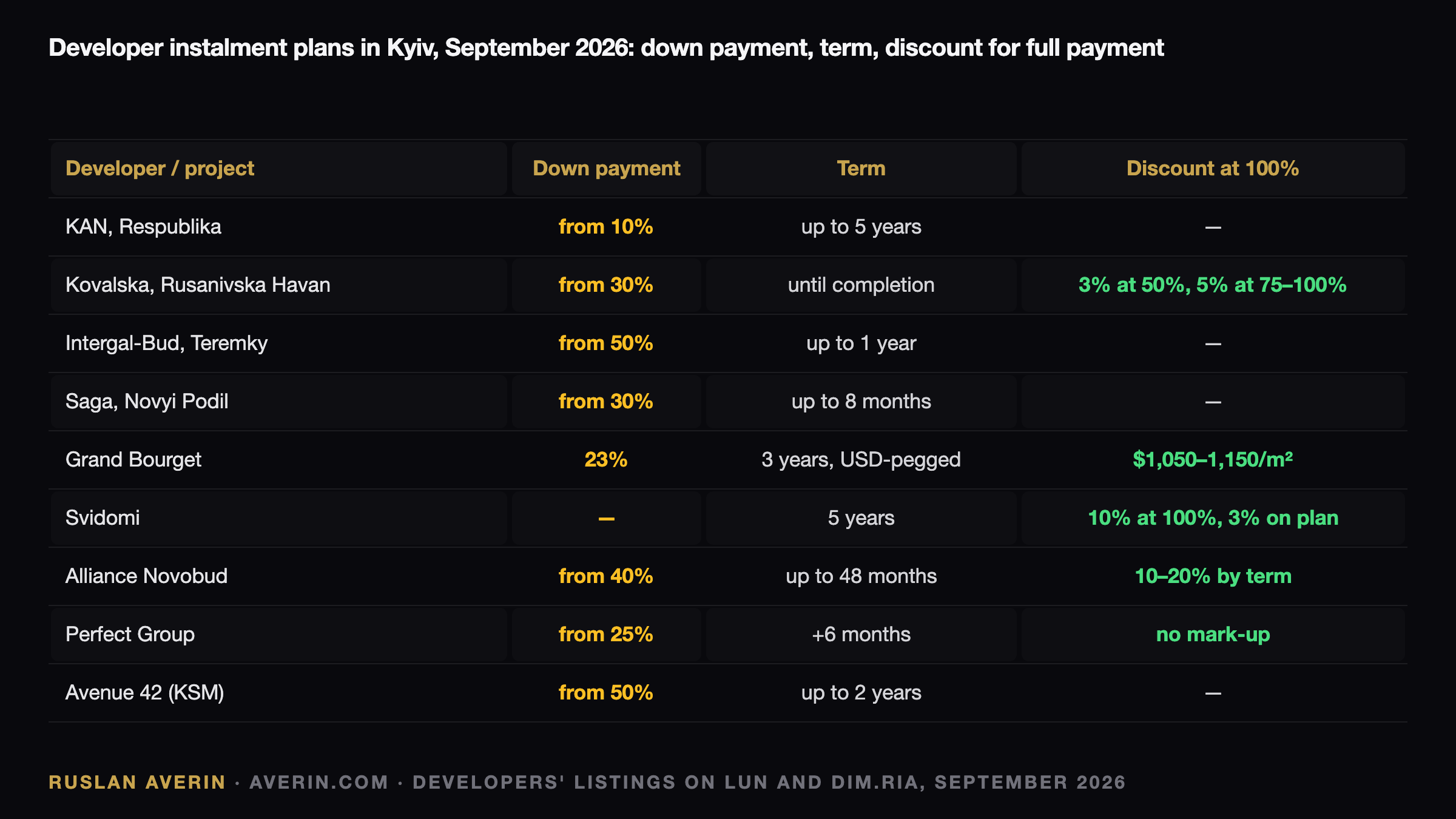
What is on offer in September 2026
| Developer / project | Deposit | Instalment term | Rate | Discount at 100% |
|---|---|---|---|---|
| KAN, Respublika | from 10% | up to 5 years | 0% | — |
| Kovalska, Rusanivska Havan | from 30% | until delivery (December 2026) | 0% | 3% at 50%, 5% at 75–100% |
| Intergal-Bud, Teremky | from 50% | up to 1 year | 0% | — |
| Intergal-Bud, other projects | 30–50% | 3 months–5 years | 0% | — |
| Saga, Novyi Podil | from 30% | up to 8 months | 0% | — |
| Grand Bourget | 23% | 3 years | 0%, price in dollars | $1,050–1,150/m² at 100% |
| Svidomi | — | 5 years | 0% | 10% at 100%, 3% on the plan |
| Alliance Novobud | from 40% | up to 48 months | 0% | 10–20% depending on term |
| Perfect Group | from 25% | +6 months to the deadline | 0%, no mark-up | — |
| Avenue 42 (KSM) | from 50% | up to 2 years | 0% | — |
Data from developers' listings on LUN and DIM.RIA at the start of September. Terms change from phase to phase and from flat to flat, but the structure is constant: the smaller the deposit and the longer the term, the smaller the discount and the harsher the remaining clauses.
What "zero" costs
Instalments are never free; the question is where the price is hidden. There are three places.
The discount not given. Svidomi: 10% off for full payment, 3% off on a 5-year plan. A 7% difference for five years' use of the money is 1.4% a year on the whole sum or about 2.5% on the outstanding balance. Kovalska: 5% off for full payment against 0% on instalments until delivery, 5% over 15 months, 4% a year. That is the instalment rate, and it is below eOselya at 7% and a quarter of a market mortgage at 17–23%.
The currency peg. Grand Bourget fixes the price in dollars: at 44.55 and an NBU forecast of 45.5–46.7 by December, the hryvnia balance grows 2–5% a year. A hryvnia plan at a fixed price is a hidden discount of the same size if the hryvnia weakens, and a hidden mark-up if it strengthens.
Stage step-ups. Some contracts tie the outstanding balance to the developer's current price list or revise it quarterly. With primary prices up 15% a year, "0%" becomes 15%. A clause fixing the price for the whole term is the first thing to look for in the contract.
Bottom line: an honest instalment plan with a fixed hryvnia price and a 5–10% full-payment discount costs 2–4% a year. That is the cheapest money in Ukraine's housing market, available only to those with 30–50% in hand and the income to clear the rest in 1–5 years.
The fine print: five clauses
Termination. What the developer returns if the buyer stops paying: the whole sum, the sum minus a 5–15% penalty, or nothing until the apartment is sold to another buyer. The last option means the money is locked until an unknown date. Under forward contracts and derivatives, termination usually returns 50–70%.
Assignment. KAN prohibits assignment before commissioning. An investor on instalments in such a project has no exit before delivery on any terms. Other developers allow assignment after full payment or for a 1–3% fee.
Title. Until full payment the special property right under Law 2518-IX is registered to the buyer with an encumbrance in the developer's favour; that is the norm. Schemes with no registered right (FFB, forwards, cooperative shares) mean the buyer owns nothing but a contract until full payment and commissioning.
Penalties and schedule. The standard is 0.1% a day on the overdue amount, 36% a year. A quarter's delay on a UAH 200,000 payment costs 18,000.
Delivery and deadlines. What happens to the plan if the building is delivered late: is the schedule extended, does the developer owe a penalty, can the buyer exit. In Kyiv region 12% of complexes are frozen; a contract that does not describe delay leaves the buyer obliged to pay for something not being built.
Partner mortgages: bank plus developer
A separate class of programme is a bank loan against a specific developer's apartment at a reduced rate for the first years. Sense Bank and Kovalska: 25% deposit, up to 20 years, up to UAH 5 million, a "fixed-then-variable" rate with the figures undisclosed on the bank's site. A "9.9% first year, then 20.9%" scheme appears in advertising with no bank or project named.
The rule for reading such programmes: a low first-year rate is a developer's discount baked into the apartment price, and the rate from year two is the real market rate, 17–23%. Compare the full cost over 20 years, not the first year. As of September 2026 there is no confirmed partner programme in Kyiv with a rate below eOselya for the whole term.
Instalments versus eOselya versus the market
| Instrument | Deposit | Rate | Term | Who can use it |
|---|---|---|---|---|
| Developer instalments | 10–50% | 2–4% a year, hidden | 1–5 years | anyone with the deposit and income for the balance |
| eOselya | 10–20% | 3% or 7% for the first 10 years under the state programme | up to 20 years | categories: military, medics, teachers, IDPs, no housing |
| Market mortgage | 20–30% | 17–23% | up to 20 years | anyone with proven income |
For a buyer holding 40% of the price with a stable income, instalments are cheapest. For a buyer with 20% and a qualifying category, eOselya, and how to stack it with other programmes is in a separate piece. A market mortgage at 17–23% in 2026 is the instrument of last resort: 3% of housing deals and 7% of lending.
How to read it
In analyst Ruslan Averin's view, a developer programme is exactly as good as the developer: 0% for 5 years from a company with six phases delivered on time is worth more than 15% off from a company with one. The order of checks: sales scheme (2518-IX), delivery record, termination clause, price-fixing clause, assignment clause. Only then the rate.
Related: instalments or mortgage, a comparison that is not about the rate, investing at the pit stage.