Ukraine's state housing programmes are described separately and work together. A family buying an apartment in Kyiv in 2026 can, with the right statuses, stack a certificate for destroyed housing, deposit compensation, a subsidised rate and a city top-up into one deal. Can, but not in any combination and not in any apartment: each programme has its own ceiling, and in Kyiv those ceilings usually sit below prices.
Below is a map of what stacks with what, on September 2026 terms.
The base layer: eOselya
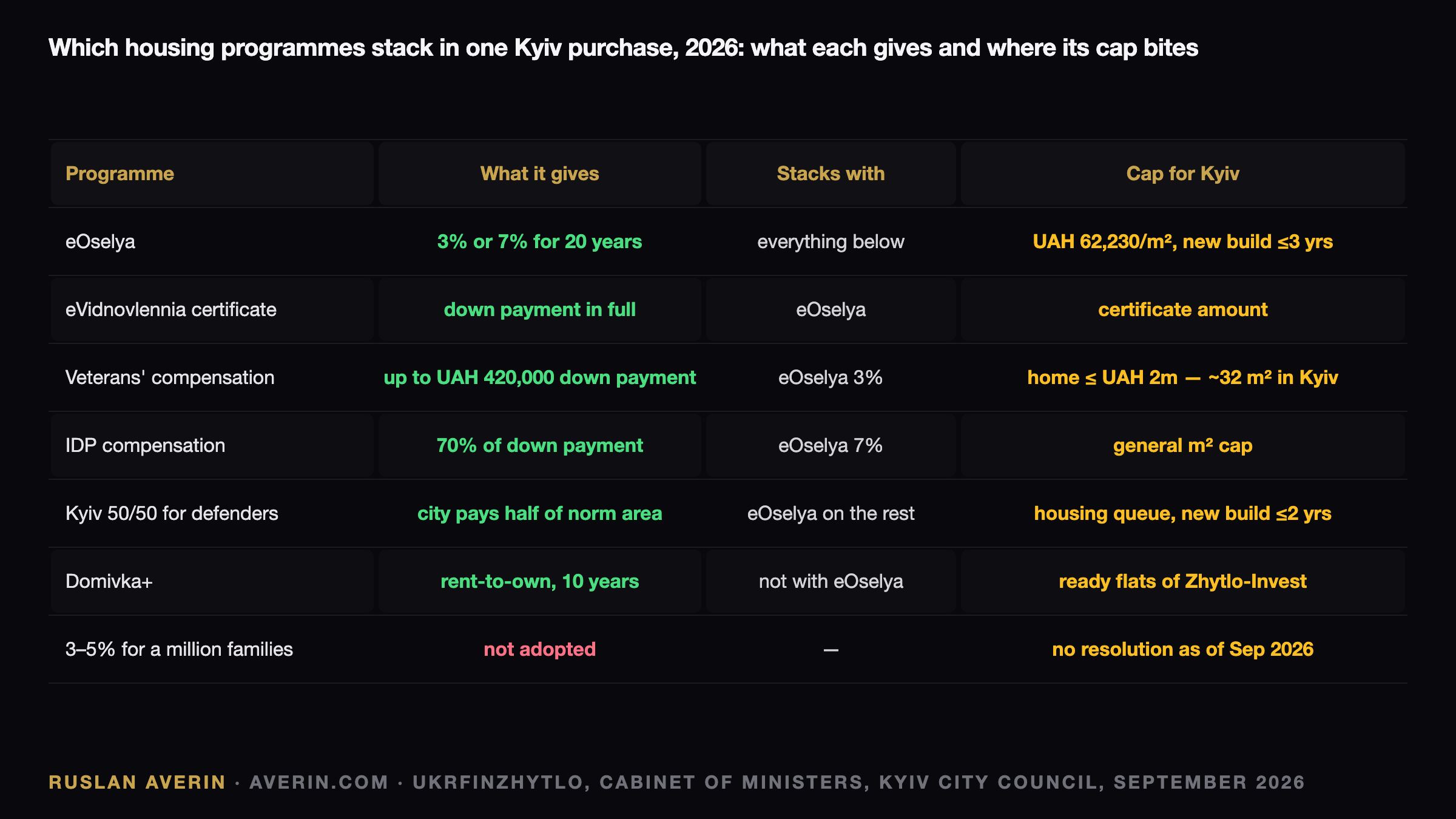
Everything stacks around eOselya because it is the only mortgage that works: 5,763 loans for UAH 11.4 billion since the start of 2026, with a plan of about 10,000 for the year. Terms as of September:
- a 3% rate (contract servicemen, security services, medics, teachers, scientists, and since 17 July veterans, people disabled by the war, families of the fallen) or 7% (IDPs and citizens without housing), rising to 6% and 10% from year 11;
- up to 20 years, deposit from 20%, from 10% under age 25; up to UAH 5 million;
- area norm 52.5 m² for one or two people plus 21 m² for each additional person;
- price cap per metre for Kyiv around UAH 62,230, with a 10% tolerance;
- housing: a new build or a building no older than three years (up to 20 years for IDPs);
- a 36-month look-back on property deals: sold a home, and the application fails.
Kyiv is not the programme's main beneficiary: in the week to 9 September the capital got 17 loans against 69 in the region. The reason is the price cap. At UAH 62,230 per metre against an average primary launch price of 63,300, only below-average objects qualify, mostly on the left bank and the outskirts; the cap is analysed in the piece on eOselya against the market.
The second layer: covering the deposit
A 20% deposit on a UAH 4.5 million apartment is 900,000. Three programmes let it be paid with someone else's money.
The eVidnovlennia certificate. A family whose home was destroyed receives a housing certificate, and since February 2024 partner banks accept it as the eOselya deposit. Kyiv is among the five regions where certificates are used most. This is the only way to buy an apartment in Kyiv under a programme with no money of one's own at all.
Veterans' compensation. From 17 July 2026: up to UAH 420,000 of the deposit, up to UAH 150,000 of first-year payments and up to 40,000 of closing costs. The condition: housing priced up to UAH 2 million. At Kyiv's cap of 62,230 per metre that is a 32 m² apartment, so the deposit compensation barely applies in the capital, whereas in Kyiv region at UAH 53,180 per metre 2 million buys 37 m², which already looks like a one-room flat. Analyst Ruslan Averin notes that this ceiling explains the 17-against-69 statistic: a veteran with compensation goes to Bucha or Vyshneve, not Darnytsia.
IDP compensation. From February 2026: 70% of the deposit, 70% of first-year payments and up to UAH 40,000 of costs, for displaced people and residents of frontline areas. No UAH 2 million ceiling, but the general price cap per metre applies.
The third layer: Kyiv city programmes
50/50 for defenders. The city pays 50% of the normative area, 9–13.65 m² per person, in a new build no older than two years or more than 80% complete. For combatants, people disabled by the war and families of the fallen on Kyiv's housing waiting list. The family covers the rest itself, including with an eOselya loan if the object is accredited. Applications in 2026 open as funding allows.
Domivka+. The municipal Zhytlo-Invest lets finished apartments on a rent-to-own basis over up to 10 years: the price is fixed in hryvnia, the monthly payment is the appraised value divided by the term plus rent and utilities; the start requires first and last month, a 3% reserve and insurance. Combatants get a 50% discount on the rent component. This is not a mortgage but a municipal instalment plan; it cannot be combined with eOselya, but one can exit it into eOselya by buying out the balance with a loan.
Kyivmiskbud. 3,775 families will receive housing by the end of 2026 under city obligations in six complexes; Podil Grad was commissioned in July. This is a queue, not a programme for new buyers.
What does not stack
- Derzhmolodzhytlo (7% for the full term, 6% deposit, under 35): a queue by application date, with no confirmed 2026 disbursements; it does not combine with eOselya, it is an alternative.
- "3–5% for 25 years for a million families": announced in spring, with neither a resolution nor a budget as of September; the only step is bill 15172 on securitisation at first reading. Waiting for it instead of eOselya means losing a year.
- Developer instalments and eOselya at the same time: no, the bank lends against an apartment with no encumbrance in the developer's favour. Sequentially, yes.
- Two eOselya loans per family: no.
Three working combinations for Kyiv
| Family | What stacks | Result |
|---|---|---|
| Veteran, family of 3, destroyed home | eVidnovlennia certificate as deposit + eOselya 3% + first-year payment compensation 150,000 | apartment up to 73.5 m² from an accredited developer with no own money |
| IDP, family of 2 | 70% deposit compensation + eOselya 7% (secondary up to 20 years old) | 6% own deposit instead of 20% |
| Combatant on Kyiv's housing list | 50/50 from the city + eOselya 3% on the balance | a loan for half the apartment instead of the whole |
A fourth combination, certificate plus city programme, does not occur in practice: the two require different statuses and different queues.
How to read it
Ukraine's programmes in 2026 stack better than commonly assumed and worse than promised. Better, because the government explicitly allowed the certificate as a deposit and the compensations do not exclude each other. Worse, because each runs into its own ceiling, and for Kyiv the main one is the price per metre: 62,230 under eOselya and 2 million under the veterans' compensation. In the analyst's view the realistic order for a buyer in the capital is: first find an object under the cap (left bank, outskirts, the region), then establish which statuses the family holds, and only then stack. In the reverse order a family with three statuses discovers there is not one building in its district that qualifies.
Related: every housing programme in 2026, the map, eOselya against the market mortgage, developer programmes, the fine print.