
Kyiv's secondary housing market is doing two things at once this autumn. Asking prices are falling in every flat size, and flats are selling faster than a year ago. That is the main finding of LUN's quarterly market report for the third quarter of 2026, published on 22 October.
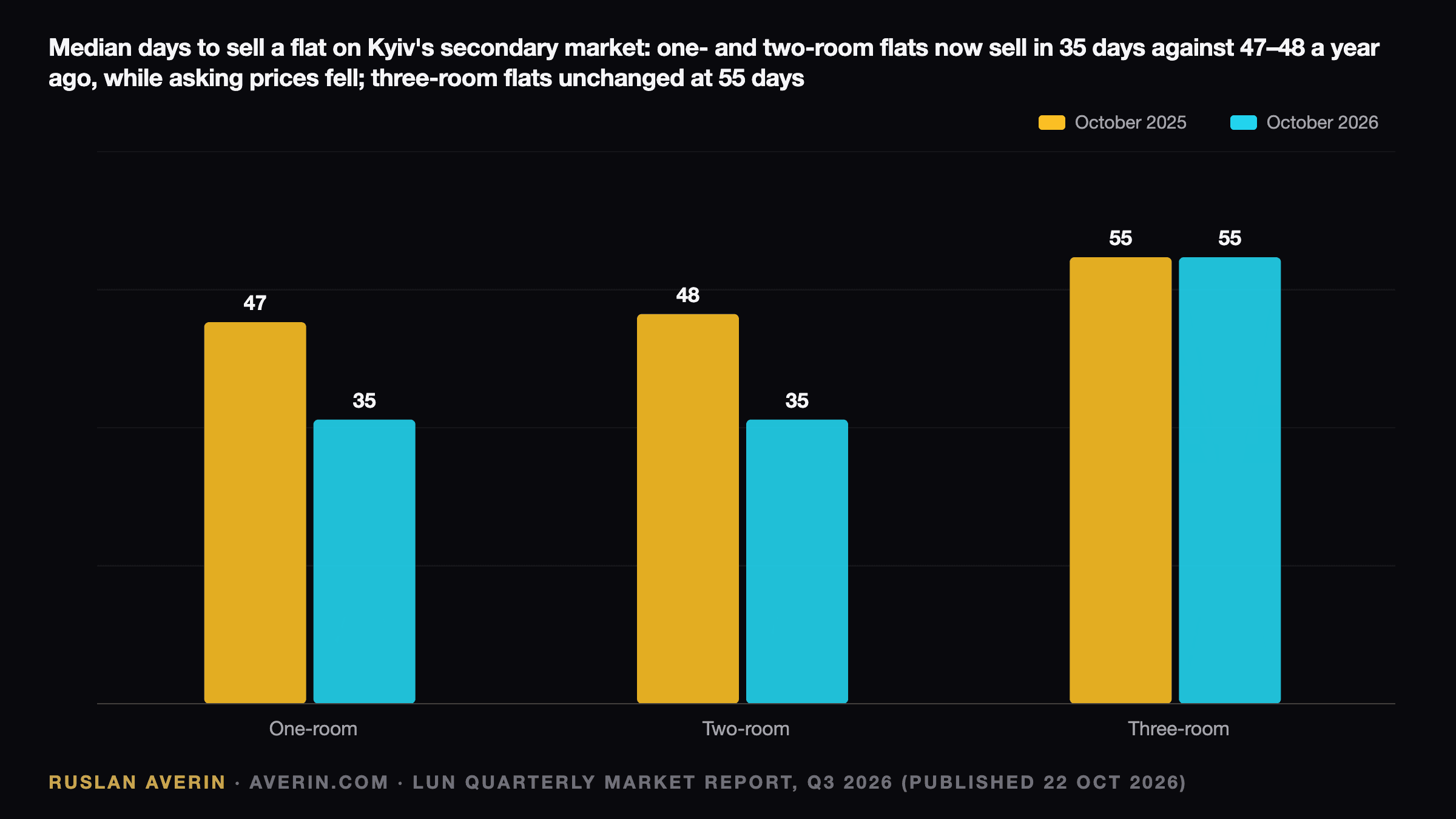
The median time to sell a one-room or two-room flat in Kyiv has dropped to 35 days, against 47–48 days a year earlier. Over the same six months the median asking price of a two-room flat fell 12.5%, from $112,000 to $98,000.
The numbers: shorter sales, lower asking prices
LUN's figures for October 2026, compared with a year earlier:
- One-room flats: median asking price $67,000, practically unchanged from $66,600 in October 2025, but 5.6% lower than six months ago. Median time to sell: 35 days, down from 47.
- Two-room flats: $98,000, down 6.7% on the year and 12.5% in six months, the steepest fall in the Kyiv market. Time to sell: 35 days, down from 48 a year ago and from 53 six months ago, a cut of almost a third.
- Three-room flats: $146,000, down 2.7% on the year and 8.8% in six months. Time to sell: 55 days, the same as a year ago, but down 20% in one month from 69 days.
LUN's reading is that falling prices have not lengthened sales. The report suggests that some sellers are adjusting their expectations and buyers are deciding faster on flats that fit their budgets. In other words, the price cuts are what is clearing the stock.
Fewer listings, especially large flats
Supply is shrinking at the same time. In a separate release on 26 October, LUN said the number of flats listed for sale in Kyiv in September was 4% lower than a year earlier and 2% lower than in August. Odesa moved the other way, with 32% more listings.
The decline in Kyiv is concentrated in larger flats: listings of flats with four or more rooms fell 18%, three-room flats 9% and two-room flats 4%. One-room listings rose 4% and now make up more than a third of all sale listings in the capital.
Liudmyla Kiriukhina, head of LUN Statistics, linked this to the rental market. Renting out a flat and selling it are different decisions for someone who moves, she said, and the growth in rental supply in Kyiv while sale listings shrink may mean some owners are not yet ready to sell. Denys Sudilkovskyi, LUN's brand and business director, added that the choice of flats in Kyiv is returning to its 2024 level, and that the anomaly was last year's increase rather than this year's decline.
The gap between asking and sold prices is widening
LUN also publishes the median price of flats that have actually been sold. In October 2026 it was $57,000 for a one-room flat, $66,500 for a two-room and $86,000 for a three-room flat. That puts sold medians about 15%, 32% and 41% below the asking medians.
The gap has grown in all three segments over the year:
- One-room: $7,000 in autumn 2025, $10,000 now.
- Two-room: $25,000, now $31,500.
- Three-room: $55,000, now $60,000.
Kiriukhina warned that this gap should not be confused with the size of a discount. The two groups are different flats that can differ in size, condition and location. What the comparison shows is how far the stock being bought sits below the stock being offered: buyers are concentrating on cheaper flats within each size.
New builds are moving in the opposite direction
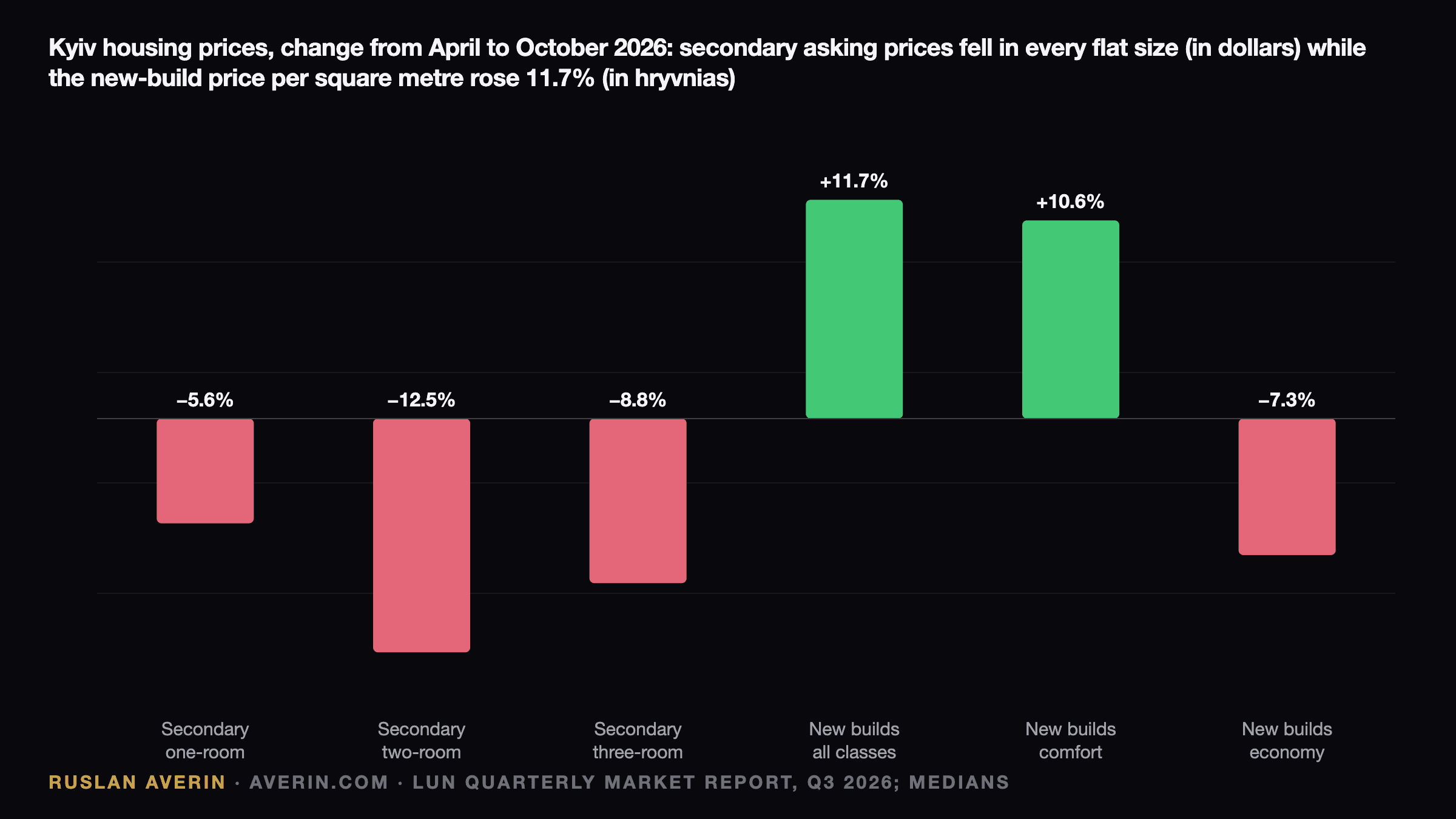
The primary market tells a different story. LUN puts the median starting price per square metre in Kyiv new builds at UAH 65,000 in October, up 18% on the year. Most of that, 11.7%, came in the last six months, from UAH 58,200 in April, and 5.2% came in the last month alone.
By class, comfort rose 10.6% in six months to UAH 56,300 per square metre; business class rose 4.7% to UAH 83,300; economy class fell 7.3% to UAH 40,500; premium slipped 0.8% to UAH 158,000. LUN notes that the overall median is rising faster than any single class, which can point to a change in the mix of projects on sale.
Part of the explanation is supply. Citing the State Statistics Service, LUN reports that construction started on 1,470 flats and houses in Kyiv in the first half of 2026, 65% fewer than the 4,248 a year earlier, roughly back to the 2024 level of 1,523. Since the start of the year sales have closed on 10,317 off-plan flats in Kyiv, while 7,674 new ones came onto the market. The September slowdown in developer sales is covered in the review of Kyiv new-build sales.
Affordability improved; yields did not
Lower secondary prices have made Kyiv flats more affordable relative to pay. LUN and Work.ua calculate that a one-room flat at the median price now costs the equivalent of 6.7 years of the full median salary in the capital, against 7.6 years both a year and six months ago. Lviv and Lutsk need 8.7 years.
For landlords the picture is less favourable. LUN's median rent for a one-room flat is UAH 17,000 a month, unchanged on the year but almost 6% lower than a month earlier, while the number of rental listings rose 66% between early August and early October. A one-room flat now costs 14.8 years of rent, 8% more than a year ago. An averin.com calculation from that ratio gives a gross rental yield of about 6.8% before tax, vacancies and repairs, below the NBU key rate of 16% on hryvnia instruments. District rents are broken down in the September rent review.
Where the market differs by district and building
City medians hide large spreads. The median one-room flat costs $148,000 in Pechersk and $43,000 in Desnianskyi, a gap of more than $100,000, up from about $77,000 a year ago. One-room flats in Pechersk rose 25% on the year, while three-room flats in Solomianskyi fell 17%. The district table from September is in the Kyiv price review by district.
Condition and building age matter too. In Holosiivskyi a renovated one-room flat has a median of $95,000 against $62,000 without renovation. Flats in Khrushchev-era buildings remain the cheapest segment at $43,000 for a one-room flat, while buildings completed after 2010 are about 81% dearer at $78,000.
What it means for buyers and sellers
Analysts following the market draw three practical conclusions from the LUN data:
- For buyers, the two-room segment has seen the largest correction, $14,000 off the median asking price in six months, but faster sales mean less time to negotiate on well-priced flats.
- For sellers, listings priced near the sold medians are clearing in about five weeks; overpriced flats sit while the asking-to-sold gap widens.
- For investors, a rising price-to-rent ratio and falling rents make buy-to-let weaker than six months ago, while new builds keep getting dearer.
In analyst Ruslan Averin's view, the combination of faster sales and lower asking prices suggests a market that is finding its clearing level rather than freezing, with the adjustment carried by sellers' expectations. The risk is the winter: the LUN report itself names regular Russian strikes, power cuts and a difficult heating season as sources of uncertainty for anyone planning a deal.
What to watch
- LUN's November data: whether the 35-day sale time holds once the heating season and outages begin.
- Sale listings: a further fall in large-flat supply would support three-room prices.
- New-build starts in the second half: the first-half collapse will shape choice in 2027–2028.
Related: Kyiv investment: four ways compared, Kyiv apartment prices by district and Kyiv new-build sales fall 62%.