
The hryvnia banknotes now leaving circulation are the small ones: the UAH 1, 2, 5 and 10 notes of the 2003–2007 designs. They stopped being legal tender on 2 March 2026, and ordinary bank branches will exchange them only until 26 February 2027 inclusive. After that date the window narrows to four authorised banks and the National Bank of Ukraine itself.
The rules come from NBU Board Resolution No. 14 of 17 February 2026, announced by the NBU on 20 February. With the bank deadline just under four months away, the topic is back in Ukrainian search trends. The key facts, as published by the NBU:
- Which notes: UAH 1, 2, 5 and 10 banknotes of the 2003–2007 designs, of every year of issue.
- Not legal tender since: 2 March 2026. Shops, service businesses, banks and financial institutions do not accept them for payments.
- Any bank branch in Ukraine: free exchange until 26 February 2027 inclusive, one year from withdrawal.
- Authorised banks (Oschadbank, PrivatBank, Raiffeisen Bank, PUMB): until 28 February 2029 inclusive, three years from withdrawal.
- The NBU: "currently without a time limit".
- Limits and fees: none. The exchange is free and there is no cap on the amount.
What exactly is being withdrawn
The NBU stresses that the rule applies to the design, not to the year printed on the note. A UAH 10 note of the 2004 design printed in a later year is covered in the same way. These notes are replaced by circulation coins of the same denominations, which have been in use for years: the UAH 1 and 2 coins since 27 April 2018, the UAH 5 coin since 20 December 2019 and the UAH 10 coin since 3 June 2020.
Withdrawal did not start this year. Banks and the NBU have been taking the small notes out of circulation for almost six years: the UAH 1 and 2 notes from 1 October 2020, the UAH 5 and 10 notes from 1 January 2023. The March 2026 step ended their status as a means of payment.
The NBU gave three reasons. The notes are rarely seen in retail and people almost never pay with them. Their average life is about 2.5 years, against 20–25 years for coins, so the notes still in circulation are effectively worn out. And handling, transporting and storing them costs the state, banks and retailers money. The notes have been in circulation for almost 23 years, the last eight of them alongside the coins.
How many are still out there
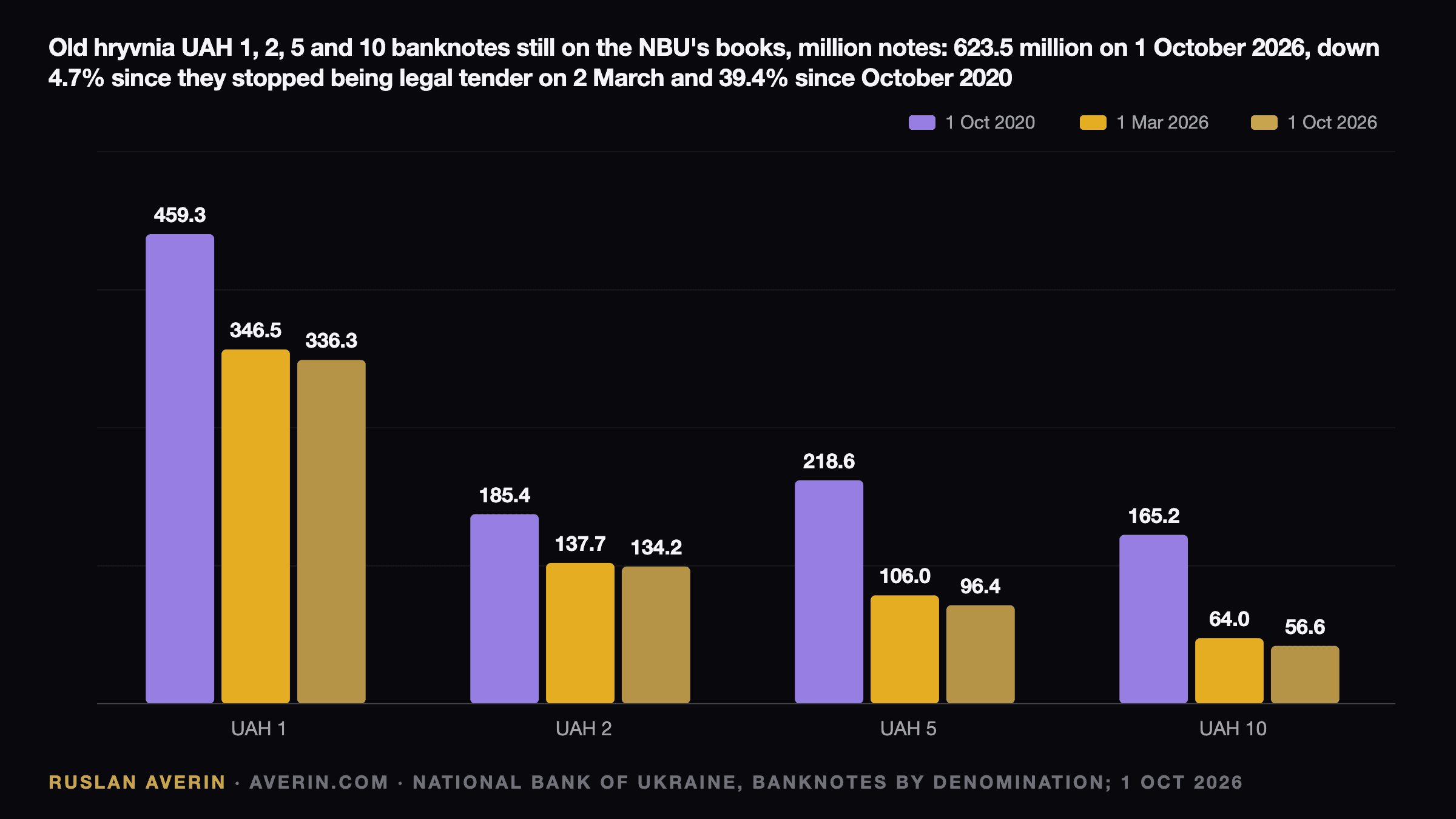
The NBU's cash statistics still list a large number of these notes. On 1 October 2026 they showed:
- UAH 1: 336.3 million notes.
- UAH 2: 134.2 million notes.
- UAH 5: 96.4 million notes.
- UAH 10: 56.6 million notes.
That is 623.5 million notes with a face value of UAH 1.65 billion. They make up 23.7% of all 2.63 billion hryvnia banknotes on the NBU's books by count, but only about 0.17% of their UAH 962.5 billion value.
The pace of return since the deadline has been slow. On 1 March 2026, the last reading before the notes lost legal-tender status, the four denominations totalled 654.2 million notes. Seven months later the figure was 30.7 million lower, a fall of 4.7%. The UAH 10 note fell fastest, by 11.5%, and the UAH 5 by 9.0%. The UAH 1 and 2 notes fell by less than 3% each. Over six years, since 1 October 2020, the total has dropped by 39.4%.
These statistics count notes the NBU has issued and not yet received back. They do not show how many are physically still in wallets and drawers. In analyst Ruslan Averin's view, the small decline in the UAH 1 and 2 counts, notes withdrawn since 2020, suggests that many of them are lost, damaged beyond use or kept as keepsakes, and will never come back. For a household the sums are small, but the free exchange at any bank lasts only until 26 February.
Notes that are not being withdrawn yet
A second group of older notes is often confused with the first. The UAH 20, 50, 100, 200 and 500 banknotes of the 2003–2007 designs, the third generation, are being "gradually withdrawn". According to the NBU, they remain legal tender and do not need to be specially exchanged. As legal tender, they must be accepted in payments.
What has changed is that banks no longer issue them from their cash desks:
- UAH 20 and 100: since 1 January 2023.
- UAH 500: since 1 August 2024.
- UAH 50 and 200: since 1 November 2024.
When these notes reach a bank, they are not paid out again and are replaced over time by fourth-generation notes. The NBU has not set a date for them to lose legal-tender status.
The oldest notes are a separate case. Banknotes of UAH 1, 2, 5, 10, 20, 50, 100 and 200 of designs issued before 2003, the first and second generations, stopped being legal tender on 1 October 2020. They can be exchanged only at the NBU and the authorised banks, until the end of martial law and for three months (90 days) after it ends or is lifted.
The UAH 2,000 note, in circulation since 4 September 2026, is not affected. Why a UAH 5,000 note is not coming is covered in our article on the UAH 5,000 banknote rumour.
Coins: kopecks and the old UAH 1
Coins follow the same logic. According to the NBU:
- 1, 2 and 5 kopecks: withdrawn from circulation on 1 October 2019.
- 25 kopecks: withdrawn on 1 October 2020.
- 10 kopecks: gradual withdrawal since 1 October 2025; the coins remain a means of payment for now.
- Golden UAH 1 coin made before 2018, including ordinary-quality commemorative coins: gradual withdrawal since 1 October 2020; it still circulates alongside the silver-coloured coin introduced in 2018.
Where and how to exchange
For the UAH 1–10 notes of the 2003–2007 designs, any branch of any bank in Ukraine must exchange them until 26 February 2027. They can be swapped for coins and banknotes of any denomination in circulation, with no limit on the amount and no fee, according to the NBU.
From 27 February 2027 only the four authorised banks, until 28 February 2029, and the NBU will exchange them. The NBU lists its own units for exchanging withdrawn notes and coins in the Lviv, Dnipropetrovsk, Khmelnytskyi and Odesa regions and in Kyiv.
What to do with damaged banknotes
Worn or damaged notes that are still legal tender are a different matter, governed by NBU Board Resolution No. 134 of 3 December 2018. Under those rules:
- Worn notes (faded, soiled, torn, with stains or writing) must be accepted by shops as payment and by banks without limit, unless they show signs of counterfeiting.
- Significantly damaged notes must also be accepted by banks without limit if at least 55% of the original area survives in one piece, or if a note torn in two keeps both identical serial numbers and the two parts cover at least 55% of its area.
- Fee: banks must exchange unfit notes accepted under these rules free of charge.
- Notes damaged by fire, flood or chemicals: the NBU and the authorised banks accept them for examination, which the NBU carries out free of charge; the value of notes found authentic is reimbursed.
One wartime exception matters. Notes that banks deliberately damaged during martial law, by drilling holes, cutting or staining them so they could not be used if seized, are not legal tender and are not exchanged. The NBU advises refusing such notes in payment.
Related: no UAH 5,000 banknote and UAH 973 billion in cash, the dollar exchange rate forecast for Ukraine and the Bank of England's new banknotes.