Bank of America reports third-quarter 2026 results before the US open on Wednesday 14 October, with the conference call at 8:30 a.m. New York time. Morgan Stanley reports the same morning. The shares closed on Monday 12 October at $54.58. That is 0.8% below the 2025 year-end close of $55.00 and 15.8% below the closing high of $64.81 on 12 August.
This is the one big bank that has already told the market its quarter will be softer. On 14 September Brian Moynihan warned that investment banking fees would fall, and the stock lost 5.1% that day. The print on Wednesday is less about a beat than about whether that warning was conservative, and whether net interest income can carry earnings while fees cool.
Update, 15 October 2026: the results
Bank of America reported on Wednesday 14 October. Reported EPS was $0.91, including a $1.2 billion charge, or $0.17 a share, for anti-money-laundering and sanctions penalties under OCC and FinCEN orders announced on 13 October. Excluding the charge, EPS was $1.08, two cents below the FMP consensus of $1.10. Revenue rose 3% to $30.0 billion, short of the $30.6 billion expected.
| Metric | Consensus | Actual |
|---|---|---|
| EPS | $1.10 | $0.91 reported, $1.08 adjusted |
| Revenue | $30.6B | $30.0B |
| Net interest income | $16.3B or more (preview line) | $16.4B ($16.6B FTE), up 8% |
| Investment banking fees | $1.6–1.8B (September guide) | $1.8B, down 11% |
| Buybacks | at least $6B (preview line) | $6.0B |
| Noninterest expense | near $18.6B (preview line) | $18.5B adjusted, $19.7B reported |
All four lines from the preview held. CFO Alastair Borthwick said: "We still expect to hit that full-year revised NII growth guidance of approximately 8%." For 2027 he expects "full-year growth of NII to be 8% or more", assuming three 25 basis point hikes through June 2027. Investment banking fees came in at the top of the range. Trading was weaker than "roughly flat": $5.1 billion, down 5%, with FICC down 17% to $2.6 billion and equities up 11% to $2.5 billion. The CET1 ratio was 10.9%. Brian Moynihan said on the call: "We understand the seriousness of compliance, and we are responsible for getting it right."
The shares closed on 14 October at $51.39, down 4.76% from $53.96 on 13 October. The S&P 500 fell 1.11% and the KBW Bank Index 1.49% on a day when September CPI came in at 3.7%, above the 3.6% forecast. Pre-market on 15 October, at 4:22 a.m. New York time, the stock was quoted at $51.79.
What it changes. I read this as a quarter where the core held and the headline did not. NII and capital return did what I asked of them, yet the stock fell more than four times as much as the S&P 500. Adjusted expenses rose about 7% against revenue growth of 3%, so operating leverage turned negative; Borthwick said: "We expect to return to operating leverage in Q4." At about 1.8 times tangible book of $29.14, I would now watch whether fourth-quarter NII rises sequentially, as guided.
What the consensus expects
The consensus compiled by Financial Modeling Prep (FMP) is EPS of $1.10 on revenue of $30.6 billion, from 12 analysts for EPS. Individual estimates run from $1.05 to $1.16. A dataset quoted by Tiger Brokers on 7 October shows $1.12 and $30.76 billion.
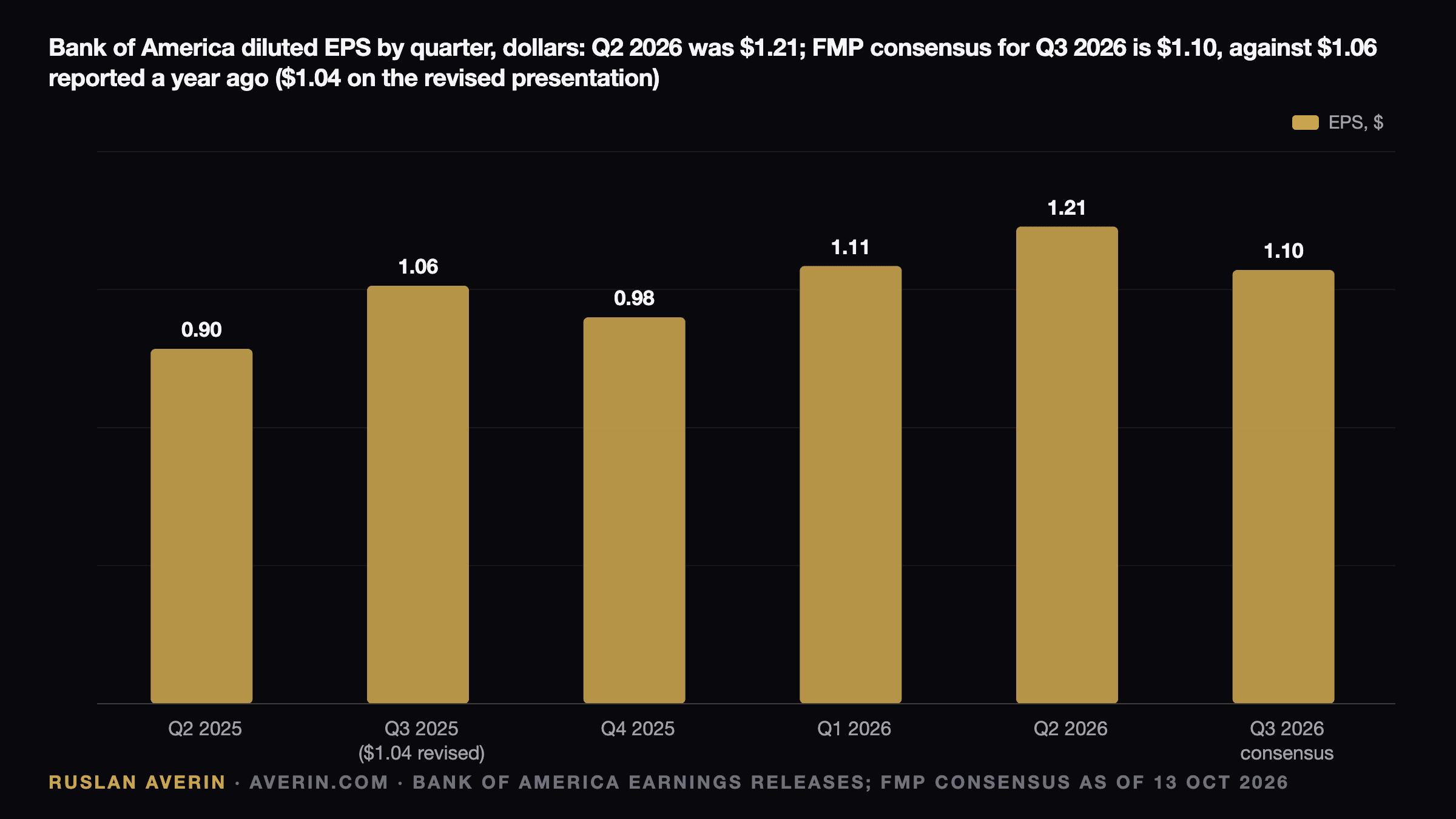
The year-ago base needs one adjustment. In October 2025 Bank of America reported third-quarter EPS of $1.06 on revenue of $28.1 billion. In January 2026 it changed its accounting presentation and revised prior periods: the revised third quarter of 2025 shows revenue of $29.0 billion and net income of $8.3 billion, or about $1.04 a share. Against that base, $1.10 means EPS growth of roughly 6% and revenue growth of about 5%. That is a sharp slowdown from the second quarter, when EPS rose 34% to $1.21 on revenue of $31.6 billion.
The September warning on fees and trading
Moynihan spoke at the Barclays Global Financial Services Conference on Monday 14 September. "What we're seeing is the market generally in investment banking is down 10% or so," he said, citing Dealogic data, and added that Bank of America was "not as well positioned in some of the businesses that have more activity", so its decline would be a bit larger. Reports of the session put third-quarter investment banking fees at $1.6–1.8 billion, against $2.0 billion a year earlier and $2.1 billion in the second quarter.
Sales and trading revenue, he said, would be roughly flat year on year. The base is $5.4 billion, with $3.1 billion from fixed income and $2.3 billion from equities in the third quarter of 2025. Within the quarter equities were up and fixed income was down. In the second quarter trading revenue was $7.1 billion, up 33%, with equities up 70% to $3.6 billion.
The contrast with JPMorgan is the point. A day later JPMorgan co-president Doug Petno guided to investment banking fees and Markets revenue up by a mid-to-high-teens percentage. If the industry turns out stronger than Moynihan's "down 10%", Bank of America's guidance becomes a question of market share, not of the cycle.
Net interest income: the line that carries the quarter
Second-quarter net interest income was $16.0 billion, up 9% year on year ($16.2 billion on a fully taxable-equivalent basis). The guidance has moved up three times: 5–7% growth for 2026 in January, 6–8% in April, and in July CFO Alastair Borthwick said growth would be at the upper end of 6–8%. That forecast assumed one 25 basis point Fed hike in September. The Fed delivered it on 16 September, lifting its target range to 3.75–4.00%.
The arithmetic is simple. NII was $60.1 billion in 2025. Growth of 7–8% requires second-half NII of about $32.6–33.2 billion, or roughly $16.3–16.6 billion a quarter, against $16.0 billion in the second quarter. A third-quarter figure at or above $16.3 billion keeps the upper end credible.
The balance sheet is asset-sensitive: the bank estimates that a rate path 100 basis points above the forward curve would add about $1 billion of NII over 12 months. The offset is deposit pricing. Average deposits were $2.02 trillion in the second quarter, and how much of the hike the bank has had to pass on to depositors is the question I would ask first.
Expenses and operating leverage
Second-quarter noninterest expense was $18.6 billion, up 8%, and the efficiency ratio improved to 59%. Operating leverage was 6.6% in the quarter and more than 450 basis points in the first half. Management raised its full-year target to 300–400 basis points. The bank no longer gives expense guidance; on the July call Borthwick said expense now follows revenue: "If the revenue isn't there, the expense will come down."
The third quarter tests that. With investment banking fees down and trading flat, revenue growth comes mostly from NII and asset management fees. If expenses stay near $18.6 billion while fee revenue falls, quarterly operating leverage narrows, and the full-year range would need a strong fourth quarter.
Credit and capital
Credit has been quiet. Second-quarter provision expense and net charge-offs were both about $1.4 billion, roughly flat on the first quarter, and card charge-offs and delinquencies improved year on year. At the September conference Moynihan said consumers "are still spending". A reserve build tied to rates or oil prices would be the surprise, not the base case.
Capital return is the steadier support. The CET1 ratio was 11.2% at the end of June, against the 10% minimum management cites. In the second quarter the bank returned $8.0 billion: $6.0 billion of buybacks and $2.0 billion of dividends. First-half repurchases totalled $13.2 billion, and about $17 billion was left on the $40 billion authorisation as of 30 June. In July the quarterly dividend went up 14% to $0.32 a share. With tangible book value at $29.37 per share, the stock trades at about 1.9 times tangible book.
How the stock got here, and the scenarios
Bank of America rose 1.9% on the day of its second-quarter report, 14 July, closing at $60.62. It peaked on 12 August. The September guidance then broke the trend: from $62.69 on 11 September the stock fell to $59.47 on 14 September, on volume about 86% above its three-month average, and it has lost 12.9% in total to Monday's $54.58.
JPMorgan, Wells Fargo and Citigroup report before the open today, 13 October. FMP consensus for them is EPS of $5.93, $1.85 and $2.65. For Bank of America the key readings are JPMorgan's investment banking fees against Petno's guidance and any comment on deposit costs after the hike. Strong industry fees would make the $1.6–1.8 billion range look either conservative or like lost share. Our previews of JPMorgan, Wells Fargo and Citigroup set out the numbers.
In analyst Ruslan Averin's view, four lines decide the reaction:
- NII of $16.3 billion or more, with the upper end of 6–8% confirmed or raised. Any trim would say deposit costs are absorbing the hike.
- Investment banking fees against $1.6–1.8 billion. A result at or above the top of the range would mean September was the low point of expectations.
- Buybacks of at least $6 billion, which would show the bank is not hoarding capital after the warning.
- Expenses near $18.6 billion, with operating leverage still positive.
The stock has already priced much of the fee warning. If NII and capital return come in line, I would expect the reaction to depend more on the outlook for 2027 NII than on third-quarter fees. The asymmetric downside is a cut to NII guidance alongside fees at the bottom of the range.
Related: the Q2 2026 big-bank earnings read-through, the Fed's 16 September hike to 3.75–4.00% and the 10-year Treasury at 5%.