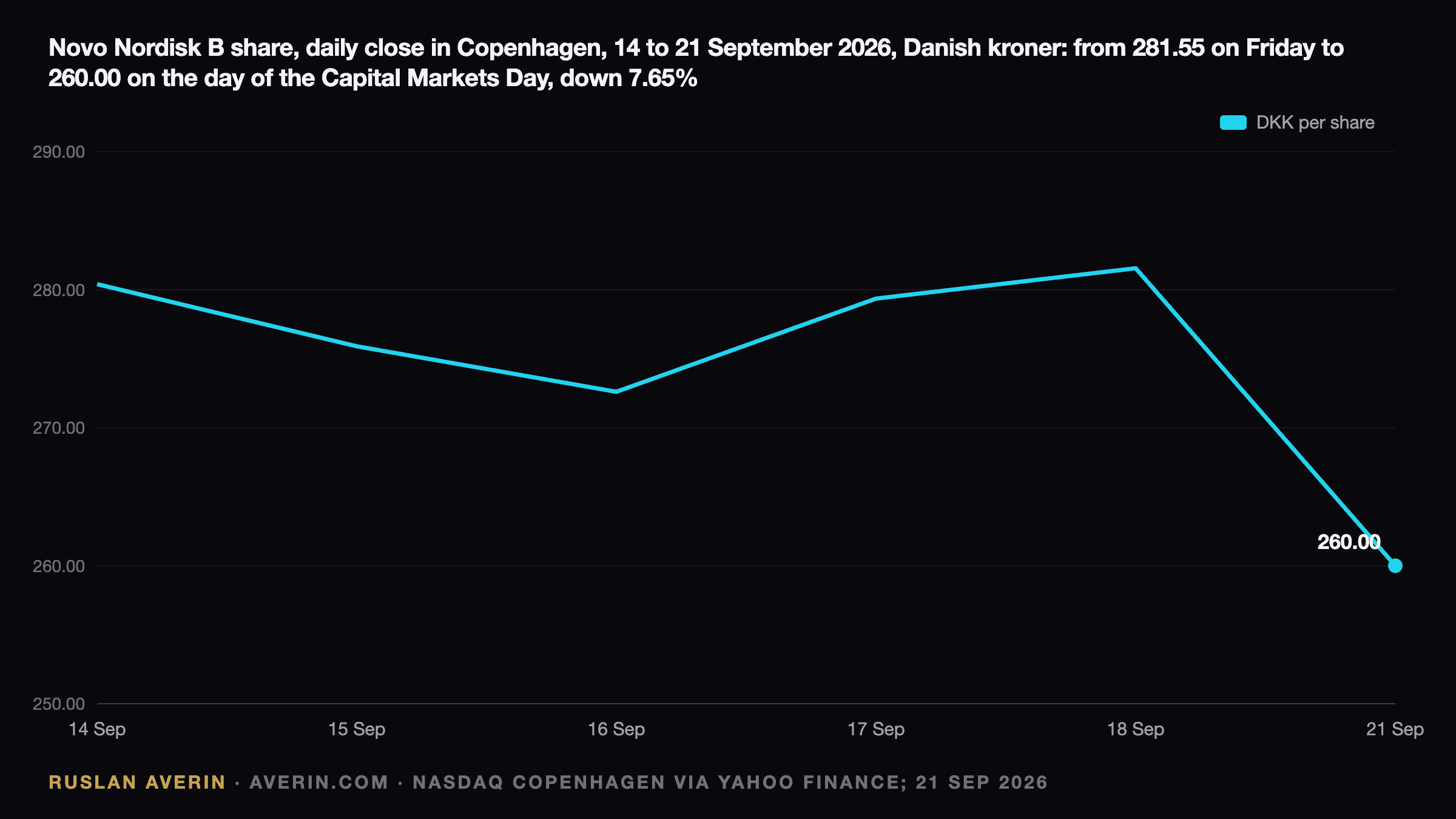
Novo Nordisk hired a hall in London on Monday to tell investors what the company looks like after Wegovy. By the time the chief executive had finished, the shares were down 8.4% at the low, and they closed in Copenhagen at DKK 260.00, down 7.65% from Friday's DKK 281.55. That takes roughly $16 billion off a company that was worth about $207 billion at the weekend. The stock had opened higher, at DKK 284.30. It took the presentation to bring it down.
I do not own Novo. I have been waiting for this day to decide whether I should, because a company at eleven times earnings with a 3.2% dividend and the second-best franchise in the largest drug category in history is exactly the kind of thing I buy. This is what I heard, and why I am still waiting.
What Novo promised
The company calls them ambitions, not guidance, and the release says so in the language lawyers use: "inherently uncertain", based on a 2026 baseline, "do not constitute financial guidance or an outlook". With that caveat, here is the list.
| Ambition | Target | By when |
|---|---|---|
| Sales growth | in line with a peer group of 14 large pharma companies | 2026–2030 |
| Operating margin | "broadly stable", adjusted | 2026–2030 |
| Dividend | "attractive dividend per share" maintained | ongoing |
| Pipeline sales, risk-adjusted | more than DKK 150 billion, about $23 billion | 2035 |
| New medicines with blockbuster potential | more than five | 2030 |
| Late-stage programmes | at least five in obesity and diabetes, at least five elsewhere | 2030 |
| Oral obesity capacity | ten-fold scale-up, enough for 15 million patients | end of decade |
| Patients reached | more than 60 million | 2030 |
| Acquisitions | balance sheet "can support" deals larger than bolt-ons | not in the targets |
Mike Doustdar, a year into the job, named the problem himself. Semaglutide, the molecule inside Ozempic and Wegovy, loses US exclusivity in 2032, and the United States is more than half of Novo's sales. He called it "the elephant in the room" and gave the answer the whole day was built around: "We plan to come on the other side of the LOE as a bigger company than we are today and a much more diversified version of it."
Why the shares fell on a growth plan
Because the first line of the table has no number in it, and the market supplied one. Growing "in line with" Lilly, AstraZeneca, Gilead, Johnson & Johnson, AbbVie, Novartis, Sanofi, Roche, GSK, Amgen, Merck, Biogen, Pfizer and Bristol Myers Squibb means growing like an average large drug company. BMO's Evan Seigerman put the implied figure at about 3.6% a year and said it was "already priced in", which leaves the "burden of proof" on management. Markus Manns at Union Investment said the 2030 sales outlook and the stable margin "failed to impress" and that the 2032 patent cliff had not been addressed properly. Reuters reported that management was pressed repeatedly on pricing and on acquisitions; the low of the day was DKK 257.90.
Think about what the peer-group sentence concedes. Three years ago Novo was growing sales at more than 30% a year and was the most valuable company in Europe. A target of growing like Pfizer and Bristol is an admission that the obesity market's growth now belongs to somebody else, and the tape said who: Eli Lilly was trading higher in New York as Copenhagen closed. Lilly has the stronger injectable, guided 2026 revenue to $82–85 billion, and has an approved once-daily obesity pill, Foundayo, already in launch. Novo's reply is on the capacity line: a ten-fold increase in oral manufacturing to supply 15 million patients by the end of the decade. It is the right reply, and it is four years away.
The DKK 150 billion pipeline figure has the same problem. It is a 2035 number, it is risk-adjusted by the company that owns the pipeline, it includes assets already known, and it excludes acquisitions. CagriSema, the combination meant to take over from Wegovy, is due to launch early next year, with higher doses and standalone cagrilintide planned for 2028. Against that, the most recent pipeline news investors actually have is a failure: ziltivekimab, the anti-inflammatory heart drug, lowered its markers in the ZEUS trial without reducing heart attacks or deaths, and on 7 September Novo stopped two further trials, HERMES and ATHENA, after the monitoring committee saw a "low likelihood" of a different result.
What the price now says
| Measure | Value |
|---|---|
| Novo Nordisk B, close 21 September | DKK 260.00 |
| Change on the day | −7.65% |
| Day's range | DKK 257.90 – 284.30 |
| Against the first week of January 2026 | about 32% lower, from DKK 381.45 |
| Against the June 2024 peak | roughly three-quarters lower, from just above DKK 1,000 |
| ADR 52-week range | $35.12 – $64.16 |
| Price to earnings | about 10.7 |
| Dividend yield | about 3.2%, $1.28 a share |
| Market value | about $191 billion |
Ten to eleven times earnings is what the market pays for a drug company whose main product goes generic inside the forecast window and whose replacement is not yet on sale. That is the correct multiple for that description. The question is whether the description is right. The bear case is simple: US prices for the injectables are already falling under political and compounding pressure, the pill race has a leader and it is not Novo, and by 2032 the semaglutide cash flow that funds everything else starts to go. The bull case is equally simple: more than 60 million patients, manufacturing scale nobody else has outside Indianapolis, a 9,000-job restructuring already taken, and a balance sheet that Doustdar said on Monday can carry a large acquisition. If he buys a late-stage asset well, the first line of the table gets a number, and it is higher than 3.6%.
What I make of it
In analyst Ruslan Averin's view Monday was an honest day and the market punished the honesty. Doustdar could have printed a double-digit growth target and been believed for two quarters. He printed the truth, which is that Novo is now a large, cheap, cash-generative pharmaceutical company with one ageing franchise and a pipeline that has to be proved drug by drug. I would rather own that at DKK 260 than the story at DKK 1,000, but I do not think there is any hurry. Nothing on the list above reads out before CagriSema launches next year, the Fed and two other central banks raised rates last week, which does long-duration healthcare no favours, and a stock that falls 7.65% on its own investor day usually has sellers left. My marker is the ADR's 52-week low of $35.12: if that holds through the third-quarter report and CagriSema's label arrives on time, I start a position. If the acquisition comes first, I read the price before I read the press release.
Related: Eli Lilly's obesity pill and what the launch has to prove, three central banks raising rates in 72 hours, the Fed's September decision and Gemini's breakout and what it means for Alphabet and security stocks.