
Kyiv is no longer the most expensive city in Ukraine in which to buy a one-room flat. OLX Real Estate's comparison of August 2026 with August 2025, published on 21 September, puts the median resale price at $78,300 in Uzhhorod and $77,200 in Lviv, with the capital third at about $75,000. Prices rose over the year in 18 of the 20 regional centres the study covers. The capital's 4% was among the slowest of them; Khmelnytskyi's 20% was the fastest, and Lviv added 19%.
The ranking is a map of the war as buyers price it. Money and people have moved west, towards the EU border and away from the front line, and the two cities at the top are the two furthest from the front and closest to the border. Analysts who track the market note that the order at the top is less important than the gap that has opened behind it: a one-room flat in Kherson costs $12,000, less than a sixth of the Uzhhorod price, and fell a further 14% in a year.
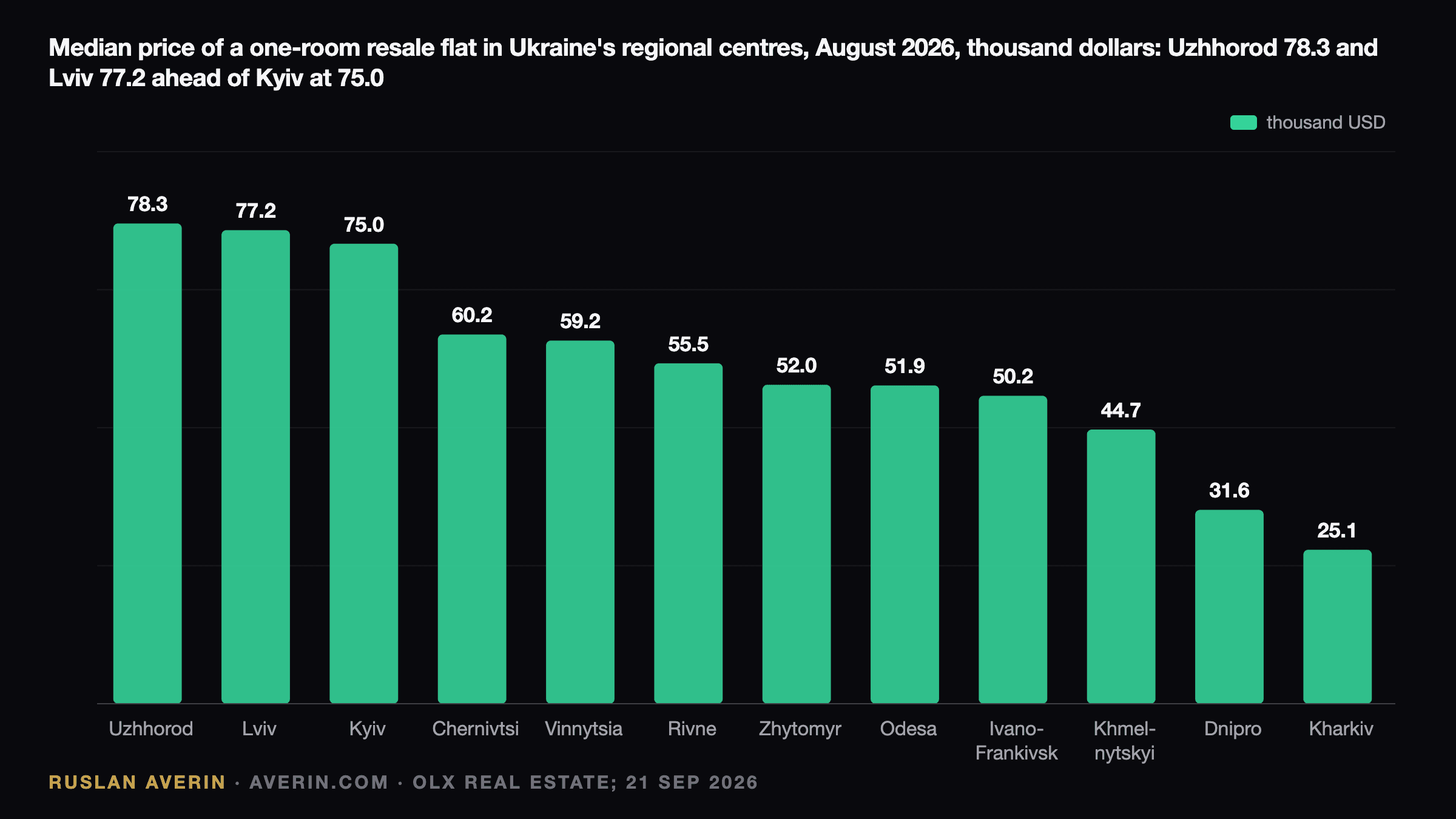
Prices in 20 regional centres
| City | One-room resale flat, median, August 2026 | Change over a year |
|---|---|---|
| Uzhhorod | $78,300 | +13% |
| Lviv | $77,200 | +19% |
| Kyiv | $75,000 | +4% |
| Chernivtsi | $60,200 | +6% |
| Vinnytsia | $59,200 | +17% |
| Rivne | $55,500 | −5% |
| Zhytomyr | $52,000 | +11% |
| Odesa | $51,900 | +16% |
| Ivano-Frankivsk | $50,200 | +16% |
| Cherkasy | $48,300 | +7% |
| Khmelnytskyi | $44,700 | +20% |
| Poltava | $39,600 | +7% |
| Chernihiv | $34,200 | +4% |
| Kropyvnytskyi | $31,800 | +17% |
| Dnipro | $31,600 | +4% |
| Kharkiv | $25,100 | +6% |
| Sumy | $24,000 | +13% |
| Mykolaiv | $20,500 | +6% |
| Zaporizhzhia | $16,000 | +2% |
| Kherson | $12,000 | −14% |
Three groups are visible. The west and centre, from Lviv and Khmelnytskyi to Vinnytsia, Ivano-Frankivsk and Kropyvnytskyi, are rising at 16–20% a year in dollars. The large eastern and southern cities, Dnipro, Kharkiv, Mykolaiv and Zaporizhzhia, are rising at 2–6% from very low bases: a flat in Kharkiv costs a third of one in Lviv. And two cities are falling: Kherson, under daily shelling, and Rivne, down 5%. Odesa's 16% is the exception in the south.
A note on the Kyiv figure. OLX's median of about $75,000 for the capital (its July release gave $74,776) is measured on its own listings. LUN's September median for a one-room flat in Kyiv is $68,500, and the median of flats actually sold on the same series is $55,500, as the district-by-district review on 17 September showed. The series differ in method, not in direction: all of them show Kyiv growing at 3–5% a year in dollars. Inside the city the spread is wider than between most regional centres: OLX's July data put a one-room flat in Pechersk at $164,076, up 14%, and one in Desnianskyi at $45,309.
Why the west overtook the capital
Demand came first. Uzhhorod is the regional centre furthest from the front line and sits on the Slovak border, a short drive from Hungary. Lviv is the country's relocation capital for businesses and for families from the east. Both have a small housing stock relative to the number of people who arrived, and construction costs in western Ukraine rose by about 10% in the first eight months of 2026, according to developers quoted by Informator. Marianna Bihunets, commercial director of the builder GAZDA, expects new-build prices to rise another 3–5% this autumn and 7–10% in projects close to completion: "In the autumn the buyer will increasingly be buying certainty and safety."
Rents confirm it. LUN's September figures, covered in the autumn rental review, have a one-room flat renting for 29,100 UAH a month in Uzhhorod and 26,300 UAH in Lviv against 18,000 UAH in Kyiv. Set against the OLX prices and the official exchange rate of 44.67 UAH per dollar on 21 September, that is a gross yield of about 10.0% in Uzhhorod, 9.2% in Lviv and 6.4% in Kyiv. The sources differ, so the figures are an order of magnitude rather than a quote, and they are gross: before vacancy, repairs, the 5% military levy and 18% income tax on declared rent. But the direction is unambiguous. Investors who bought in the west two years ago are earning more rent on an asset that has also risen faster.
What the state programme and the NBU add
The subsidised mortgage programme is still the only mortgage market there is. In the week to 21 September the Ministry of Economy reported 170 eOselya loans worth 377.3 million UAH: 87 at the preferential rate for servicemen, veterans, teachers, doctors and scientists, and 83 at the rate for families without housing and displaced people. Since the start of 2026 the programme has issued 6,079 loans for 12.1 billion UAH. Kyiv region led the week with 60 loans, the city of Kyiv had 29 and Lviv region 20; 105 of the 170 were for first-sale housing, 66 of those still under construction. Ukrfinzhytlo, which runs the programme, is preparing, according to Interfax-Ukraine, to take about €1 billion of securitised mortgage paper to international markets after the war.
The entry ticket, not the monthly payment, is what keeps buyers out. A survey of LUN and Work.ua data reproduced by Molodyi Bukovynets on 10 September put the first instalment for a programme flat at 636,000 UAH in Lviv, 633,000 in Uzhhorod and 602,000 in Vinnytsia, against 386,000 in Kyiv and 230,000 in Kharkiv. Outside the programme, borrowing became dearer on 17 September, when the National Bank raised its rate to 16%, citing "persistent fundamental price pressure" with August inflation at 8.1%, as the review of that decision set out. A deposit or a government bond in hryvnias now competes directly with a flat in Kyiv yielding 6.4% gross. It competes less well with 9–10% in the west, which is part of why the money keeps going there.
What analysts take from it
In analyst Ruslan Averin's view the OLX table is a risk map priced in dollars. The premium for Uzhhorod and Lviv is a premium for safety, and it will shrink if security improves, because the people who moved will have a choice again; the discount on Kharkiv, Mykolaiv and Zaporizhzhia is an option on the same event in the other direction. Buyers choosing between them are choosing which way to be wrong. Those who need an address rather than a position are looking at the middle of the table, Vinnytsia, Khmelnytskyi, Ivano-Frankivsk and Zhytomyr, where prices are 23–42% below Lviv, growth runs at 11–20% a year, and the programme's first instalment is the binding constraint. For Kyiv the message of 4% is stability, not weakness: prices that doubled over seven years are pausing while the rest of the country catches up.
Related: Kyiv flat prices by district in September, rents in Kyiv and the regions this autumn, how Ukrainian flat prices doubled in seven years and the NBU's September rate decision.