The word was "raise". At 14:00 ET on Wednesday the Federal Open Market Committee lifted the target range for the federal funds rate by a quarter point to 3.75–4.00%, the first increase since 26 July 2023, and it did so 12–0. Seven weeks ago three regional presidents dissented in favour of exactly this move; on Wednesday nobody dissented against it, including Christopher Waller, who had argued for patience on 3 September. The statement is short and drops the one sentence that had given the doves cover: July's "supply shocks that have driven price increases in certain sectors, including energy" is gone. What is left is "Inflation remains elevated. Today's policy action will support a timelier return to the Committee's 2 percent goal."
I wrote on Tuesday night that the funds rate was the smaller of the two decisions and that the dot plot and the 10-year would matter more. That turned out to be the right frame. The hike was 92% priced and moved nothing; the dots and thirty minutes of Kevin Warsh moved everything.
What the dots did
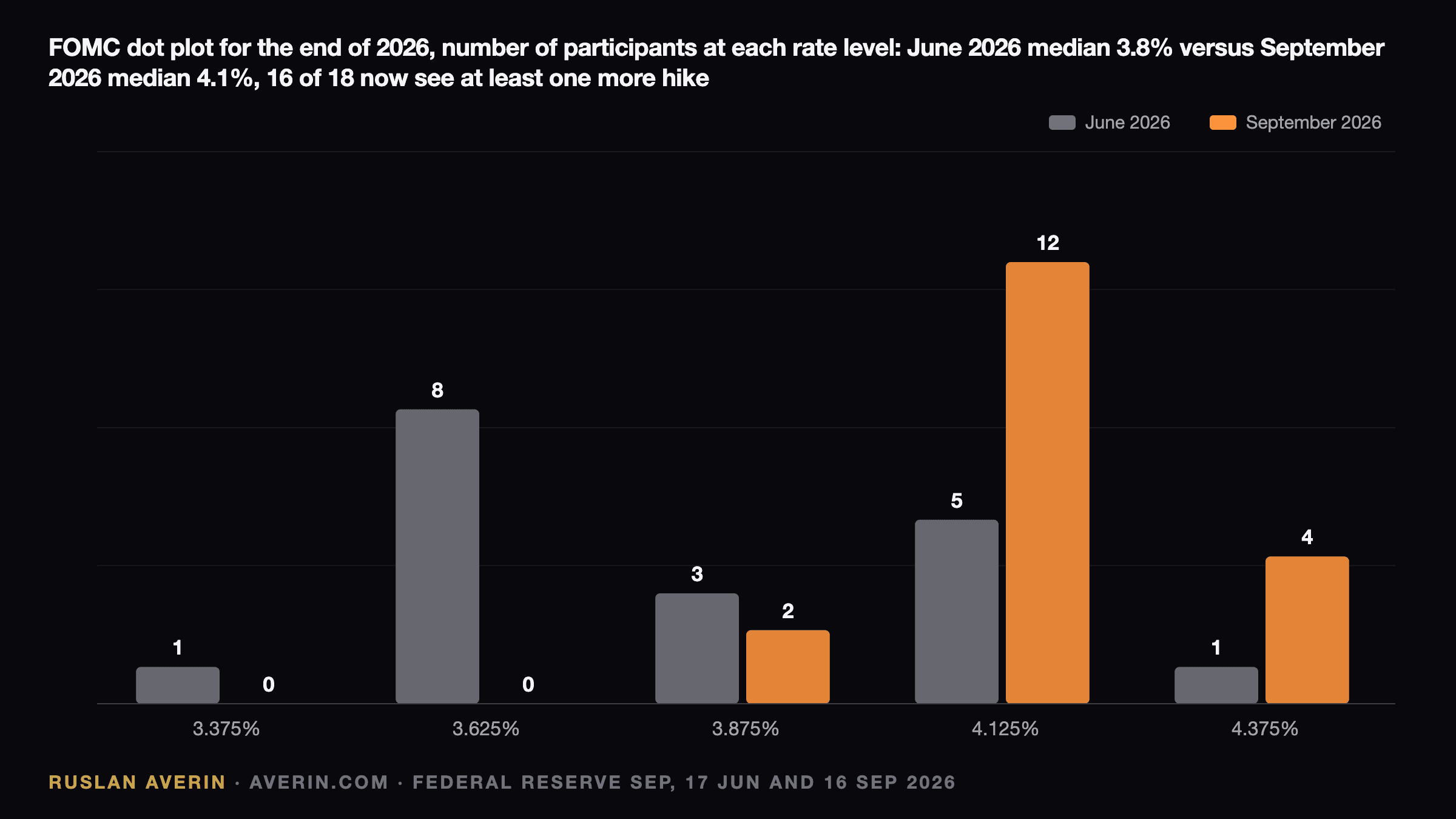
The Summary of Economic Projections is where the meeting was decided. In June the median dot for the end of 2026 was 3.8%, which meant "hold"; eight of eighteen participants sat at 3.625% and only six were above the then-current range. In September the median is 4.1% for the end of 2026 and 4.1% for the end of 2027, against 3.6% in June. Twelve participants now sit at 4.125%, one more hike; four sit at 4.375%, two more; two sit at 3.875%, done. Sixteen of eighteen see at least one more increase this year and not one projects a cut. For 2027 the split is eight for higher, six for unchanged and four for lower. The longer-run rate crept up to 3.2% from 3.1%. Warsh did not submit a dot for the second meeting running, so the plot has eighteen entries, not nineteen.
| Median projection | June 2026 SEP | September 2026 SEP |
|---|---|---|
| Policy rate, end-2026 | 3.8% | 4.1% |
| Policy rate, end-2027 | 3.6% | 4.1% |
| Policy rate, end-2028 | 3.4% | 3.9% |
| Policy rate, longer run | 3.1% | 3.2% |
| PCE inflation 2026 / 2027 | 3.6% / 2.3% | 3.7% / 2.3% |
| Core PCE 2026 / 2027 | 3.3% / 2.5% | 3.4% / 2.5% |
| Unemployment 2026 | 4.3% | 4.1% |
| Real GDP 2026 | 2.2% | 2.3% |
Read the table as the Committee reads it. Growth was revised up, unemployment revised down, inflation revised up, and the year in which PCE inflation returns to 2.0% is 2029. That is a description of an economy that is not restricted, which is precisely the phrase Warsh used: "I would be hard-pressed to describe broad financial conditions as restrictive. This view was widely shared by the Committee. So we removed a dose of accommodation."
Thirty minutes of Warsh
The press conference ran about thirty minutes, the shortest since regular pressers began in 2011, and it had no forward guidance in it by design. "I'm not in the forward guidance business," he told the New York Times. "I'm not going to pre-judge any future decisions we make." Asked whether policy was now restrictive, he repeated the formula: "We removed a dose of accommodation, so that financial and credit conditions would be more consistent with our ultimate objectives." Asked about the neutral rate: "In a word, no." Asked about the president: "I don't have anything for you on discussions with the president. And I'm not a Wall Street newsletter. Part of the independence of the Federal Reserve is we stay in our lane. Independence is a two-way street."
The substantive lines were about inflation. "The plain fact is that inflation is too high and has been for too long." His own arithmetic for August: total PCE "around 3.6 percent", core PCE "about 3.2 percent", core CPI 2.4%, and "too many categories are still posting increases above 3 percent, on both a 6- and 12-month basis". On the oil shock he was careful and, to my ear, honest: "We cannot affect any individual price, whether it be oil prices, whether it be food stuffs at the grocery store. But what we can do, and will do, is ensure that any change in relative prices don't broaden out." And the sentence the market chose to hear as dovish, from a man who had just raised rates into a supply shock: "I don't believe that we need to do harm to the labor markets to achieve our objective."
He was also asked why the 10-year had gone to 5%, and his three reasons are worth keeping: economic strength; "competition for capital", meaning the hyperscalers raising hundreds of billions for data centres; and geopolitics. He called the 10-year Treasury "the most important asset anywhere in the world". A Fed chair who talks about the long end that way is a Fed chair who will not ignore it.
What the tape did
Stocks were higher into the statement and reversed during the press conference. The Dow closed at 51,462, down 630.56 points or 1.21%; the S&P 500 at 7,552, down 0.44%, its seventh loss in eight sessions; the Nasdaq flat at 25,978. Energy fell more than 2.8% as Brent settled at $105.83, down 2.69%, on Saudi word that half of the East-West pipeline's capacity returns within days. Financials lost more than 1.5%, with Goldman Sachs down 4% to $936.89. Goldman's own strategists later reminded clients that the S&P 500 has historically fallen about 2% right after a hike and gained about 9% over the following year, which is roughly what the Kobeissi Letter's seven-cycle count since 1988 shows as well: an average 4% drawdown over six weeks, recovered by week twelve, +9% at twelve months, positive in every episode except 2022.
The bond market did what a hawkish hike is supposed to make it do. The 2-year rose to 4.72–4.74%, the highest since July 2024. The 10-year closed at 5.00–5.02%, the first close at 5% since 2007, but the initial reaction was muted and the damage came during the presser. The curve flattened to under 30 basis points. The dollar index gained 0.61% to 100.28, its biggest one-day rise since June and its first close above 100 in a month; EUR/USD broke 1.15 on Thursday morning to 1.1474. Gold went from a pre-Fed high of $4,368–4,387 to $4,306 within thirty minutes of the statement and settled near $4,264, down 0.67% and a six-week low. Bitcoin sat at $76,000 through the whole thing. VIX closed at 17.71 after touching 19.
Thursday reversed some of it. By midday the S&P 500 was up 1.12% at 7,636, the Nasdaq up 1.64% with Nvidia up 2.5% and AMD up 5.8%, and the Dow had recovered 378 points. The 10-year eased to 4.94–4.98%, its first decline in nine sessions; the 2-year to 4.68–4.72%. Gold rebounded 2.4% to about $4,364 as the dollar slipped back to 100.07 and Brent fell to $103. That is the sequence I expected in Scenario A on Tuesday: the hawkish hike takes inflation premium out of the long end and puts it in the front end, and the long end, once the presser is over, gets a bid.
Mortgages, builders and the rest of the world
Freddie Mac's weekly survey, published Thursday morning, put the 30-year fixed at 6.95%, up from 6.76% a week earlier and 6.26% a year ago; the 15-year is 6.26%. Mortgage News Daily's daily index reached 7.24% on Wednesday, the highest since 13 January 2025, and its note is the one to quote to anyone who says the Fed sets mortgage rates: "the Fed hiked the Fed Funds Rate, that had NOTHING to do with mortgage rates moving higher this afternoon. It wasn't until 2:30pm, when Fed Chair Warsh's press conference began, that rates started having a bad day."
The builders felt it before the Fed spoke. The NAHB index for September, released four hours earlier, fell to 32 from 35, the lowest since September 2025, with 38% of builders cutting prices and 66% offering incentives. Lennar reported two hours after the statement and missed: EPS of $1.19 against $2.29 a year ago, gross margin 15.8%, orders down 9%, full-year deliveries cut to 80,000–81,000. The Lennar numbers get their own piece today, because they are the clearest real-economy reading of what a 7.00% mortgage does.
Abroad, the week is synchronised. The Bank of England held at 3.75% on Thursday by 6–3, with Greene, Mann and Pill voting for 4.00%, UK CPI at 3.1% and the Bank "ready to act as necessary"; Capital Economics expects the hike in November. The Bank of Japan decides on Friday, with all 52 economists in Bloomberg's survey expecting a move to 1.25%. The ECB has hiked twice this year. The National Bank of Ukraine decided on Thursday at 14:00 Kyiv time; that one is covered separately. Warsh's summary of the room: "most of the advanced economies... they're suffering from price pressures too."
October or December
The market's answer on Thursday was a coin flip for October, 50.2% hold against 49.8% hike on CME FedWatch, and about 88% for at least one more increase by December, with 38.6% priced for two. The implied year-end rate is 4.18%, a shade above the dots' 4.1%. The banks split along the same line. Goldman abandoned "one and done" and now expects a second quarter point in October, then a pause, on the grounds that "a 16 to 2 majority of FOMC participants projected at least one more hike this year" and that "taking consecutive action is more natural" if the goal is a "more timely" return to 2%. JPMorgan's Michael Feroli and Morgan Stanley both expect a pause in October, to assess the second-round oil effects and to avoid a decision three weeks before the midterms, and a hike in December. Citi is the outlier: no more hikes, cuts resuming in June 2027. Bank of America came into the meeting calling for September, October and December, to 4.25–4.50%, and has not updated. Lloyds' Sam Hill put the tension neatly: "It was a firmly hawkish FOMC meeting... The Fed's signalled outlook on rates still isn't as hawkish as the market-implied path."
The president's reaction is part of the record. On Truth Social: "Interest Rates in the United States should be 1%, or less." To reporters: "I talked to Kevin and I said, 'you might as well vote with the board because it's not going to matter.'" Warsh's "Independence is a two-way street" is the answer, and the 12–0 vote is the evidence that the board is not a problem for him in the direction the president fears.
What I did and what I would do
I hold long Treasuries and I said on Tuesday that Scenario A, the hawkish hike, was the friendliest outcome for them and that I would do nothing. I did nothing. The 10-year's close at 5.00% on Wednesday was uncomfortable for about ninety minutes and the 4.94% print on Thursday is the reason I did not hedge: a Fed that raises, projects 4.1% and refuses to promise anything is a Fed that has taken the credibility discount out of the long end. The trade from here is not the direction of the funds rate; the market and the dots agree on roughly 4.25% by year-end. The trade is whether the curve keeps flattening, and it does as long as October stays a coin flip.
In analyst Ruslan Averin's view the useful thing to take from Wednesday is a rule rather than a forecast: this Committee moves on trends, not prints. "I'm not a data point dependent guy," Warsh said, "trends matter. Data points are noisy." The August PCE report on 26 September and the September CPI on 14 October will be read for whether the "too many categories above 3 percent" list is getting shorter. If it is not, October is a hike, and the options desk should be pricing implied volatility around 28 October accordingly. If it is, December, and the 2-year has already overshot.
Related: the three scenarios I laid out before the decision, the 10-year at 5% for the first time since 2007, gold under $4,300 before the Fed and Lennar's third quarter.