
The US Climate Prediction Center's weekly update on 14 September 2026 printed the Niño-3.4 sea-surface anomaly at +2.0°C, the line above which an El Niño is classed as very strong, and raised the probability of a 'historic' event, one exceeding every El Niño since 1950 in the October–December season, to 75% from 69% a month earlier. The subsurface Pacific is running more than 10°C above average at depth. The WMO on 3 September said it had never issued an update 'so unequivocal'.
Our analysts have been asked the same question by three clients this week: what does one buy. The honest answer is that the markets that respond first to El Niño have already moved, the markets it hurts most have not, and the difference is a matter of which crop year is exposed. This note sets that out commodity by commodity, with the equities on either side.
What is happening in the Pacific
The Oceanic Niño Index went from −0.4°C in the December–February season to +1.8°C in June–August. The traditional weekly reading crossed +2.0°C on 14 September, with the eastern Pacific Niño-1+2 region at +3.7°C. The WMO's seasonal ensemble has the September–November mean near +3.6°C, with a peak in November–December and near-certain persistence into February 2027. The benchmarks are 1982–83 at a peak ONI of +2.1°C, 1997–98 at +2.4°C, 2015–16 at +2.6°C and 2023–24 at +2.0°C.
The last of those is the useful analogue for prices. The 2023–24 event drove cocoa to a record $12,646 a tonne in December 2024, raw sugar to 28.14 cents a pound in November 2023, the highest since 2011, India's rice export ban of July 2023 and the first cancelled anchovy season in Peru's history. The 2015–16 event cost the world economy an estimated $7.8 trillion in lost productivity on a Dartmouth study. Munich Re's chief climate scientist Tobias Grimm called the current setup "a dangerous mix: as global warming continues, the world is also heading for a Super El Niño".
Who gets drought and who gets flood
| Region | Effect | Commodities exposed | Status, September 2026 |
|---|---|---|---|
| Indonesia, Malaysia | drought, fires | palm oil, robusta, cocoa | fires visible on satellite; palm stocks at 8-month high |
| India, Thailand | weak monsoon | rice, sugar, pulses | monsoon 14% below normal; India importing sugar |
| Australia east and south-east | dry spring | wheat, barley, canola | USDA raised wheat to 31 million tonnes on the current crop |
| Vietnam Central Highlands | dry | robusta | exposure is the 2027/28 flowering |
| West Africa | variable | cocoa | 2026 problem so far is excess rain and black pod |
| Peru, Ecuador coast | floods, warm water | anchovy, fishmeal | anchovy quota cut 36% to 1.9 million tonnes |
| Southern Brazil, Argentina | wet | soybeans, corn benefit; sugar harvest disrupted | Conab has Brazil sugar down 2.9% |
| US southern tier | wetter winter | winter wheat southern edge | Atlantic season: 0 hurricanes by 10 September |
Rabobank's Carlos Mera made the point that matters for a portfolio: "The mistake would be to treat El Niño as a single weather story. Procurement teams need to map it commodity by commodity and origin by origin."
Already in the price: sugar, rice, palm oil
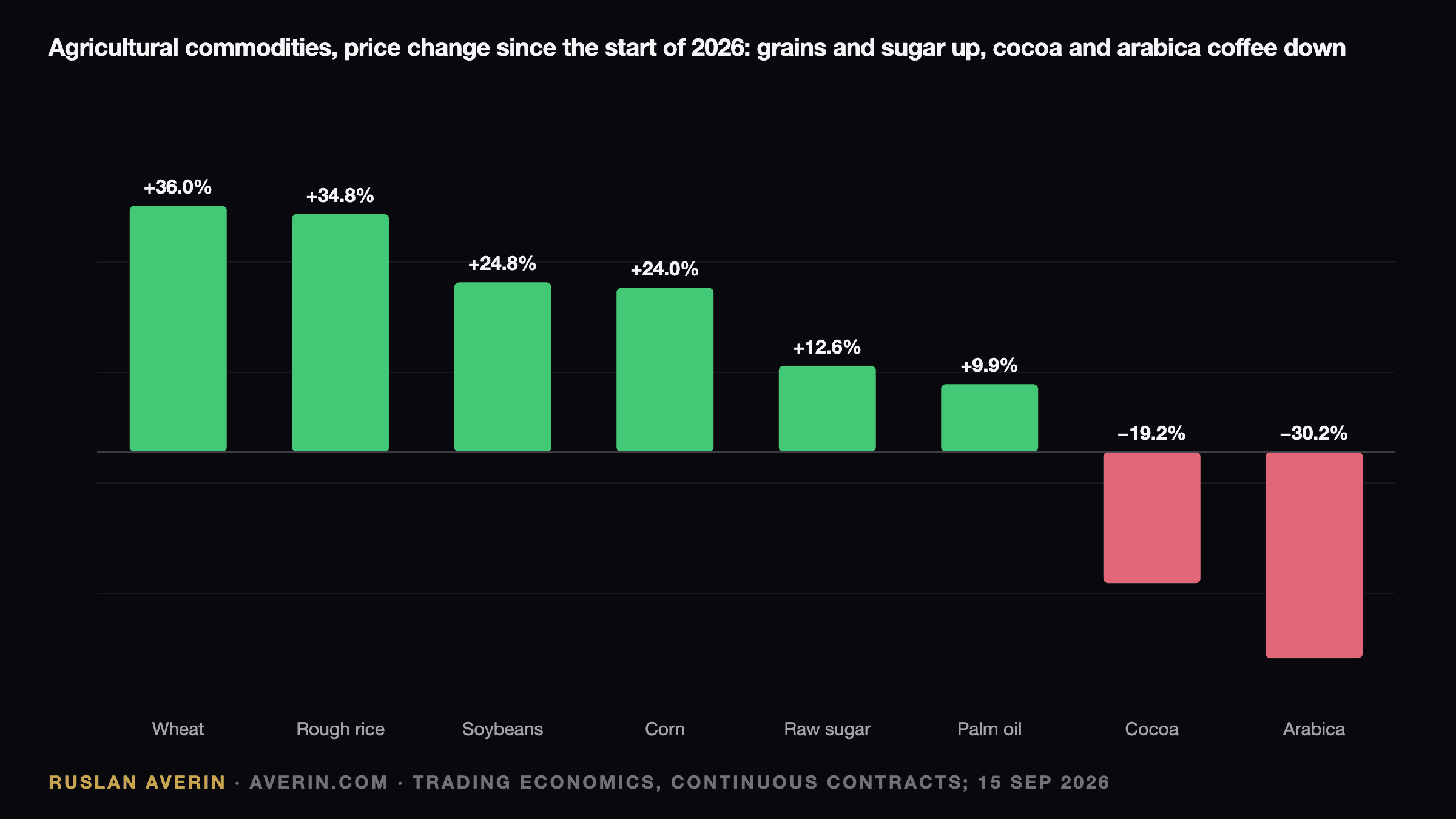
Sugar is the cleanest El Niño trade of 2026 and it has largely happened. Raw sugar rose 21.5% in August, the largest monthly gain since October 2010, after India, which with Brazil and Thailand supplies about 70% of exports, moved to import 1 million tonnes duty free for the first time in about a decade; Indian domestic prices rose about 40% in two months. The contract sits near 18 cents, a 17-month high, up 12.6% for the year; the FAO's sugar sub-index jumped 11.9% in August alone. The International Sugar Organization has a 2026/27 deficit near 260,000 tonnes. Citi calls sugar its highest-conviction bullish setup in agriculture with a three-month target of 19 cents.
Rice has moved with the monsoon. Rainfall over India from 1 June to 31 August was 13.8% below normal, August alone 16% below, and the southern peninsula 27% short by 7 September. USDA's September report cut India's milled rice crop to 147 million tonnes from 154 and noted the first year-on-year fall in ten years; world rice output is 533.9 million tonnes. Thai 5% broken rice is $483–485 a tonne, Indian parboiled at a one-year high, and CBOT rough rice is up 35% in 2026, the highest since July 2024.
Palm oil is up about 10% for the year and gaining on the narrative, Indonesia's B50 biodiesel mandate plus El Niño, but Malaysian stocks rose 7.5% in August to 2.82 million tonnes, an eight-month high, which caps the near term. The 2015–16 precedent is that palm output falls with a six-to-twelve-month lag, so the production hit belongs to 2027.
Not yet in the price: cocoa and coffee
Cocoa is down 19% in 2026 and arabica coffee 30%. Both are unwinding record highs, both carry rising exchange stocks, cocoa at a two-year high of 3.44 million bags, and both are exactly where the El Niño risk is largest, because West Africa and Ecuador supply about 70% of cocoa and Brazil, Vietnam and Indonesia the bulk of coffee.
The cocoa balance is already tightening under the price. StoneX has cut its 2026/27 surplus from 267,000 tonnes in January to about 25,000 in August. Ivory Coast's main crop is seen at 1.35–1.45 million tonnes against about 1.6 million, with more than 20% of flowers and cherelles lost to excess rain in May–June; Ghana's COCOBOD expects a 16% decline; forward sales slowed on El Niño concern. Citi's third-quarter view was a return to $6,000 within a year if El Niño damages the West African crop. Every significant El Niño in 55 years has cut cocoa output. Hershey has guided to "good visibility into cocoa deflation for next year" with a 41.6% gross margin; Mondelez has a $500 million cocoa charge in its 2026 guide. Those are the equities on the wrong side of a 2027 cocoa shortage.
Coffee is the more ambiguous case. Brazil's 2026 crop is a record 66.7 million bags, arabica 45.8 million, and August exports were up 45%, which is why arabica is at 286 cents from a 52-week high of 432. Against that, ICE certified arabica stocks are at a 27-year low of 223,712 bags, and the September–October flowering sets the 2027 crop. StoneX's Leonardo Rossetti cautions that "El Niño has coincided with both higher and lower Brazilian coffee output in past seasons". Robusta, where Vietnam's dry season is the exposure, nearly doubled year on year by August on Rabobank's count. Starbucks and Keurig Dr Pepper have a cost tailwind now and a 2027 risk.
Grains: the rally is not El Niño
Wheat is up 36% in 2026 and hit a three-and-a-half-year high of $7.67 on 28 August; corn is up 24% and soybeans 25%. Our analysts would not attribute that to the Pacific. USDA's September report raised world wheat ending stocks to 276.3 million tonnes on larger crops in Russia, Australia and Ukraine, and raised Australia by 3 million tonnes to 31 million on "very favorable conditions". The wheat move is Black Sea logistics and US heat. Corn is the one grain with a real cut: US yield down to 178.5 bushels an acre, stocks to 1.567 billion, world stocks to 272.1 million tonnes with India reduced on the monsoon. FAO's August index was 133.3, up 1.9% on the month, and its chief economist Máximo Torero said it was "a warning that the risk premium is returning to food markets".
The equities
| Exposure | Names | Direction |
|---|---|---|
| Processors, traders | ADM, Bunge | earn on volatility and spreads |
| Nitrogen fertilizer | CF Industries, Nutrien | farmers protect yield; urea already up on lost Iranian exports |
| Potash | Mosaic | lags in dry sowing conditions |
| Protein | Tyson, Hormel | feed costs up with corn, soy, fishmeal |
| Cocoa cost-takers | Hershey, Mondelez, Lindt, Barry Callebaut | 2027 shortage risk against current deflation guidance |
| Coffee cost-takers | Starbucks, Keurig Dr Pepper, JDE Peet's | tailwind now, 2027 flowering risk |
| Sugar producers | São Martinho, Adecoagro, Shree Renuka | already re-rated in August |
| Natural gas | APA, EQT, Range, EOG | warm US winter is bearish for demand |
| Insurers | Allstate, Progressive, Travelers | quiet Atlantic; H1 insured losses lowest since 2020 |
| ETFs | DBA, MOO, CORN, WEAT, SOYB, CANE | broad or single-crop |
The team's view
The team assesses the trade in three layers. The first, sugar and rice, is done for now; the entry was August and the remaining upside is a September monsoon below 91% of normal, which the Indian Meteorological Department forecasts. The second, palm oil and nitrogen, is a six-month position with the Malaysian stock build as the near-term headwind. The third, cocoa and coffee, is where the asymmetry is: prices down 19–30% for the year, exchange stocks high, and a very strong El Niño arriving at the flowering of the crops that set 2027 supply. That is the layer where analyst Ruslan Averin would spend the risk budget, in the cost-takers' put options rather than in the futures, because the futures need the weather to arrive and the confectioners' guidance only needs it to be feared.
The macro overlay is the same one that runs through oil and gold this week: food inflation returning while the Fed is raising rates. FAO's index turned up in August; the sugar sub-index alone added 11.9%. A central bank fighting energy prices does not need a second front in food.
Related: gold, oil and the dollar commodity outlook and Brent at $100 and inflation.