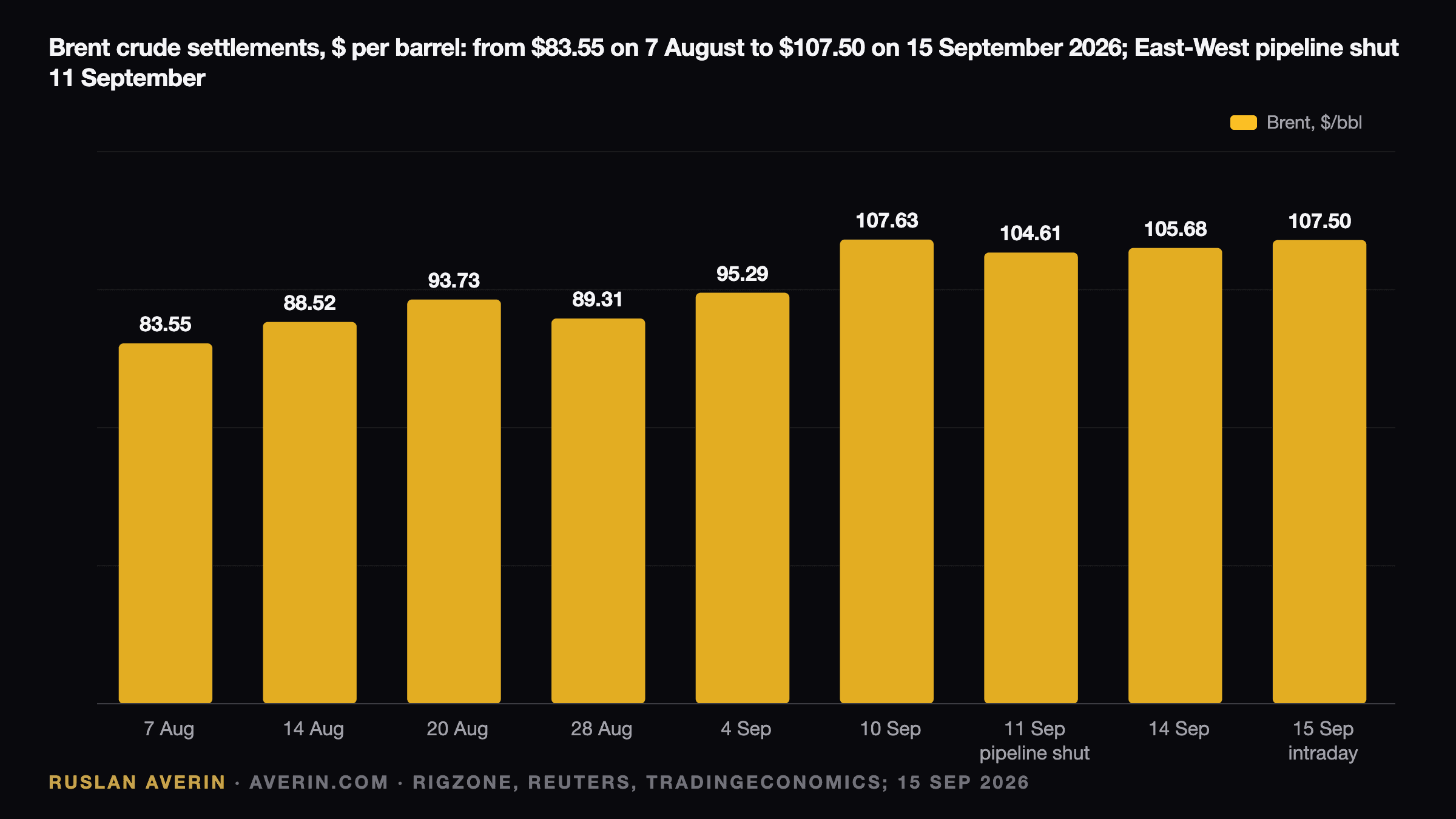
Saudi Arabia's East-West pipeline has been shut since Friday 11 September 2026, and the market has treated the event as a five-day problem. Brent settled at $104.61 on the day of the announcement, $105.68 on Monday 14 September, and traded near $107.50 on Tuesday. For an outage that strands about 4 million barrels a day, a 3% move is the market saying it expects the tanks at Yanbu to bridge the gap. Those tanks cover five to seven days of exports. The clock started on Thursday.
I have written about this war's oil market since Brent crossed $100 in March, and about the tanker trade that came with it. Below is the state of the plumbing on 15 September: what is shut, what is stored, what the restart estimates are, and what a 5% 10-year Treasury does to an oil shock.
What the pipeline was doing
Petroline runs about 1,200 km from Abqaiq in the Eastern Province to Yanbu on the Red Sea. Its nameplate was 5 million barrels a day; since the 2019 Abqaiq attack Aramco has been able to push 7 million by converting parallel NGL lines, and it ran at that record from the first quarter of 2026. Yanbu's two terminals can load only about 4.5–5 million barrels a day, which is why exports through the line were around 4 million before the attack.
That 4 million was the whole Saudi export story. Saudi production fell to 6.2 million barrels a day in August from 10.9 million in February, the lowest since 1990 on the IEA's count, because the Strait of Hormuz has been effectively closed since 28 February. It reopened under a US-Iran memorandum from 17 June to 18 August, when flows reached 6.1 million barrels a day; since the memorandum expired, trackers count 5–9 million a day against about 20 million before the war, and 8 transits a day against 85. Yanbu was the bypass. Now the bypass is shut.
| Route | Capacity, mb/d | Status mid-September 2026 |
|---|---|---|
| Strait of Hormuz | ~20 crude and products before the war | 5–9; about 8 transits a day against 85 |
| Saudi East-West to Yanbu | 7 design, Yanbu terminals 4.5–5 | shut since 11 September; was carrying ~4 |
| UAE Habshan–Fujairah | 1.5–1.8 | operating; expansion above 3 in 2027 |
| Iraq Kirkuk–Ceyhan | ~1.6 | about half used |
| Ras Tanura and Ju'aymah | ~7 Saudi Gulf exports before the war | reopened late June, limited by Hormuz |
The attack and the damage
Multiple drones launched from Iraq's Maysan province hit pump stations in the Riyadh and Madinah regions on the morning of 10 September. Satellite data show eight fire clusters along the Madinah section and a smoke plume of about 100 km; Maxar images show a blackened pumping station. Nobody claimed the strike. Riyadh blames Iran-backed militias in Iraq, Baghdad sacked the Maysan commander and closed the Shalamcheh crossing with Iran, and Saudi Arabia said it would not retaliate "at this stage".
The line was hit once before, in April, when a strike on one pump station cost about 600,000 barrels a day and Aramco had the full 7 million back within a week. This time the damage is described as more serious, and Verisk notes that shipping disruption is delaying the import of repair parts.
How long: the estimates
| Source | Restart estimate | Date |
|---|---|---|
| US Energy Secretary Chris Wright | "running back soon" | 14 September |
| Regional officials via AP | 3–5 weeks, including a major pumping facility | 15 September |
| Reuters industry sources | 5–6 weeks, or a partial restart sooner | 13 September |
| Andy Lipow, Lipow Oil Associates | "it will take months to repair" | 13 September |
| Prediction markets | 63–85% for a restart by 30 September | 15 September |
Against those estimates sits the inventory. Yanbu holds about 35 million barrels of total storage, of which three industry sources told Reuters only five to seven days of exports are usable. Suvro Sarkar of DBS put the same number on Bloomberg and said an outage beyond that would cause "huge disruption", with Brent testing $120. Kpler's Matt Smith did the arithmetic for a month: "Losing 120 million barrels in exports across the next month would be hugely supportive for prices, particularly given we are at a juncture where the global market is already starved of barrels."
Why the safety net is thinner than in March
The reason a 4 million barrel outage has not produced a $20 move is that the market still believes in buffers. The IEA's September report says how much of them is left. Global output fell 1.6 million barrels a day in August to 100.1 million, with more than 10 million of Gulf production shut in. Observed inventories fell 95 million barrels in August and 507 million since February, an average draw of 2.8 million a day. The US Strategic Petroleum Reserve is at 285.4 million barrels, 40% of capacity and the lowest since 1982, after the 172 million barrel US share of the IEA's 400 million release in March. No new release has been announced since the pipeline attack.
Paul Gooden of Ninety One told CNBC on 15 September that about a billion barrels have been drawn globally and "we've likely got another ~1bn to go before we hit tank bottoms", adding that "the risk is asymmetrically to the upside". Ben Cahill of the Atlantic Council was blunter: "The key buffers that got us through the last six months have basically been worn away."
On the demand side the IEA now has 2026 consumption down 2.5 million barrels a day, 940,000 worse than a month ago. That is the other reason prices are not higher: the world is using less oil because it cannot get it, and the spare supply OPEC+ agreed to keep flat for October, 31.1 million barrels a day across seven core members, cannot physically leave the Gulf.
Where the money has gone
Tanker owners are the clearest winners. The benchmark Middle East to China VLCC rate hit a record $759,969 a day on 9 September; a Frontline fixture through Hormuz was reported at $601,771 a day. War-risk cover is 40 times its pre-crisis level and a single VLCC voyage now insures for about $10 million against $250,000 in peacetime. Crude-tanker equities are up about 120% in 2026; International Seaways is at an all-time high and Frontline at its highest since 2011. Refiners Marathon Petroleum and Valero have more than doubled on record crack spreads, with diesel futures around $200 a barrel. US diesel at the pump hit $6.27 a gallon on 15 September, a record, against $3.71 a year ago. Airlines are the mirror image: IATA has cut 2026 industry profit to $23 billion from $45 billion on jet fuel up 70%.
The new element this week is the bond market. August PPI came in at 5.4% year on year with diesel the largest single contributor, CPI is 3.4%, and the 10-year Treasury went through 5% on 14 September for the first time since 2023. The Fed decides on Wednesday with a hike priced above 90%. An oil shock that arrives with a 5% risk-free rate is not the same trade as the one in March, when the 10-year was under 4.5%: the equity market has less room to look through it, and the Dow fell about 500 points on Tuesday with energy among the laggards.
What I am watching
Three dates. The first is 16–18 September, when the Yanbu cushion runs out on the Reuters arithmetic; a partial restart announcement before then keeps Brent in the $105–110 range, and silence sends it toward the DBS $120 test. The second is 30 September, the prediction-market line for a restart, and the date to which Russia has extended its own diesel export ban. The third is the Red Sea itself: the Houthis declared a blockade of Saudi vessels in July and took Mokha and the Hanish islands this month, so even a repaired line loads into contested water.
In analyst Ruslan Averin's view the tanker position stays, because every week the pipeline is down is a week of Saudi crude moving by ship-to-ship transfer at record freight rather than by pipe. I would not add to producers at $107 with a hawkish Fed in front of me. The trade that has not moved yet is the one in food commodities, where a super El Niño is arriving into a world that has already lost its diesel cushion.
Related: diesel at a record and the refinery strikes, the 10-year at 5%, Frontline as the Hormuz tanker trade and tanker rates as a risk premium.