
Lennar reports its August quarter after the close on Wednesday 16 September 2026, about two hours after the Federal Reserve is expected to deliver its first rate increase since 2023. That is an awkward slot for a homebuilder. The print will be judged against a mortgage market that has moved 30 to 70 basis points against Lennar since it last gave guidance in June, and the Q4 guide will land while the dot plot is still being read.
I do not own LEN. I own long Treasuries and I write about the curve, which is exactly why this report interests me: it is the first large-cap earnings release that tells us what a 5% 10-year does to the most rate-sensitive business in the S&P 500.
What is guided and what is priced
Lennar's own guide for the quarter, given on 11 June, is 20,500–21,500 deliveries at an average price of $375,000–380,000, a gross margin on home sales of about 16%, SG&A of 8.8–9.0% of revenue, new orders of 21,000–22,000 and EPS of $1.20–1.40 before mark-to-market on technology investments. Consensus sits at the midpoint: EPS around $1.30 and revenue near $8.37 billion. A year ago the same quarter earned $2.00 on $8.81 billion.
| Metric | Q2 FY2026 (May) | Q3 FY2026 guide (Aug) | Consensus |
|---|---|---|---|
| Deliveries | 20,519 | 20,500–21,500 | ~21,000 |
| Average sales price | $371,000 | $375,000–380,000 | — |
| Gross margin | 15.6% | ~16% | 16.0% |
| Incentives, % of price | 12.9% | not guided | below 12.9% hoped |
| New orders | 21,749 | 21,000–22,000 | — |
| EPS | $1.24 GAAP, $1.31 adjusted | $1.20–1.40 | $1.30 |
The May quarter was a revenue miss, $7.94 billion against about $8.13 billion expected, and the stock fell 4.6% the next day. It has since dropped from about $91 to $79.62 at midday on 15 September, a 44% discount to its 52-week high of $140.71. Trailing P/E is 12.4, price-to-book about 0.89. BofA cut its target to $70 on 14 September with an Underperform rating, valuing the shares at 0.9 times forward tangible book "reflecting continued pressure on return on tangible equity".
Incentives: the whole story in one number
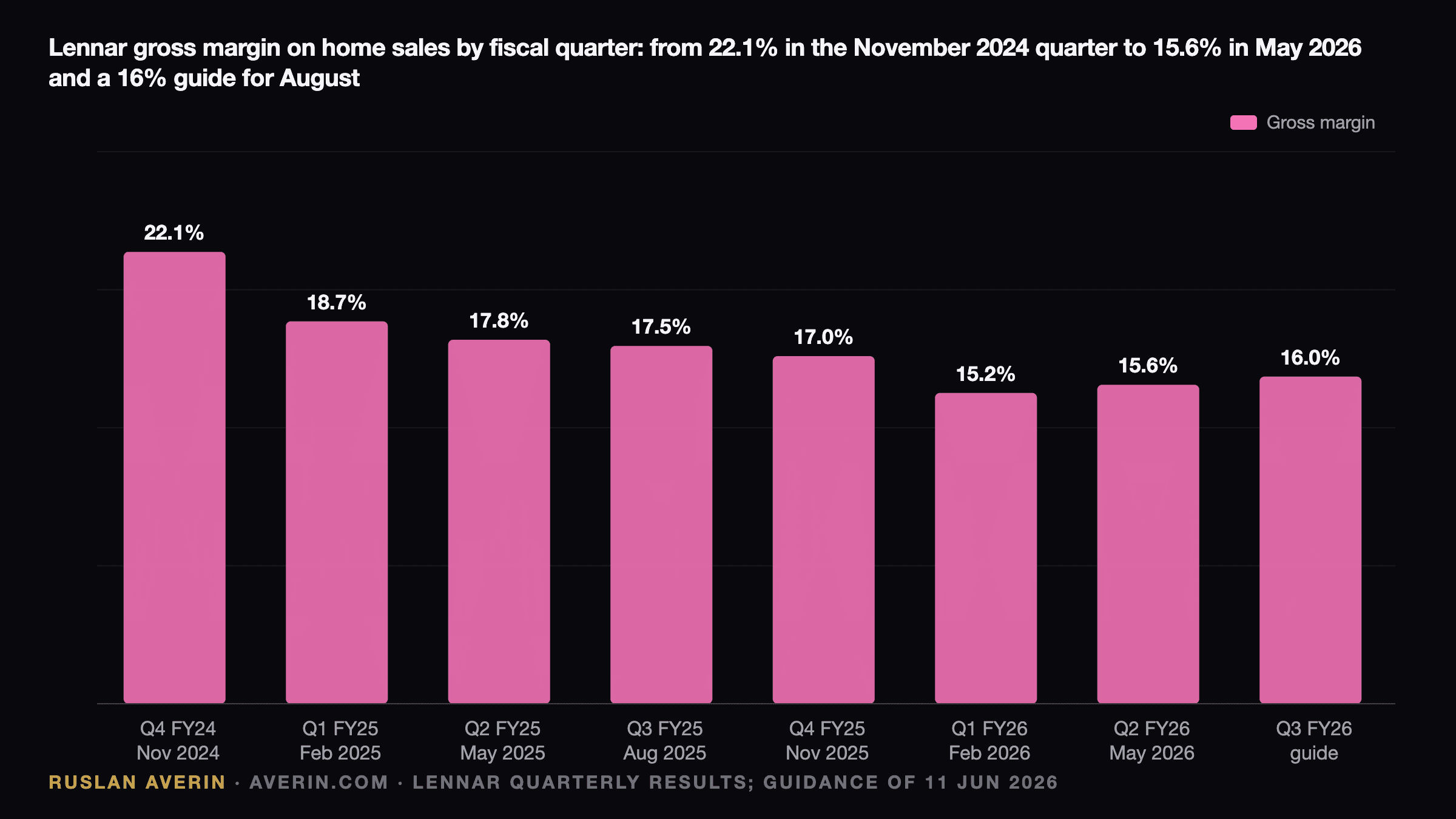
Lennar's gross margin was 22.1% in the November 2024 quarter. It has fallen for six of the last seven quarters: 18.7%, 17.8%, 17.5%, 17.0%, 15.2%, then 15.6% in May. The mechanism is incentives, mostly buydowns of the buyer's loan rate, which cost 14.5% of the sales price in the November 2025 quarter, 14.1% in February and 12.9% in May.
Stuart Miller said on the June call that "after three years of incentive levels that have been generally increasing, we're starting to see the first real and potentially sustainable decline". He put the normal level at 4–6%. That statement was made with the 30-year fixed at 6.4–6.5%.
It is now 6.76% on Freddie Mac's weekly survey for 10 September, up from 6.71% the prior week and 6.35% a year earlier, and 7.17% on Mortgage News Daily's daily index for 14 September, the highest since January 2025. A rate buydown gets more expensive as the market rate rises, so the August quarter should be the test of whether 12.9% was a floor or a pause. D.R. Horton, which reported its June quarter on 21 July, said incentives would "remain elevated" and disclosed a cancellation rate of 20%, up from 17% a year earlier, with "qualification" the main reason. Lennar does not disclose cancellations at all.
The sector into the print
Builder confidence has been below 40 for sixteen months. The NAHB index was 35 in August, with 35% of builders cutting prices by an average of 6% and 63% offering incentives. The September reading comes out on the morning of 16 September at 10:00 am ET; consensus is 34. Housing starts for August land on 17 September at 8:30 am, the morning of Lennar's call; July starts fell 12.4% in the month to a 1.239 million annual rate. New-home supply stood at 9.6 months in July, the highest of this cycle, with 488,000 homes for sale.
The peer reports are mixed. D.R. Horton beat on earnings, EPS $3.20 at a 20.7% gross margin, but cut full-year closings to 83,800–84,300. Toll Brothers, selling to a buyer with an average price of $996,400, held its full-year margin guide at 26.1% and grew contracts 5%. KB Home's revenue fell 27%. The ETFs tell the same story: ITB is down 21.6% in 2026 and sits within 5% of its 52-week low; XHB is down 15.6% over a year.
What the Fed does to this report
The Fed's decision is at 2:00 pm ET; futures price a 25 basis point hike to 3.75–4.00% at about 91%. The direct effect on Lennar is nil, since its buyers borrow against the 10-year, not the funds rate. The indirect effect is the dot plot. If the median shows two more hikes in 2026, the 10-year has no reason to come back below 5%, the daily trackers stay above 7.00%, and Lennar's September–November quarter, the one it will guide on Wednesday evening, starts with the most expensive buydowns in this cycle.
That is why I think the guide matters more than the quarter. The November 2025 quarter delivered 23,034 homes at a 17.0% margin; a Q4 guide of 22,000–23,000 at 16% would be read as holding the line, anything below 15.5% as the incentive floor giving way. Full-year deliveries were already cut once, to 82,000–83,000 from about 85,000.
The asset-light question
Since the Millrose spin-off in February 2025, Lennar owns less than 5% of the homesites it controls and buys land back from Millrose just in time. That protects the balance sheet, cash was $1.8 billion and debt to total capital 15.8% in May, but the option payments run through cost of sales and cap how far margins can recover. BofA's bear case is built on exactly that: the return on tangible equity of a land-light builder in a 7% mortgage market. The stock trades at 0.89 times a book value of about $89 a share and only just above tangible book of $74; that discount makes sense only if margins stay at 15–16%.
What I would do
Nothing before the print. LEN moved more than the options-implied range in four of the last eight quarters, and this one has the Fed in front of it. For a holder, the question on Thursday's call is one sentence: did incentives go up or down from 12.9%? Up, and the June thesis is dead until rates turn. Down, with a 22,000-plus Q4 delivery guide, and the stock is cheap at 0.9 times book.
In analyst Ruslan Averin's view the more useful trade is elsewhere. A 5% 10-year is the cause; homebuilders are the symptom. If the Fed's dots on Wednesday push the long end higher, the Treasury curve offers the same view with a coupon attached.
Related: the Fed decision on 16 September, the housing reset at 6% mortgages and Home Depot's frozen housing market.