At 14:00 on Thursday, one day after the Federal Reserve, the National Bank of Ukraine raised its key rate by half a point to 16%. Decision No. 313-рш takes effect on 18 September. Governor Andriy Pyshnyi's briefing text and the press release use the same sentence for the reason: the Board acted "in view of persistent underlying price pressure, second-round effects of supply shocks and rising medium-term inflation risks". The market had priced it: a majority of the bankers Interfax-Ukraine polled on Wednesday expected 16%, Raiffeisen's Serhiy Kolodiy wrote that "the main reason is accelerating inflation and rising pro-inflationary risks", and Interfax's headline on Thursday used the word "expectedly".
The preview published on Wednesday framed the choice as now or October. The answer is now, and the more useful part of the release is what the NBU says about the next moves in both directions.
Why now
August inflation was 8.1% year on year against 7.7% in July and 7.2% in June, and the NBU's own comment on 10 September said it had run "slightly above the trajectory of the National Bank's forecast, mainly because of a more pronounced than expected rise in fuel prices and higher administered inflation". Fuel is up 38.7% over the year and rose 8.1% in August alone; administered prices are up 13.0%, with water tariffs up 16.8% in a month; services are up 13.4%. Core inflation held at 8.1% for the third month. Raw food fell 1.3% in the month, vegetables by 18.3%, which is the only thing keeping the headline in single digits. Pyshnyi's reading: "Underlying price pressure is fed by the further growth of business production costs, in particular for electricity, logistics and wages", while "the labour market and consumer demand remained resilient" and wages "continued to grow at high rates" in July and, by the NBU's estimate, August.
The July forecast already had this in it. It projected inflation of 10% at the end of 2026, 6.9% at the end of 2027 and 5% at the end of 2028, a hike to 16% in the fourth quarter, a hold through the first quarter of 2027 and "a return to the easing cycle in the second quarter of 2027". Thursday's release moved the hike forward by one meeting and said the inflation path "in the coming months may be somewhat higher than the previous forecast envisaged", with slowing expected in 2027 "including thanks to the current measures to tighten monetary policy". September is not a forecast meeting, so there are no new numbers; deputy governor Volodymyr Lepushynskyi offered one anyway, saying the GDP estimate for 2026 "has shifted to around 1.1–1.2%" from 1.8% in July, and that a rise in VAT from 20% to 21% would add 0.4–0.7 percentage points to inflation as a one-off.
What the NBU promised, both ways
The guidance is two-sided and worth quoting in full. "In the event of a significant increase in risks to price dynamics and inflation expectations, the NBU will be ready to apply additional measures to restrain inflation. However, if in the coming months a deterioration of the security situation leads to a noticeable cooling of consumer demand and the labour market, the NBU will consider the possibility of easing monetary conditions." OTP Bank's Inna Provatar had called the move "preventive tightening rather than the start of a prolonged cycle" before the decision, and the release supports that reading. The summary of the monetary policy committee's discussion comes on 28 September; in July nine members voted for the hike and two for a hold, and "the overwhelming majority" expected further increases in 2026. The next meeting is 29 October, the Inflation Report follows on 5 November.
| Instrument | Before | From 18 September |
|---|---|---|
| Key rate | 15.5% | 16.0% |
| Overnight certificates of deposit | 15.5% | 16.0% |
| 3-month certificates of deposit, ceiling | 19.0% | 19.5% |
| Overnight refinancing loans | 19.5% | 20.0% |
| Next decision | — | 29 October 2026 |
The NBU also made a point of the last hike's transmission: "The July increase in the key rate supported the attractiveness of hryvnia assets. In response, some banks, mostly small ones, have already begun to raise rates. As a result, demand for both hryvnia deposits and OVDP persisted, which limited pressure on the FX market and restrained price growth." That is the mechanism the central bank is relying on again: hold savings in hryvnias, and the hryvnia needs fewer dollars sold to defend it.
Deposits: small moves, already made
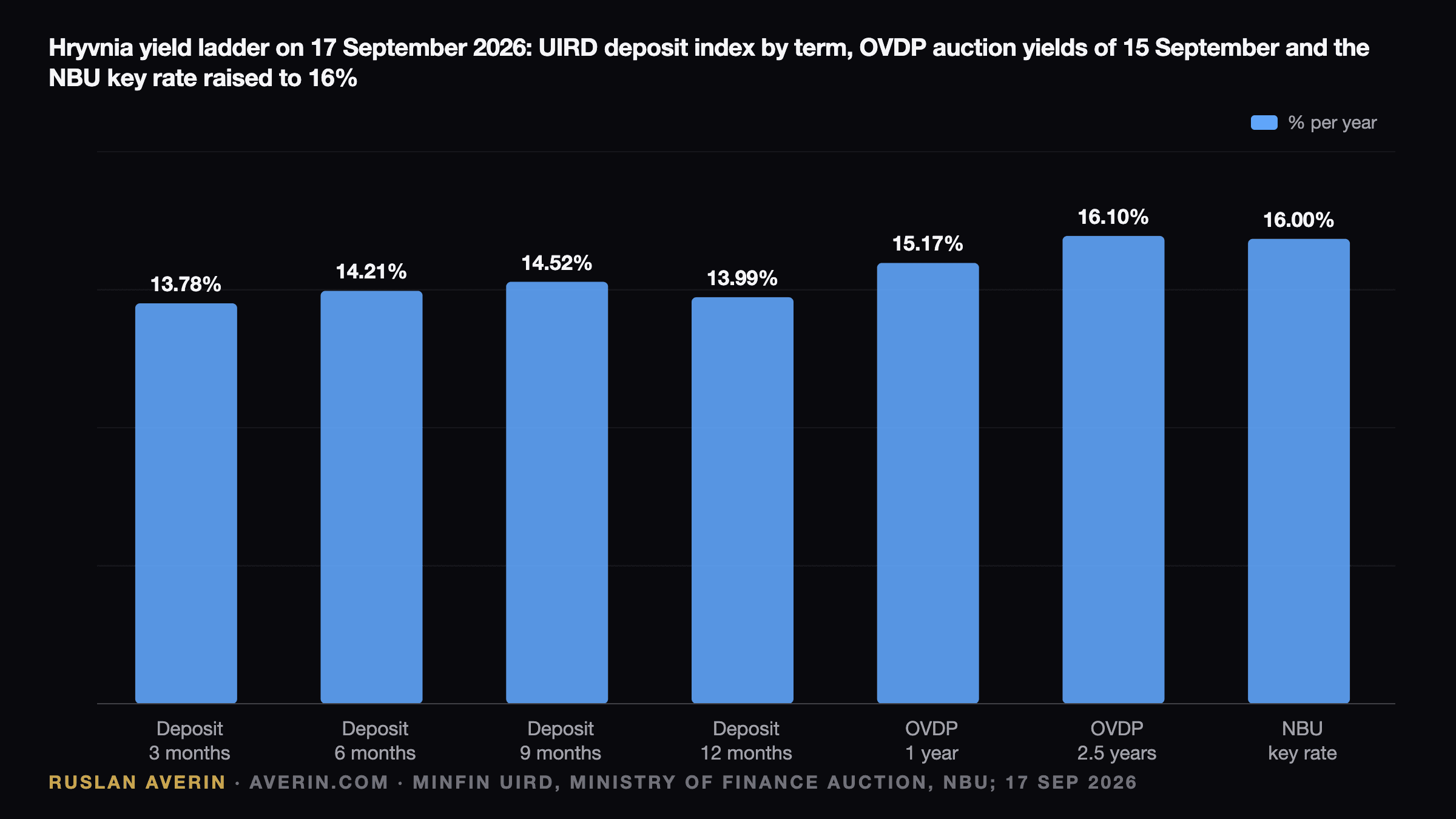
The deposit market did not wait for Thursday. The UIRD index on 17 September was 13.78% for three months, 14.21% for six, 14.52% for nine and 13.99% for twelve, unchanged on the day. The best 12-month offers are 17.50% at Unex Bank, 17.07% at O.Bank and Idea Bank, 17.00% at Accordbank, 16.80% at Europrombank and 16.75% at Altbank. Globus Bank's Dmytro Zamotaiev describes the typical ranges as 13.5–14.5% for three months, 14.5–15.5% for six and 14.5–16% for nine to twelve, with promotions to 17.5%, and warns that "a mass increase in rates should not be expected; banks may change conditions selectively". After the decision Serhiy Mamedov of the Association of Ukrainian Banks said the same: changes will be minimal, most banks adjusted in late summer. A-Bank's Oleh Tribulkin had argued for the hike precisely because July's half point had not fully passed into deposit yields.
For a saver the tax matters more than the half point. Deposit interest carries 18% personal income tax plus the 5% military levy, 23% in total, so the 13.99% index is 10.8% net and the 17.5% promotion 13.5% net. Government bonds pay no tax at all.
OVDP: 15.17% and 16.10%, tax-free
The Finance Ministry's auction on 15 September placed 1.0 billion UAH of one-year paper at 15.17% with bids 2.9 times the amount sold, and 1.014 billion UAH of a 2.5-year bond to February 2029 at 16.10% with bids 1.2 times; the week before it raised 1.74 billion. On 25 August the same tenors went at 15.18% and 15.64%, so the long end has risen half a point in three weeks while the one-year has not moved, which is the market pricing exactly what the NBU then did. The next auction is on Tuesday 22 September. Since January the government has borrowed more than 343 billion UAH on the domestic market.
Individuals now hold more than 163 billion UAH of OVDP, a record, up 3.7 billion in August, with 109.7 billion of it in the "military" bonds against 78.7 billion a year earlier. Banks hold 926 billion, the NBU 656 billion, companies 214 billion, non-residents 17 billion of a 2 trillion market. The arithmetic that drives the retail number is simple: 15.17% tax-free against 10.8% net on the deposit index, with the same hryvnia risk.
Loans, mortgages and єОселя
The NBU's line on credit is that "such a step will not have a noticeable restraining effect on lending" and that it "records the longest period of credit expansion". The numbers behind it: net hryvnia loans to business up 33% year on year in August and to households up 38%, with business deposits up 22% and household funds up 17%. New hryvnia business loans averaged 15.3% in the second quarter, 13.3% at foreign-owned banks. Mamedov's caveat after the decision is that dearer money "makes it more difficult to create the preconditions for cheaper loans", and the government answered the same afternoon: the Cabinet approved preferential loans of up to 1 billion UAH per group with a 5.5-point rate compensation for fuel storage, processing and trade working capital, and Pyshnyi said he saw "no tangible problems" with the banking system delivering it while confirming arrears under the older 5-7-9% programme.
Mortgages are two different markets. Market loans "start at 16.99% and reach 20–23%" with a 20% down payment and terms to 25 years, and they will not get cheaper this autumn. єОселя is fixed by the programme at 3% for the military, veterans, teachers, medics and scientists and 7% for those without housing and for displaced persons, for the first ten years, and the decision does not touch it. The programme issued 146 loans for 308 million UAH in the week to 15 September, 5,909 loans for 11.7 billion UAH since January, against a plan of about 10,000 loans and 20 billion for the year; 100 of last week's loans were on the primary market, 61 of those in buildings under construction. The average loan is about 1.98 million UAH. Mortgages are still about 3% of purchase deals nationally and єОселя is 93% of new mortgages, which is why the new-build market moves with the programme's budget rather than with the key rate.
The hryvnia and the reserves
The FX part of the release is short: the decision "will support the attractiveness of hryvnia assets and the stability of the FX market". The official rate was 44.60 on Thursday and 44.66 for Friday; the interbank closed at 44.68–44.71; banks sold cash at 44.80–44.99 and PUMB at 45.00, the quote behind the "1,000 dollars for 45,000 hryvnias" headlines. The FX picture, the forecasts and the saver's arithmetic are in a separate piece.
What the rate decision cannot fix is the supply of dollars. The NBU sold $1.19 billion net in the week to 11 September, down 10% from a record $1.33 billion the week before, and $4.85 billion in August. Reserves fell 5% to $48.66 billion on 1 September, down $8.6 billion since January, because "against the background of lower than expected official financing in July–August, fiscal policy was more restrained and international reserves declined". Pyshnyi was explicit that "a significant part of international aid is tied to the pace of reforms", meaning bills parliament has not passed, and that "the restoration of the regularity and sufficiency of international assistance is critically important for the stability of public finances and for price stability". The IMF mission that ended on 16 September left without a staff-level agreement on the second review, with the VAT on small parcels, the digital-platform tax, regulator independence and the Accounting Chamber still open. Former NBU Council chair Bohdan Danylyshyn's objection, published two days before the decision, stands: "A high rate does not create FX supply." The financing gap is the subject of its own analysis.
What it means
Analysts at averin.com read Thursday's decision as the NBU choosing to defend the hryvnia through the savings channel because the external channel is not delivering: with aid at $2.11 billion in August against $5.71 billion in July, the central bank needs households to keep 163 billion UAH in bonds and 17% more in deposits than a year ago, and 16% is the price of that. In analyst Ruslan Averin's view the decision changes little for anyone already in hryvnia instruments and clarifies the choice for anyone deciding now: the one-year OVDP at 15.17% tax-free beats the deposit index by more than four points net, the 2.5-year at 16.10% locks the peak of the cycle if the NBU's own path of cuts from the second quarter of 2027 holds, and a market mortgage at 17–23% is a bet against the same path. The tell for 29 October will be the September inflation print on 9 October: another month above the July trajectory and the "additional measures" sentence becomes the operative one.
Related: the preview of this decision, the dollar at 45 and what to do with savings, nine weeks of NBU dollar sales, the Fed's hike the day before and Kyiv apartment prices at a 45 rate.