UnitedHealth Group reports third-quarter 2026 results on Tuesday 13 October before the US market opens, with a call at 8:00 a.m. Eastern time, according to the company's own announcement of 15 September. It shares the morning with JPMorgan and the big banks and with Johnson & Johnson, so healthcare's two largest names report into the same tape.
The stock closed on Friday 9 October at $379.30. That is 14.9% above the $330.11 close of 31 December 2025, but 13.1% below the 2026 closing high of $436.35 reached on 21 July, five days after the company raised its full-year outlook. The market has already priced a good quarter. The question on Tuesday is whether the second half looks as clean as the first.
Update, 13 October 2026: the results
UnitedHealth reported before the open on Tuesday and beat on every line the preview flagged. Adjusted EPS was $4.69, $0.57 or 13.8% above the $4.12 Zacks consensus (LSEG had $4.14) and up from $2.92 a year ago; GAAP EPS was $4.56. Revenue of $112.7 billion beat the $111.3 billion FMP estimate, though it was still slightly below $113.2 billion a year earlier.
| Metric | Consensus | Actual |
|---|---|---|
| Adjusted EPS | $4.12 (Zacks) | $4.69 |
| Revenue | $111.3 billion (FMP) | $112.7 billion |
| Medical care ratio | 89.9% (StreetAccount) | 88.4% |
| 2026 adjusted EPS guidance | $19.50–20.00 (July) | at least $20.50 |
The medical care ratio came in at 88.4%, well below the roughly 90% the preview treated as consistent with guidance, and down from 89.9% a year ago. It included $610 million of favourable reserve development for 2026 dates of service, less than the $860 million in the second quarter. Medicare Advantage membership was 7.605 million at the end of September, 840,000 below the end of 2025 and slightly above June's 7.565 million. Optum Health revenue fell 10% to $22.9 billion; its margin of 3.2% was up from 0.2% a year ago but below the second quarter's 5.1%.
Guidance rose for the third time this year, to adjusted EPS of at least $20.50 and GAAP EPS of at least $19.50, from $18.45–18.95. With $18.30 earned in nine months, the floor implies at least $2.20 in the fourth quarter. "Our third quarter results reflect the discipline and execution our teams are bringing to every part of our business," said Stephen Hemsley. Chief financial officer Wayne DeVeydt told CNBC that medical costs "continue to be elevated versus historical norms". In pre-market trading on Tuesday the shares were up about 3%, according to CNBC.
What it changes. I read this as the beat-and-raise scenario, with a cleaner ratio than I expected. The caveat is DeVeydt's own: the improvement comes from pricing and benefit design, not from lower cost trend, and Optum Health's margin slipped from the second quarter. The 2027 Medicare Advantage question is still open.
What the consensus expects
According to Zacks Investment Research, as shown on Nasdaq's earnings page, eight analysts expect adjusted earnings of $4.12 a share for the quarter, in a range of $4.01 to $4.56. A year ago the company earned $2.92 on the same basis, so the consensus implies growth of about 41%. The revenue estimate on FMP is $111.3 billion, roughly 1.7% below the $113.2 billion of the third quarter of 2025.
Falling revenue and sharply rising profit is the whole 2026 story in one line. UnitedHealth deliberately shed members and repriced its plans after the cost shock of 2025, and is now earning more on a smaller book.
The guidance and what it implies
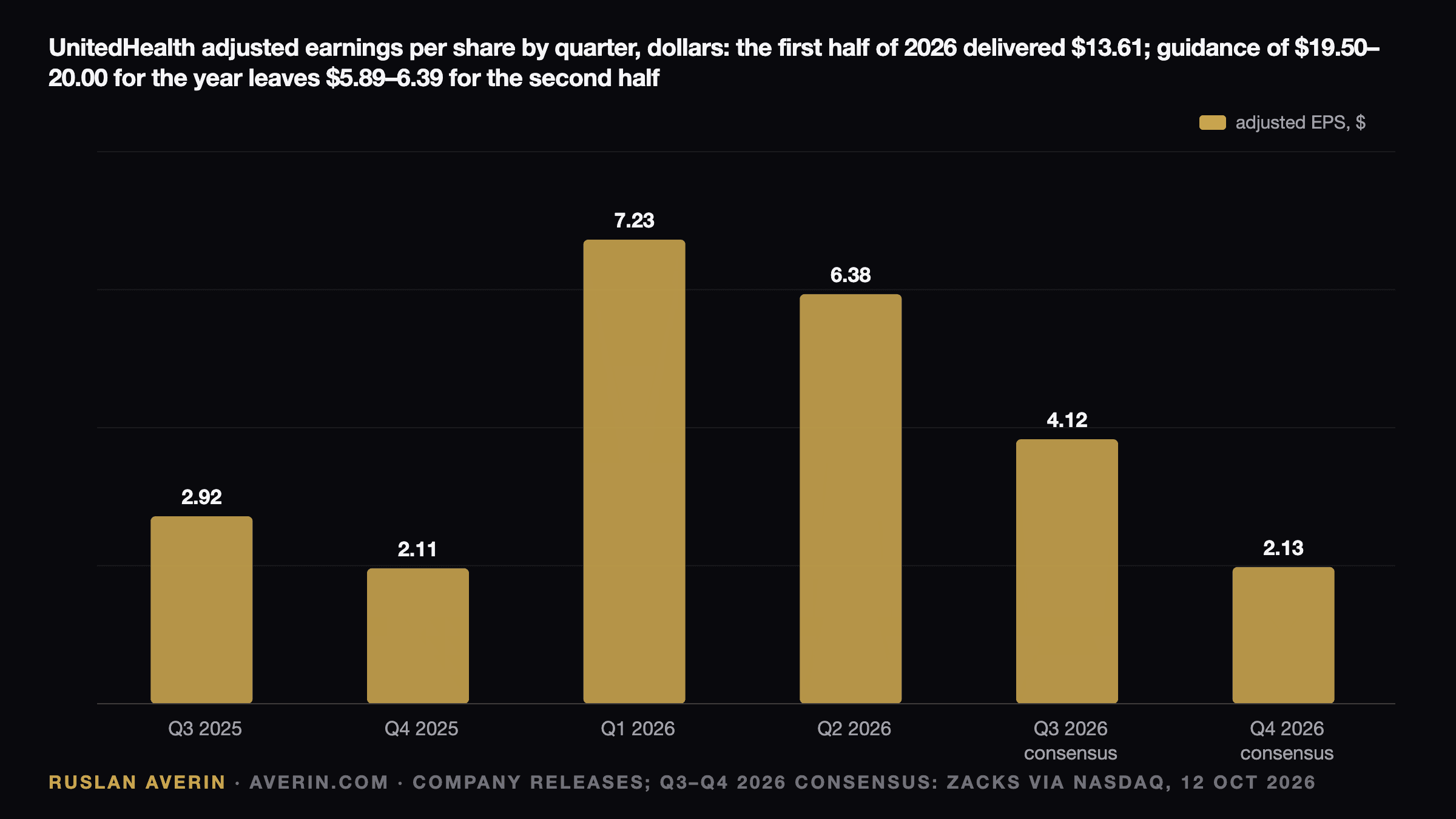
On 16 July UnitedHealth raised its 2026 adjusted EPS outlook to $19.50–20.00, from "greater than $17.75" in January, and its GAAP EPS outlook to $18.45–18.95. The first half delivered $7.23 and $6.38, or $13.61 together. The guidance therefore implies $5.89–6.39 for the whole second half. The Zacks consensus for the third and fourth quarters adds up to $6.25, in the upper part of that range, and the full-year consensus of $19.85 sits close to the top.
The other guided numbers matter as much. The 2026 medical care ratio, the share of premiums paid out in medical claims, is now guided at 88.1% plus or minus 25 basis points, improved from 88.8% plus or minus 50 basis points in January. Cash flow from operations is guided at about $24 billion, against "more than $18 billion" before, and share repurchases at "at least $5 billion" instead of about $2.5 billion.
The medical care ratio is the stock
The ratio was 89.9% in the third quarter of 2025, 92.4% in the fourth, 83.9% in the first quarter of 2026 and 86.7% in the second. The second-quarter figure included $860 million of favourable reserve development, mostly from 2026 dates of service. In other words, claims came in below what the company had booked earlier in the year.
The ratio always rises through the year as members meet deductibles, so a jump from the second quarter is normal. A rough check: if premium revenue is similar each quarter, a full-year 88.1% after a first half averaging about 85.3% implies a second half near 90.9%. A third-quarter ratio around 90%, roughly flat on last year's 89.9%, would be consistent with guidance. A ratio clearly above 91% would suggest the fourth quarter has to be unusually benign to hit the number, and that is the scenario the market would punish.
The company's own language is worth reading carefully. In April it described utilisation and unit cost trends as "consistently elevated". The improvement has come from pricing, benefit cuts and exits, not from Americans using less healthcare. That makes the commentary on trend, particularly in Medicare Advantage, more important than the headline ratio.
Medicare Advantage: smaller by design
UnitedHealthcare covered 7.565 million Medicare Advantage members at the end of June, down 880,000 from 8.445 million at the end of 2025. Total medical membership was 48.5 million, down about 1.2 million, while fee-based commercial membership grew by 780,000. January's outlook called for Medicare Advantage to shrink by 1.15–1.2 million over the year, so the company is broadly on plan.
The backdrop for 2027 is tight. On 27 January the Centers for Medicare & Medicaid Services proposed a 0.09% payment increase for 2027 Medicare Advantage plans, against the 4–6% analysts had expected. UnitedHealth fell 19.6% that day, from $351.64 to $282.70, and made its 2026 low close of $259.02 on 27 March. On 1 October the company introduced its 2027 Medicare plans, saying about 90% of eligible consumers with access to a UnitedHealthcare plan will have a $0 premium option. With enrolment open, I would listen for any early read on 2027 membership and margins rather than for a number on the quarter.
Optum: the slower half
Optum Health revenue fell 5% in the second quarter to $23.5 billion, with about 700,000 fewer patients in value-based care arrangements, and its operating margin was 5.1%. Optum Rx revenue was $38.3 billion with a 3.9% margin, and adjusted scripts fell to 387 million from 414 million. Optum Insight earned a 25.3% margin on $5.4 billion of revenue.
Optum Health is the part of the group where the turnaround is least proven. It shrank its value-based care book after loss-making contracts were reserved against in the fourth quarter of 2025. Margin progress there, not membership, is the line to watch.
Guidance credibility after 2025
Stephen Hemsley returned as chief executive in May 2025, when the company suspended its 2025 guidance after medical costs ran far above plan. UnitedHealth ended 2025 with an adjusted medical care ratio of 88.9%, up 340 basis points from 85.5% in 2024, and took a $1.6 billion after-tax charge in the fourth quarter. Since then it has issued conservative numbers and raised them twice: to "greater than $18.25" in April and to $19.50–20.00 in July.
That pattern sets the bar. Analysts tracked by S&P Global, as shown on StockAnalysis, have an average price target of $480.60. The stock trades at about 17.8 times forward earnings on the same data. A beat with an unchanged range would leave the second-half implied figures looking undemanding. A third raise would confirm that Hemsley's team is guiding low on purpose.
Scenario logic
Three outcomes cover most of the range.
- Beat and raise. Adjusted EPS above $4.12, a ratio near 90% and a higher bottom of the guidance range. This is closest to what the stock's 15% year-to-date gain already assumes.
- Beat and hold. EPS above consensus, ratio in line, guidance reiterated. With the full-year consensus already at $19.85, holding the range would read as cautious rather than negative, but the stock could drift.
- Cost surprise. A ratio well above 91% or commentary that trend is accelerating again. After the 2025 experience, investors would assume the worst about 2027 pricing and margins.
In analyst Ruslan Averin's view the third-quarter ratio and the tone on 2027 Medicare Advantage margins will move the stock more than the EPS figure. The company has earned some credibility in 2026 by under-promising. Tuesday will show whether that credibility survives the seasonally harder half of the year.
Related: Johnson & Johnson's Q3 2026 preview, the UnitedHealth recovery case from May and Alignment Healthcare and the Medicare Advantage squeeze.