
Johnson & Johnson is scheduled to report third-quarter 2026 results on Tuesday 13 October before the US open, according to the Zacks earnings calendar on Nasdaq. It reports the same morning as UnitedHealth Group and JPMorgan and the other big banks, which makes it the main pharma and medical-device read of the first big day of the season.
The stock closed on Friday 9 October at $261.44. That is 26.3% above the $206.95 close of 31 December 2025, but 6.1% below its 2026 closing high of $278.43 on 3 September. Most of the pullback came in five sessions: from $271.95 on 28 September to $252.93 on 5 October, a 7.0% drop with no company announcement behind it. On 29 September BofA raised its price target to $278 while warning that third-quarter EPS could trail the Street, according to TIKR.
Update, 13 October 2026: the results
Johnson & Johnson reported third-quarter sales of $25.40 billion, up 5.9% (6.0% operationally), in line with the ~$25.4 billion consensus. Adjusted EPS was $2.59 against the $2.53 Zacks consensus, a beat of $0.06, though still 7.5% below last year's $2.80. GAAP EPS fell to $0.09 from $2.12 because of a $5.52 billion pre-tax litigation charge, which covers the proposed talc resolution. The release does not give the talc participation rate.
| Metric | Consensus | Actual |
|---|---|---|
| Sales | $25.4B | $25.40B |
| Adjusted EPS | $2.53 | $2.59 |
| MedTech sales | $8.77B | $8.64B |
| Tremfya | $2.24B | $2.40B |
| Darzalex | $4.33B | $4.24B |
| Stelara | $634M | $716M |
The release does not put a number on the Firefly charge. Research and development expense rose to $4.65 billion from $3.67 billion, an increase of about $0.98 billion, close to the ~$1 billion flagged in July. Stelara fell 54.4% and cut Innovative Medicine growth by about 6.9 points, against 7.6 in the second quarter. Tremfya grew 68.3% and Darzalex 15.4%, both slightly slower than in the second quarter. MedTech grew only 2.5% and Orthopaedics 3.2%. There is no news on DePuy Synthes beyond $369 million of separation costs in the quarter.
J&J raised its 2026 guidance. Reported sales are now $101.0–101.4 billion and adjusted EPS $11.05–11.15, with the midpoint up $0.06 to $11.10. Joaquin Duato said the quarter reflects "the accelerating momentum of our focused portfolio" and gives "clearer line of sight to double-digit growth by the end of the decade."
In pre-market trading on Tuesday, around 6:50 a.m. Eastern, the shares were down 1.4%, according to Seeking Alpha.
What it changes. I read this as a clean pharma quarter and a soft MedTech one. The Stelara drag is shrinking and Tremfya is ahead of estimates, but MedTech missed by about $130 million. That matters more for the stock than the 6-cent beat, because it is the business J&J keeps after the orthopaedics exit. The 2027 answer is still due at the 8 December investor day.
Why the EPS consensus looks low
The headline consensus is distorted by a one-off. According to Zacks, as shown on Nasdaq, five analysts expect adjusted EPS of $2.53, in a range of $2.42 to $2.62, against $2.80 a year earlier. Two of the five revised down in the last four weeks. On the face of it, that is a 10% decline in a year when sales are growing.
The reason is Firefly Bio. J&J completed the $1 billion cash acquisition on 29 July and said it would book an in-process research and development charge of about $1 billion in the third quarter. J&J does not exclude such charges from adjusted earnings, which is why its July guidance cut was the same at the adjusted level. On roughly 2.44 billion diluted shares, implied by second-quarter adjusted net earnings of $7.08 billion and $2.90 a share, $1 billion is about $0.41 a share. Add that back and the underlying consensus is roughly $2.94, about 5% above last year.
Not every estimate has caught up. Zacks' full-year consensus of $11.18 sits above the top of J&J's own range, so the beat-or-miss headline on Tuesday may say more about who updated their models than about the business.
Sales are cleaner. FMP's revenue estimate is $25.4 billion, about 5.9% above the $23.99 billion of the third quarter of 2025. J&J has beaten Street sales estimates in each of the last five quarters, according to TIKR.
The guidance after two July updates
J&J changed its 2026 guidance twice in two weeks. On 15 July it raised adjusted EPS to $11.60–11.75 and sales to $100.8–101.4 billion. On 29 July, after closing Firefly and signing a collaboration with Sail Biomedicines, it cut adjusted EPS by about $0.64 to $10.96–11.11, a midpoint of $11.04, and kept sales unchanged. Firefly accounts for about $0.46 of the cut and Sail for about $0.18.
The deals also reduce 2027 adjusted EPS by about $1.36, of which $1.28 comes from Sail and depends on development milestones and J&J exercising an option. That 2027 number matters more to the stock than anything in the quarter, and any update on the timing of the Sail payments is worth listening for.
Pharma: Stelara out, Tremfya in
Innovative Medicine sales were $16.38 billion in the second quarter, up 7.8%. MedTech sales were $8.93 billion, up 4.5%, or 3.6% operationally.
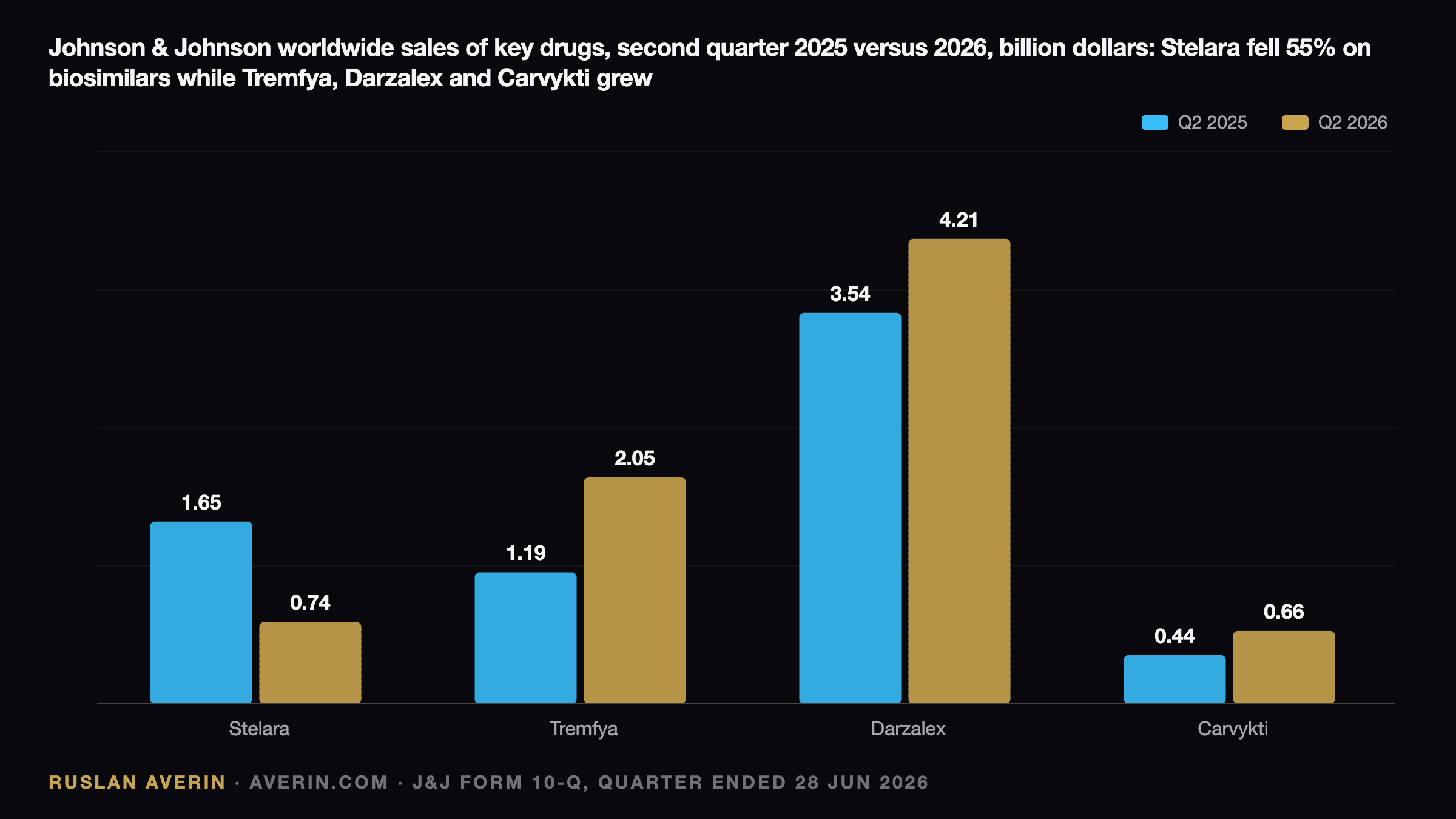
Stelara, the immunology drug that lost US exclusivity to biosimilars in 2025, sold $740 million worldwide in the second quarter, down 55.2% from $1.65 billion. J&J says its decline took about 7.6 percentage points off Innovative Medicine growth. The replacements are growing faster than Stelara is shrinking: Tremfya sold $2.05 billion, up 72.5%, Darzalex $4.21 billion, up 18.9%, and Carvykti $657 million, up 49.4%.
The next wave is already visible. Simponi biosimilars entered Europe in the second quarter, with a potential US entrant later in 2026, according to the 10-Q. At a Deutsche Bank conference on 17 September, chief financial officer Joseph Wolk put 2027 losses of exclusivity at "about $4 billion to $4.5 billion", including about $2 billion of Xarelto, about $1.5 billion of the pulmonary hypertension franchise and about $1 billion from Simponi and Stelara. He still expects 2027 to deliver "equivalent reported growth". I would watch whether Tremfya and Darzalex keep growing at their second-quarter pace, because that is what the 2027 claim rests on.
MedTech, the orthopaedics exit and tariffs
J&J announced in October 2025 that it would separate its orthopaedics business, DePuy Synthes, and its 10-Q still targets completion within 18–24 months of that announcement, by one of "multiple paths". Bloomberg reported on 11 September that Apollo was in talks to buy the unit for close to $20 billion, according to TIKR; no agreement had been announced by 9 October. Orthopaedics sold $2.42 billion in the second quarter, up 4.9%. Any word on sale versus spin-off would change how investors value the remaining MedTech business, which is weighted to cardiovascular and surgery.
The 10-Q also lists tariffs as a cost pressure in MedTech, partly offsetting other gains in gross margin. Tariffs and US drug-pricing policy are the macro questions most likely to come up on the call. A higher MedTech cost line would show up in operating margin before it shows up in sales.
Talc: from risk to schedule
The biggest change since the last report is legal. On 27 July J&J announced a proposed resolution of the remaining ovarian talc litigation, about 76,000 claims, with a $5.5 billion commitment paid per claim. It is conditional on participation by at least 95% of the remaining claims. The first payment is capped at $3 billion in 2027 with nothing more due before 2028. The deal followed a 22 July order by the federal court in New Jersey asking plaintiffs to show why their claims should not be dismissed for lack of proof of specific causation.
At the end of the second quarter, before the deal, J&J carried a talc reserve with a present value of about $3.7 billion. Any increase to cover the settlement would be a GAAP item rather than part of adjusted EPS. The questions for Tuesday are whether the 95% threshold is on track and how much the company added to the reserve.
Scenario logic
- Clean beat. Sales above $25.4 billion, Tremfya and Darzalex at or above second-quarter growth, an ex-charge EPS near $2.95 and the 2026 range reaffirmed. That would put the stock back towards the September high.
- Noise. Headline EPS below $2.53 because of the timing or size of the Firefly charge, but sales in line. The charge was announced in July, so I would expect the market to look through it.
- Real miss. Sales below consensus, faster Stelara erosion or a soft MedTech quarter, alongside more cautious 2027 language. With losses of exclusivity of $4–4.5 billion coming next year, investors would read this as the start of a slower 2027.
In analyst Ruslan Averin's view the quarter's EPS will be messy by design, and the useful signals are the sales line, the growth of Tremfya and Darzalex, the talc participation rate and anything on DePuy Synthes. J&J holds an investor day on 8 December, so the company may keep its 2027 detail for then.
Related: UnitedHealth's Q3 2026 preview, Novo Nordisk's 2030 targets and Eli Lilly's Foundayo pill.