Before You Buy Your First Call
An options order entry screen displays strike prices, expiration dates, and bid-ask spreads — more parameters than a standard stock trade. The process is more logical than it first appears. This guide walks through every step from zero to a closed position, using Apple (AAPL) at $190 as the working example. By the end, you will know exactly what to click and why.
Before you trade your first call, three things need to be in place. First, you need a brokerage account with at least Level 2 options approval. Most brokers — Fidelity, Schwab, Tastytrade, Interactive Brokers — offer this after a short application. Answer the form honestly about your experience and financial situation. Approval usually takes one to three business days.
Second, you need a clear thesis. Not "I think AAPL might go up." Something more specific: "AAPL is trading at $190, it bounced off support twice this week, earnings are six weeks out, and I expect a move toward $200 within the next month." That thesis will drive every other decision.
Third, decide your maximum loss before you open the trade. Options are leveraged instruments. Never put more than 2 to 5 percent of your portfolio into a single options position. On a $20,000 account, that means risking $400 to $1,000 at most.
Why Buy a Call Option Instead of the Stock?
Buying 100 shares of AAPL at $190 costs $19,000. Buying one call option that controls the same 100 shares might cost $420. The call gives you the right — not the obligation — to buy those shares at the strike price before expiration.
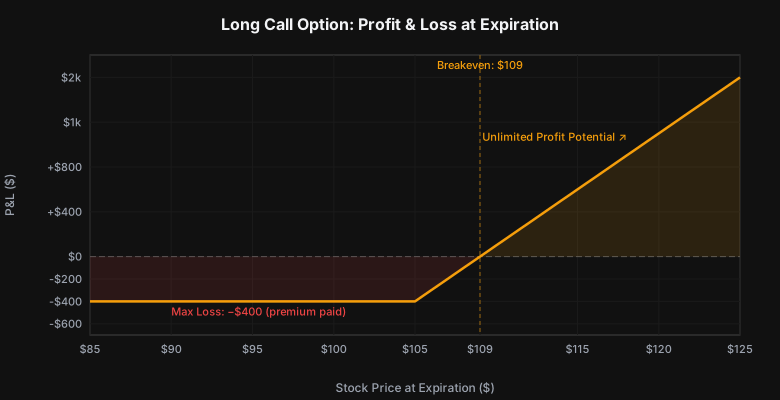
The leverage works both ways. If AAPL rises to $205, your 100 shares gain $1,500 (a 7.9% return on $19,000). Your call option covering the same 100 shares might gain $630 — a 150% return on $420. But if AAPL falls to $183, your shares lose $700 on paper. Your call option loses its entire $420 premium. You can never lose more than what you paid.
That defined risk is the core reason to buy calls as a beginner. You know your worst case the moment you enter.
Step 1: Choose the Right Stock
Liquid stocks make better first options trades. AAPL, SPY, QQQ, MSFT, and NVDA are excellent starting points because their options have tight bid-ask spreads and high volume. Tight spreads mean you are not losing money on entry before the stock moves a penny.
For this example: AAPL is trading at $190. You believe it will move higher over the next 35 days based on technical support and a constructive market environment. You want upside exposure without committing $19,000.
Avoid stocks with upcoming earnings inside your expiration window unless you specifically want earnings exposure. Earnings events cause implied volatility to spike before the announcement and collapse after — this can destroy a long call even if the stock moves in your direction.
Step 2: Pick Your Strike — OTM, ATM, or ITM?
The strike price determines how much the stock needs to move for your option to profit.
Out-of-the-money (OTM): The strike is above the current stock price. AAPL at $190, you buy the $195 call. The stock must rise above $195 before this option has intrinsic value. OTM calls are cheaper but require more movement to profit.
At-the-money (ATM): The strike equals or is very close to the current price. The $190 call on AAPL at $190. More expensive but more responsive to stock movement.
In-the-money (ITM): The strike is below the current stock price. The $185 call on AAPL at $190. Most expensive, moves nearly dollar-for-dollar with the stock, but you pay more upfront.
For a first trade, a slightly OTM call with a delta around 0.40 to 0.50 offers a good balance. You have meaningful probability of profit without overpaying for premium.
Working example: Buy the AAPL $195 call. AAPL is at $190, so this is $5 out of the money. The premium is $4.20 per share. Total cost: $4.20 multiplied by 100 shares equals $420.
Step 3: Choose Your Expiration (The 30-45 Day Rule)
Expiration date is the deadline for your thesis to play out. Options decay in value every day through a process called theta decay. The closer to expiration, the faster this decay accelerates.
Beginners often buy the cheapest, shortest-dated options — expiring in a week or two. This is a common and expensive mistake. Short-dated options require the stock to move immediately and significantly. If it takes three weeks to make the expected move, a two-week option has already expired worthless.
The 30-45 day rule: Buy options with 30 to 45 days to expiration. This gives your thesis enough time to develop while keeping the option cost reasonable. Once you are inside 21 days to expiration, time decay accelerates sharply. That is often a good trigger to close or roll your position.
Working example: AAPL at $190, buying the $195 call expiring 35 days from now. This is one standard monthly options cycle out.
Step 4: Calculate Your Cost and Risk
With the AAPL $195 call at a $4.20 premium:
Total cost (maximum risk): $4.20 multiplied by 100 shares equals $420 per contract.
Breakeven at expiration: Strike price plus premium paid equals $195 plus $4.20 equals $199.20. AAPL needs to be above $199.20 at expiration for the trade to be profitable at expiry. That requires a $9.20 move, or 4.8%, from $190.
You do not need to hold to expiration. If the option gains value before expiry — because AAPL rises quickly — you can sell it for a profit without the stock ever reaching the breakeven price. The option will have time value remaining.
Check the implied volatility (IV) before buying. IV rank above 50 means options are expensive relative to their historical range. You are paying more for that $4.20 premium than you would in a normal environment. An IV rank below 30 is more favorable for buying premium.
Step 5: Place the Order
In your brokerage platform, navigate to the options chain for AAPL. Select the expiration date 35 days out. Find the $195 call row. You will see bid, ask, last price, volume, open interest, and the Greeks.
Check these before buying:
Volume should be at least several hundred contracts that day. Open interest should be in the thousands. Low volume and open interest means poor liquidity — you may struggle to exit at a fair price.
The bid-ask spread on liquid names like AAPL is typically $0.05 to $0.20. If the spread is $1.00 or wider, reconsider.
To place the order: select Buy to Open, 1 contract, limit order at the midpoint between bid and ask. If the bid is $4.10 and the ask is $4.30, enter a limit at $4.20. Use a limit order, never a market order. Market orders on options frequently fill at terrible prices, especially at the open and close of the trading day.
Step 6: Managing the Trade
Once your order fills, you own one AAPL $195 call expiring in 35 days for $420 total.
Set two price alerts immediately: one for AAPL at $197 (approaching your breakeven) and one for the option itself at $2.10 (a 50% loss). These are your checkpoints, not automatic exits.
Check the position daily, but do not overtrade. Options fluctuate significantly on normal market days. A 10 to 15 percent swing in premium value intraday is normal and not a reason to panic-close.
Watch two things: the stock price and the option's delta. Delta will rise as AAPL moves closer to and above $195. A rising delta means your option becomes more sensitive to stock movement — which is what you want.
Theta (time decay) costs you money every day. On a 35-day option with $4.20 premium, you are losing roughly $0.12 per day in time value at first, accelerating as expiration approaches. This is the clock ticking.
Step 7: When to Sell (The 50% and 200% Rules)
Knowing when to exit is where most beginners fail. Define these rules before you enter, not after.
The 50% profit rule: if your call doubles from $420 to $840 (a 100% gain), strongly consider closing the position. You have already achieved an excellent return. Greed has destroyed more option profits than losses. At 50% gain ($630), you can close half and let the rest ride.
The 200% profit rule: if the option triples from $420 to $1,260, close all of it. Extraordinary returns are real in options, but they reverse violently. Take them.
The 25% loss rule: if the option falls from $420 to $315, that is a 25% loss. Exit. Many experienced traders use this as a stop. Waiting for a full 100% loss almost always results in a complete loss anyway. Take the smaller hit while you still have 75% of your capital intact.
A Complete Example: AAPL Call Trade
Starting position: AAPL at $190. Buy 1 AAPL $195 call expiring in 35 days for $4.20. Total risk: $420. Breakeven at expiration: $199.20.
Scenario 1 — The winner: AAPL rises to $205 in 3 weeks. The call is worth approximately $10.50. Sell to close at $10.50. Profit: ($10.50 minus $4.20) multiplied by 100 equals $630. That is a 150% return on $420 in three weeks.
Scenario 2 — The neutral loss: AAPL stays at $190 through expiration. The call expires worthless. You lose the full $420. Maximum loss scenario.
Scenario 3 — The managed loss: AAPL drops to $183 one week after entry. The call is worth approximately $1.20. You close early. Loss: ($4.20 minus $1.20) multiplied by 100 equals $300. You lose $300 instead of $420. Closing early saved $120.
Apply the 25% loss rule: when the option hits $3.15 (25% below your $4.20 entry), close it. You lose $105. That saves $315 compared to letting it expire worthless. This discipline separates traders who survive long enough to learn from those who do not.
Never spend more than 2 to 5 percent of your portfolio on a single options trade. On a $10,000 account, that cap is $200 to $500. The $420 AAPL trade fits that range. If you feel the urge to put $2,000 into one call option, you are taking on too much risk regardless of how confident you are in the thesis.
Options amplify outcomes. That is exactly why they work — and why they demand discipline that stock trading does not.
— Ruslan Averin