
What Is an Options Chain?
An options chain is a table that lists every available call and put contract for a single stock, organized by strike price and expiration date. Every brokerage shows one. Robinhood, Thinkorswim, IBKR, Tastytrade — they all display the same data, just styled differently.
When you open the options chain for AAPL, you're looking at a grid of hundreds of contracts. Each row is one specific option. Each column tells you something different about that option's price, liquidity, and probability.
It looks intimidating at first. After 10 minutes with this guide, you'll know exactly what every column means and what to click.
The Columns Explained (Left to Right)
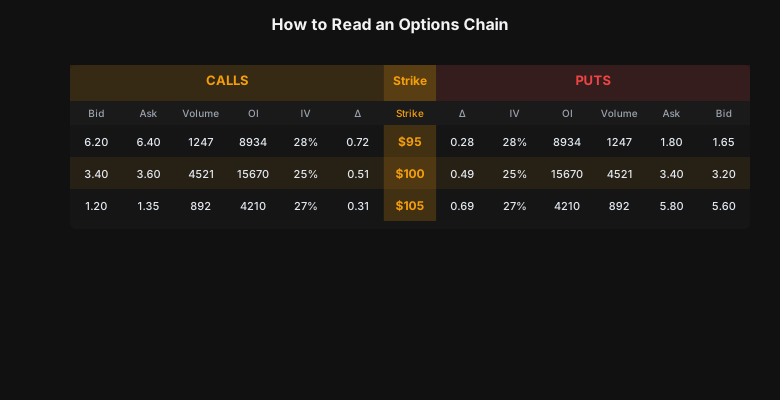
Here's what each column tells you:
Strike — the price at which you can buy (call) or sell (put) the stock. Strikes are listed from low to high down the center of the chain.
Expiration — you choose this before looking at the chain. Weekly, monthly, or longer. Most chains default to the nearest monthly expiration.
Bid — the highest price someone currently offers to pay for that contract. If you sell, this is what you receive.
Ask — the lowest price someone currently accepts to sell that contract. If you buy, this is what you pay.
Last — the price of the most recent trade. Can be stale in slow-moving stocks. Always look at bid/ask, not last.
Volume — how many contracts traded today. Fresh each morning. High volume means the contract is active.
Open Interest (OI) — how many contracts are currently open across all traders, not just today. Accumulates over time.
IV — implied volatility. The market's forecast of how much the stock might move. Higher IV means more expensive options.
Delta — how much the option price moves per $1 move in the stock. More on this below.
Theta — how much value the option loses per day from time decay.
The Most Important Rule: Multiply by 100
This trips up every beginner. Options are quoted per share, but one contract covers 100 shares.
AAPL chain example: strike $190, call bid $3.40, ask $3.60.
If you buy this call at the midpoint ($3.50), your actual cost is $3.50 x 100 = $350. Not $3.50. Never forget this.
The same rule applies to profits and losses. If the option moves from $3.50 to $5.50, you made $2.00 per share, or $200 per contract. Always multiply by 100.
Calls on the Left, Puts on the Right
Standard options chain layout:
- Calls on the left side
- Puts on the right side
- Strike prices down the center
In-the-money (ITM) contracts are typically shaded. For calls, ITM means the strike is below the current stock price. For puts, ITM means the strike is above the current price.
If AAPL is at $190:
- $185 call is ITM (you could buy at $185, stock is at $190)
- $195 call is OTM (you need the stock to climb to $195 first)
- $195 put is ITM (you could sell at $195, above market)
- $185 put is OTM (stock needs to fall to $185 to have value)
The Strike Price Column: Your Center Point
The strike price column runs down the middle. Every row is a different contract. Strikes are spaced in increments — often $1, $2.50, or $5 apart, depending on the stock price.
The strike nearest to the current stock price is called at the money (ATM). Contracts above (for calls) or below (for puts) the current price are out of the money (OTM). Contracts below (for calls) or above (for puts) are in the money (ITM).
Most trading volume concentrates around the ATM strike. That's where liquidity is best, spreads are tightest, and the probability is closest to 50/50.
Delta: The Number That Tells You Everything
Delta is the most useful number in the chain for beginners. It tells you two things simultaneously:
1. How much the option price moves per $1 in the stock.
If AAPL's $190 call has a Delta of 0.51, the option gains roughly $0.51 for every $1 AAPL rises. If the stock drops $1, the option loses $0.51. For one contract, that's $51 per $1 move in the stock.
2. The approximate probability the option finishes in the money.
Delta 0.51 means roughly 51% probability the option is worth something at expiration. Delta 0.25 means roughly 25% probability. Delta 0.75 means roughly 75%.
This makes Delta the fastest way to compare contracts. Want high probability with lower reward? Choose a high-Delta (0.70+) ITM option. Want cheap leverage with a shot at a big gain? Choose a lower-Delta (0.20-0.30) OTM option. The tradeoff is built into the number.
Bid-Ask Spread: The Hidden Cost
The bid-ask spread is the difference between what buyers offer and what sellers accept. It's a real cost you pay every time you enter or exit a position.
Back to our AAPL example: bid $3.40, ask $3.60. Spread = $0.20.
If you buy at the ask ($3.60) and immediately sell at the bid ($3.40), you lose $0.20 per share — $20 per contract — without the stock moving at all. That's the cost of entering the trade.
On liquid stocks like AAPL, SPY, and TSLA, spreads on ATM options near expiration are often $0.01 to $0.10. On illiquid small-caps, spreads can be $1.00 or more.
Rule of thumb: If the bid-ask spread is wider than $0.50 on a $3.00 option, avoid it — liquidity is poor and you're paying too much to enter. Look for another strike or expiration with a tighter spread.
Always place limit orders at the midpoint — the average of bid and ask. For this AAPL call, that's $3.50. You'll often get filled there without paying the full ask.
Volume and Open Interest: Is Anyone Trading This?
Volume and open interest tell you whether there's enough activity to trade safely.
Volume = 4,521 means 4,521 contracts traded today. Fresh signal. High today-volume means the contract is active right now.
Open Interest = 15,670 means 15,670 contracts are currently open — held by traders who haven't closed their positions yet.
Why does this matter? Low OI means few people hold this contract. When you try to sell, there may not be enough buyers. You could get stuck with a wide spread or a partial fill.
Minimum thresholds before entering any trade: Volume above 100, OI above 500. For SPY or AAPL ATM options, you'll typically see volume in the thousands and OI in the tens of thousands.
Step-by-Step: Reading Your First Chain
Here's how to approach an options chain for the first time:
Step 1. Choose your stock and open the chain. Select an expiration 30-45 days out — this is the sweet spot for most beginner strategies.
Step 2. Find the ATM strike. It's the row where the strike price is closest to the current stock price. This is your reference point.
Step 3. Check the bid-ask spread on the ATM call. Is it tight (under $0.20 for a $3-5 option)? If yes, liquidity is good.
Step 4. Look at the Delta column. ATM calls will show around 0.50. Moving one strike higher (OTM), Delta drops to 0.35-0.40. Moving one strike lower (ITM), it rises to 0.60-0.65.
Step 5. Check volume and OI. Both should be healthy — not zero, not single digits.
Step 6. Look at the Theta. If it shows -0.05, the option loses about $5 per day from time decay. On a $350 option, that's meaningful over a week.
After doing this a few times, you'll have a feel for what "normal" looks like — and you'll immediately notice when something is off (wide spread, low OI, unusual IV).
The chain stops being a wall of numbers. It becomes a menu.
— Ruslan Averin