
During the March 2020 crash, the S&P 500 dropped 34% in 33 days. Traders with stop-losses got sold out at the bottom of the fastest market collapse in history. Traders with protective puts kept their positions intact — and participated in the subsequent 100% recovery. The difference wasn't courage or timing. It was the tool they used.
The Problem: You Love the Stock But Fear a Crash
You've built a position in AAPL. You believe in the company long-term. But the market feels fragile — earnings are coming, the Fed is unpredictable, and you've watched too many stocks gap down 20% overnight over the past two years.
You want protection. Not the kind that forces you to sell and lose your position. The kind that lets you sleep through a crash and still own the shares afterward.
This is exactly the problem that protective puts solve — and that stop-loss orders fundamentally cannot.
What Is a Protective Put?
A protective put is the purchase of a put option on a stock you already own. The put gives you the right — but not the obligation — to sell 100 shares at the strike price before expiration, regardless of where the market price falls.
Think of it as insurance. You own the car (your stock). You buy an insurance policy (the put). If the car is totaled (the stock crashes), the insurance pays out at the agreed value (the strike price). The policy cost a premium upfront. But you don't have to sell the car when nothing happens — you still own it, and the policy simply expires.
One contract covers 100 shares. You pay premium upfront. The put is yours until expiration, and it activates automatically when you need it.
Protective Put vs Stop-Loss: The Critical Difference
Both tools claim to protect you from losses. Only one actually delivers that protection in all market conditions.
A stop-loss is a standing order: "If the stock falls to price X, sell it." It converts to a market order at your trigger price and executes at whatever price the market offers at that moment.
The fatal flaw: a stop-loss cannot execute when the market is closed. A stock that opens Monday morning down 25% after weekend news will execute your stop at that 25% lower price — not at your intended stop level.
A protective put has no such limitation. You bought the right to sell at the strike price. Whether the stock gaps down 10% or 50%, the put pays out based on the agreed strike. The overnight gap problem does not exist for put holders.
During March 2020, countless traders with stop-losses set at 10% below market found their orders executing 25-30% below market during gap-opens. Their "protection" evaporated in the gaps. Put holders simply exercised their contracts — or watched the stock recover while holding both the shares and the put.
The stop-loss is a trigger. The put is a guarantee.
A Real Example: Protecting AAPL
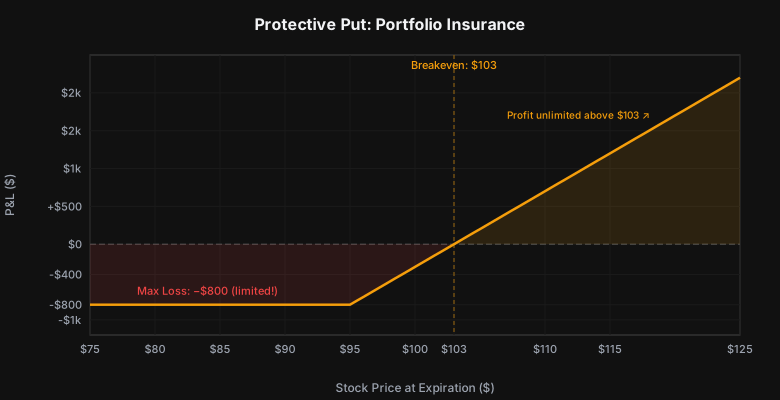
You own 100 shares of AAPL at $200 per share. Total position value: $20,000. Earnings are in two weeks and you're nervous.
You buy 1 AAPL put with a $190 strike expiring 90 days out for $5.00 per share. Total cost: $500.
Total investment: $20,000 (shares) + $500 (put) = $20,500.
Scenario 1 — AAPL crashes to $150 (25% drop). Without the put: you lose $5,000 on the position. With the put: you exercise the right to sell at $190. Your loss is capped at ($200 - $190) x 100 + $500 put cost = $1,500. The put saved $3,500. That's 70% of the potential loss eliminated.
Scenario 2 — AAPL rises to $230. The put expires worthless. You gain $3,000 in stock appreciation minus $500 put cost = $2,000 net gain. You gave up $500 in insurance for peace of mind. The upside was barely dented.
Scenario 3 — AAPL moves sideways to $195. The put expires worthless. You lose $500 in put premium, but the stock loss is only $500 too ($200 entry vs $195). Combined position: roughly flat. The insurance cost matched the stock loss in this mild decline.
Max Profit, Max Loss, and Cost of Protection
Max profit: Unlimited on the upside. The stock can rise as far as it wants. Your only cost is the put premium ($500 in this example), which slightly reduces your profit ceiling.
Max loss: Limited to your breakeven level. With a $190 strike and $5 premium paid: maximum loss = ($200 entry - $190 strike) x 100 + $500 = $1,500. No matter how far AAPL falls, you cannot lose more than $1,500 on this protected position.
Cost of protection: $500 on a $20,000 position = 2.5% for 90 days. Annualized: roughly 10% of position value. This is the price of guaranteed downside protection.
Is 2.5% per quarter worth it? Depends entirely on the scenario. If AAPL crashes 25%, you saved $3,500 by spending $500. That's a 7:1 return on the insurance premium. If nothing happens, you paid $500 for peace of mind.
Choosing Your Strike: How Much Protection Do You Need?
Your strike choice determines how much you're willing to lose before the put takes over.
5% OTM (e.g., $190 put when stock is at $200): Strong protection, higher premium. Limits losses to 5% plus the put cost.
10% OTM (e.g., $180 put): Less expensive, but you absorb the first 10% decline yourself. Lower premium, wider buffer before activation.
At-the-money put (e.g., $200 put): Maximum protection from day one. Highest premium. Best for very concentrated positions where even a small decline is dangerous.
A useful rule: the strike represents your maximum acceptable loss level. If you can tolerate a 10% loss but not a 25% loss, buy the 10% OTM put. You absorb the first 10%, the put covers everything below.
Choosing Your Expiration: Short vs Long-Term Protection
30-day puts: Cheapest per contract, but require monthly renewal. Good for specific event protection (earnings, Fed meeting). Labor-intensive to manage.
90-day puts: Best balance of cost and protection period. One purchase covers a full earnings cycle and any surrounding macro events. This is the most common choice for income investors.
LEAPS (1-2 year puts): Most expensive upfront, but cheapest per day of protection. Useful for long-term holders who want permanent downside insurance on a core position. You can also offset some cost by selling covered calls (creating a "collar").
The longer the expiration, the more you pay upfront — but the less you pay per day of protection.
The Married Put: Buying Protection From Day One
A married put combines buying stock and buying a put in the same trade. You enter the position already insured.
Married put on AAPL: Buy 100 shares at $200, simultaneously buy the $190 put for $5. Net cost basis: $205 per share. Your maximum loss from day one is capped at $1,500 regardless of what happens.
The upside: you're protected from the first day. No gap between when you bought and when you got around to adding protection. Useful in high-volatility environments where the stock could move sharply in either direction immediately after purchase.
The downside: you're paying $5 more per share to enter. Your breakeven is now $205, not $200. You need the stock to rise more than 2.5% before you're in profit.
When Protective Puts Are Worth the Cost
Protective puts are not worth running all the time on every position. The 10% annualized cost would significantly drag down returns in a normal year. They're a precision tool for specific situations.
Use protective puts when: you hold a concentrated position worth more than 5-10% of your portfolio; earnings or a major binary event is approaching within 30-90 days; the broader market is showing signs of instability (VIX above 25); you're approaching retirement or a major liquidity event and can't absorb a large drawdown.
Skip protective puts when: the stock is a small speculative position where total loss is acceptable; implied volatility is already extremely high (puts become expensive); you have a diversified portfolio where no single stock is large enough to matter.
The honest comparison: a stop-loss is free and works 90% of the time. A protective put costs money and works 100% of the time — including the 10% of scenarios where the stop-loss fails completely.
For positions that represent real money, that 10% scenario is exactly the one that matters most. A 30% gap-down on a $50,000 concentrated position is a $15,000 loss. A $1,500 protective put would have capped it at $3,000. The math is straightforward.
Use the right tool for the protection you actually need.
— Ruslan Averin