Anthropic filed an amended IPO prospectus with the SEC on Monday 2 November showing third-quarter revenue of $16.96 billion, up 1,127% year on year, and about $895.4 billion of compute and infrastructure commitments, according to the S-1/A on EDGAR. By Friday 6 November, investors told CNBC they now expect a valuation of $1 trillion to $1.5 trillion, down from the $2 trillion floated in October, with the roadshow expected to start in the week of 9 November.
Financial analyst Ruslan Averin reads the two weeks since the public filing as a repricing of the whole AI trade: the prospectus confirmed the demand story, while the Nasdaq lost more than 5% in a single session and the expected price tag fell by a quarter or more.
What was filed, and when
| Date | Filing or event | Source |
|---|---|---|
| Mon 1 June | Confidential draft registration (DRS) | SEC EDGAR |
| 13 July – 9 October | Five amended confidential drafts (DRS/A) | SEC EDGAR |
| Mon 26 October | Public Form S-1, Nasdaq Global Select Market, symbol "ANT" | SEC EDGAR, Anthropic |
| Mon 2 November | Amendment No. 1 (S-1/A) with full third-quarter financials | SEC EDGAR |
| Week of 9 November | Roadshow expected to start | CNBC, 6 November |
The amendment still leaves the price range, the number of shares and the size of the offering blank: the cover page reads that the price "will be between $ and $". Goldman Sachs and Morgan Stanley lead a syndicate of more than 20 banks that includes J.P. Morgan, Citigroup, Barclays, Wells Fargo, BofA Securities and Deutsche Bank, according to the prospectus. On Monday 26 October, the day the S-1 went public, the Nasdaq-100 closed 1.09% higher at 29,273.40.
The numbers in the prospectus
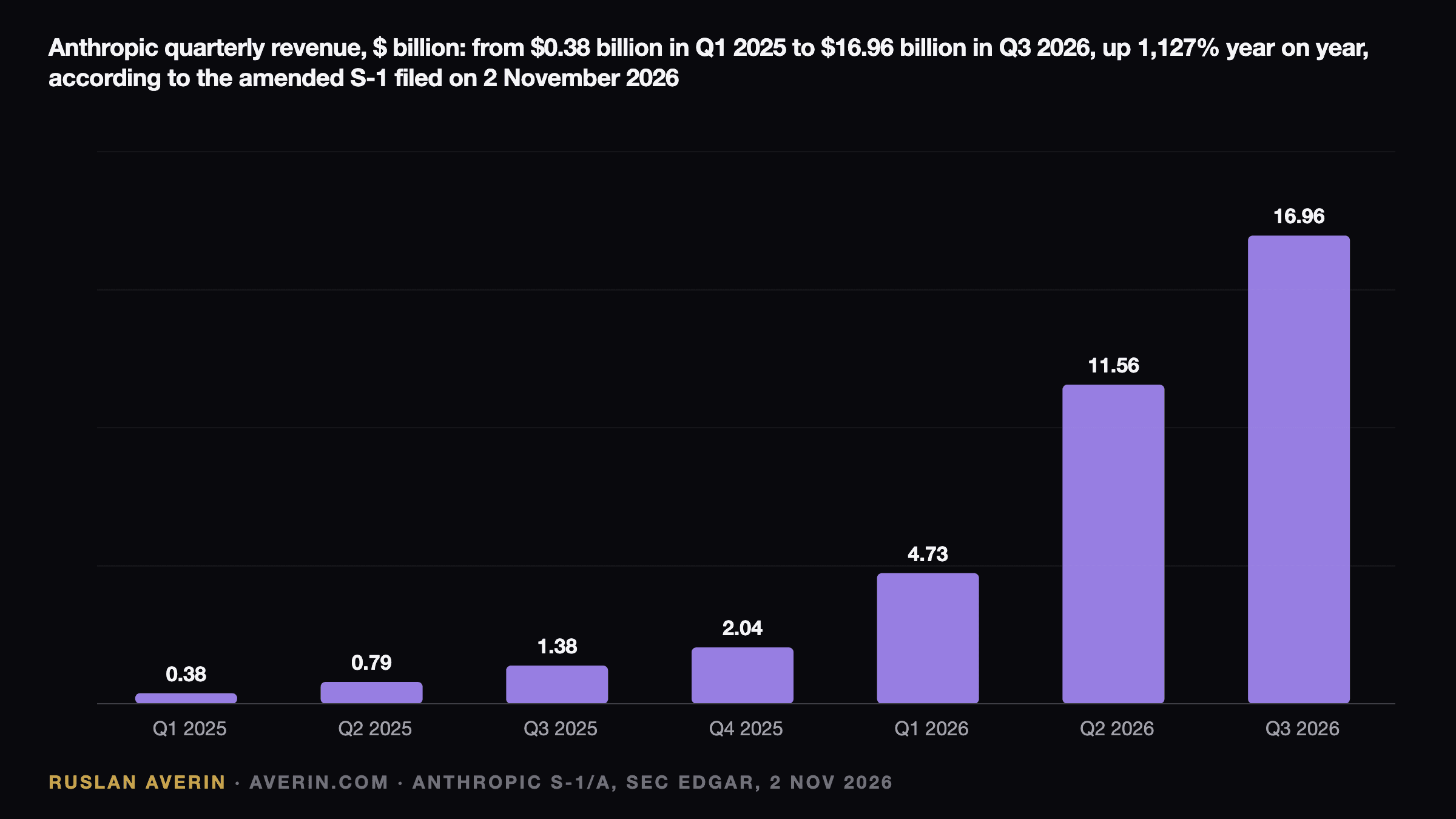
Revenue for the nine months to 30 September was $33.24 billion, against $2.55 billion a year earlier, according to the filing. Sequential growth is slowing: revenue rose 144% in the second quarter and 47% in the third, CNBC calculated.
| Quarter | Revenue | Operating income (loss) | Adjusted operating income | Net loss |
|---|---|---|---|---|
| Q1 2026 | $4.73 billion | −$1.67 billion | −$0.62 billion | $14.44 billion |
| Q2 2026 | $11.56 billion | $0.97 billion | $2.24 billion | $66.31 billion |
| Q3 2026 | $16.96 billion | −$0.57 billion | $2.46 billion | $23.29 billion |
Source: Anthropic S-1/A, quarterly results of operations (unaudited).
Of the $104.0 billion nine-month net loss, $94.3 billion is the change in fair value of convertible notes, derivatives and SAFEs, which the filing ties to the rise in the company's own valuation. On a GAAP basis Anthropic slipped back to a loss of $567 million in the third quarter; adjusted operating margin, which excludes stock compensation and non-cash charitable contributions, fell to 15% from 19%. The reason is compute: compute and infrastructure expenses were $9.86 billion in the quarter, 58% of revenue against 48% in the second quarter.
Anthropic had $95.6 billion of cash and $36.3 billion of short-term investments at 30 September, having raised $141.1 billion in total, according to the S-1/A.
What changed since our October piece
When I wrote about the reported $2 trillion IPO target on 21 October, the prospectus was not public. Here is the honest scorecard:
- Valuation: the $2 trillion figure CNBC reported on 13 October is gone. Investors now see $1 trillion to $1.5 trillion, and one told CNBC that $1 trillion to $1.25 trillion is more likely; $1.5 trillion was called a "stretch". That still sits above the $965 billion Series H of May.
- Third-quarter revenue: CNBC's pre-filing $16.8 billion became $16.96 billion in the filing, so quarter-on-quarter growth was 46.7%, not 44.8%.
- Profitability: the adjusted profit was confirmed at $2.46 billion, but the GAAP operating line was a loss.
- 2025: revenue of $4.59 billion and a net loss of $41.97 billion, in line with the leaked figures.
- Spending: Reuters' $518 billion infrastructure figure has been replaced by the filed total of $895.4 billion.
- Banks and exchange: now confirmed; the offering size is not.
How AI stocks and the Nasdaq reacted
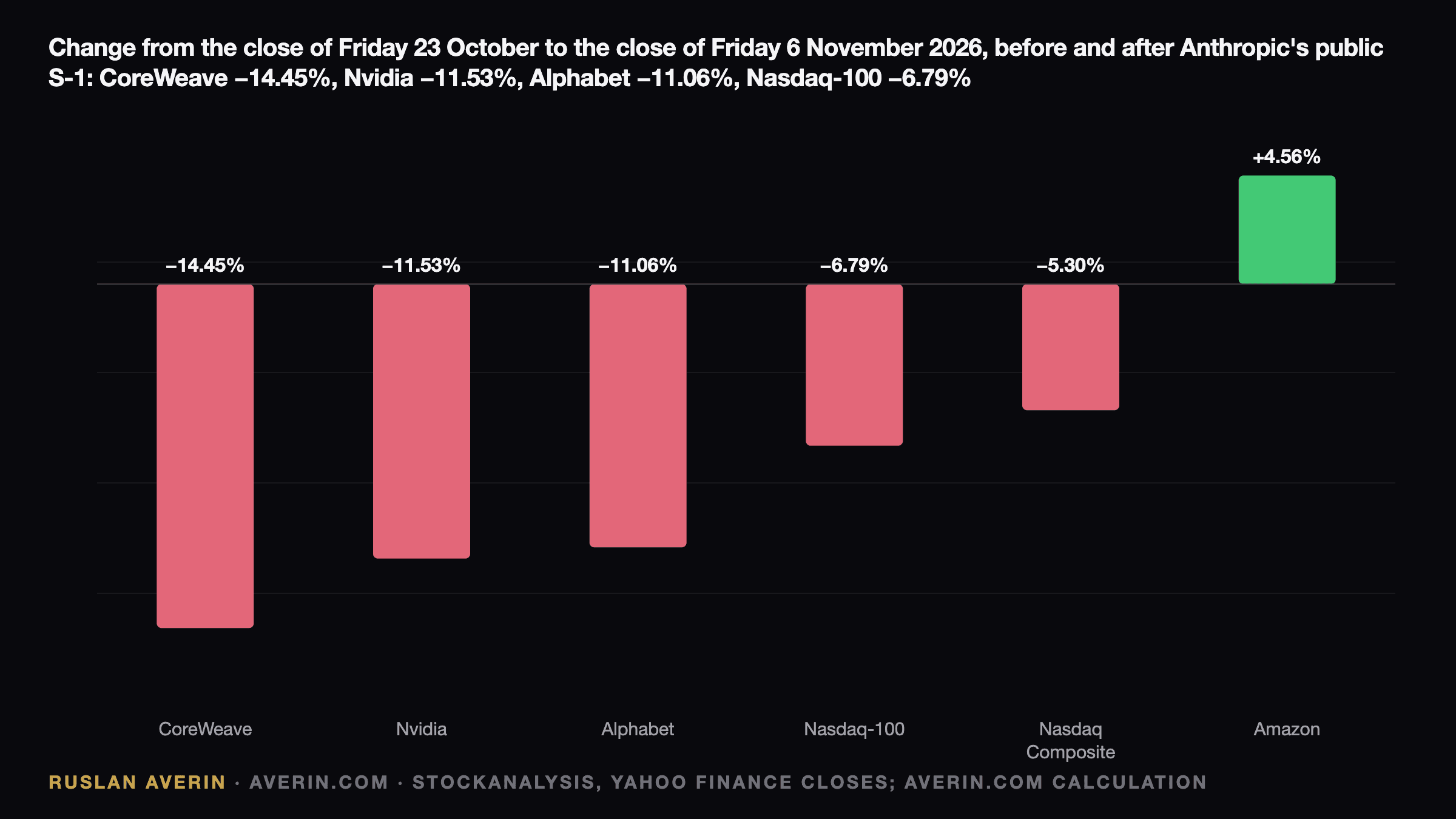
The Nasdaq Composite fell 5.52% on Thursday 5 November to 24,315.00, its steepest drop in 19 months, CNBC reported, after Tuesday's midterm elections. CNBC tied the sell-off to concern that Democrats' new power and a national rebuke of AI will slow the data-centre build-out; voters opposed data-centre ballot measures in 40 of 41 cases. Nvidia lost 9.26% that day and CoreWeave 9.83%.
On Friday the Composite closed at 24,579.43, up 1.09%, and the Nasdaq-100 at 26,989.99. Nvidia closed at $186.64 and CoreWeave at $46.40. Amazon, at $259.30, is the only name in the chart higher since 23 October. Alphabet, at $284.78, is still carrying the 12.64% fall that followed its earnings on 29 October, which I covered in the Big Tech capex stress test.
What it means for the AI capex debate
The filing puts a number on the question behind the October Nasdaq sell-off. Anthropic's commitments of about $895.4 billion are "substantially all" related to compute and infrastructure; about $447.5 billion falls before the end of 2030 and about $69.8 billion is due in the 12 months after 30 September. Annualising third-quarter revenue gives $67.8 billion, so the total commitment is about 13 times current revenue, while the next 12 months of payments are roughly one year of current revenue.
The bull case is that demand still exceeds supply: the filing says Anthropic has "consistently operated in a compute-constrained environment where customer demand exceeds available compute". The bear case is the margin: as delivered compute grew in the third quarter, the operating line went back into the red. This is the same gap between AI capex and AI revenue the market has been pricing at CoreWeave, now disclosed by the buyer rather than the seller.
For listed suppliers the filing is a revenue map. Anthropic committed at least $44.9 billion to Microsoft between November 2026 and June 2033, and up to $120.5 billion to SpaceX's AI unit for Nvidia-powered compute into 2029, about $3.1 billion a month once all capacity arrives, expected in December 2026.
Amazon and Alphabet: the listed proxies
Amazon's convertible notes cannot convert beyond 12% of Anthropic's capitalisation unless Amazon waives the cap, and a further $15 billion of Amazon note financing is available, the S-1/A shows. Alphabet has an option to buy up to $10.0 billion of stock in a private placement at the IPO price, alongside a $20 billion note facility. A listing at $1 trillion to $1.5 trillion would still mark both stakes above the May round, but well below what a $2 trillion debut implied.
At $1 trillion the price would be about 14.7 times annualised third-quarter revenue; at $1.5 trillion about 22.1 times. Gil Luria of D.A. Davidson told CNBC: "The market really needs this IPO to go well and the bankers on the deal surely understand that." I agree, and I would read a price range near the $1 trillion end as the bankers choosing a clean debut over a record valuation.
What to watch next
- Week of 9 November: roadshow launch and an S-1/A with the price range and share count, the first filed document that implies a valuation.
- Mid-November: the expected Nasdaq debut, according to CNBC; no pricing date has been filed.
- Seventh trading day after listing: Nasdaq-100 Fast Entry evaluation, explained in our October piece.
- 27, 48, 62 and 76 days after the IPO: staged lock-up releases, CNBC reported from the prospectus; some employee and early-investor shares can be sold from the first day.
Related: Anthropic's $2 trillion IPO target in October, the AI capex and revenue gap and CoreWeave's $51 billion of debt.