CoreWeave closed on Friday 16 October 2026 at $61.39, down 11.91% on the day and 25.2% on the week. The stock had closed at $82.08 on Friday 9 October. At Friday's price the company is worth about $33.9 billion, according to stockanalysis.com, roughly $11.4 billion less than a week earlier.
The week's trigger was not a profit warning or a lost customer. It was the bond market. Yields on CoreWeave's unsecured notes climbed toward 15%, a level usually associated with distressed credit, and the cost of insuring its debt against default jumped above 1,000 basis points. The number that kept appearing in coverage was "more than $51 billion of debt and obligations". It is worth taking apart.
The week in closing prices
- Monday 12 October: $80.26, down 2.22%.
- Tuesday 13 October: $77.81, down 3.05%. Late that day investor Chamath Palihapitiya posted a chart showing the 2032 bond yield had "touched 15%"; Elon Musk replied "yikes", CNBC reported.
- Wednesday 14 October: $65.78, down 15.46%, on the day the US September CPI came in at 3.7%.
- Thursday 15 October: $69.69, up 5.94%, after trading lower in the morning.
- Friday 16 October: $61.39, down 11.91%.
Friday's fall was not company-specific. The Nasdaq Composite lost 2.1% to 26,140.03 and 4.5% over the week, based on Yahoo Finance closes, and fellow neocloud Nebius fell 12.2% on the day and 25.2% on the week, almost exactly matching CoreWeave.
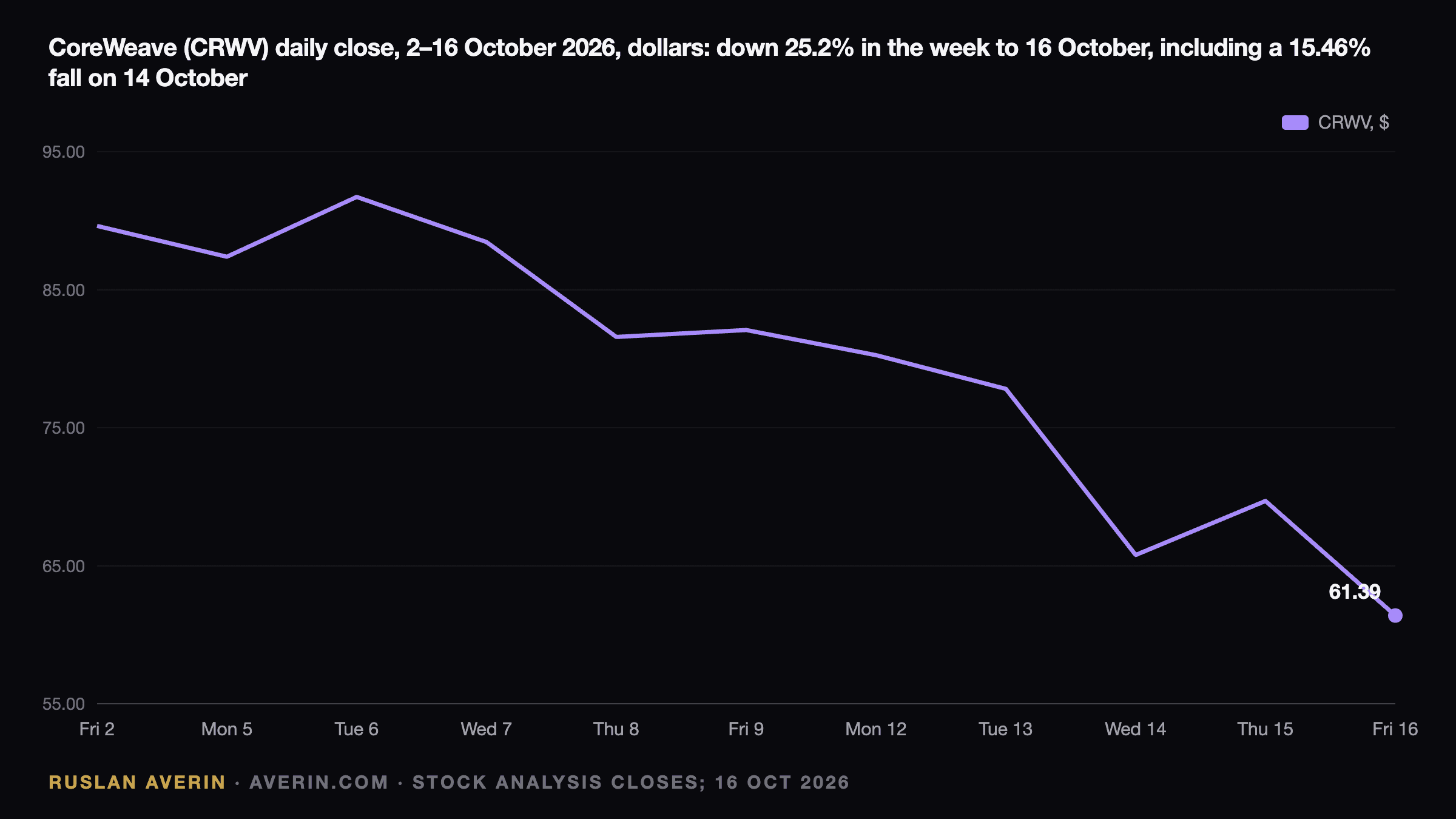
The longer view is harsher. Friday's close is 55.5% below the 2026 high close of $137.98 on 6 May and 66.6% below the record close of $183.58 on 20 June 2025. It is also 14.3% below the $71.61 close at the end of 2025.
What the $51 billion actually is
Stockanalysis.com puts CoreWeave's total debt at $51.61 billion. That figure matches the balance sheet in the 10-Q for the quarter to 30 June 2026, but only if leases are counted:
- Borrowings: $35.07 billion on the balance sheet ($35.55 billion of principal). Of that, $31.41 billion is recourse debt of CoreWeave itself and $3.66 billion is non-recourse debt of project subsidiaries.
- Operating lease liabilities: $16.32 billion, mostly long-term data centre leases.
- Finance leases: $0.22 billion.
So about $35.6 billion is money borrowed and $16.3 billion is rent owed on buildings. Both are fixed obligations, but they behave differently: a lease is not refinanced in the bond market.
The total has grown since June. On 22 September CoreWeave sold $4.2 billion of 2.875% convertible notes due April 2033, with a conversion price of about $97.85, which is 59% above Friday's close. In August it drew $1.2 billion of a new $2.6 billion term loan priced at SOFR plus 5.5% and $1.2 billion on its revolving credit facility. That is at least $6.6 billion of new borrowing after the quarter, before any further term-loan draws. In September it also set up an at-the-market programme to sell up to 35 million new shares.
What is due and when
The 10-Q gives the principal repayment schedule as of 30 June:
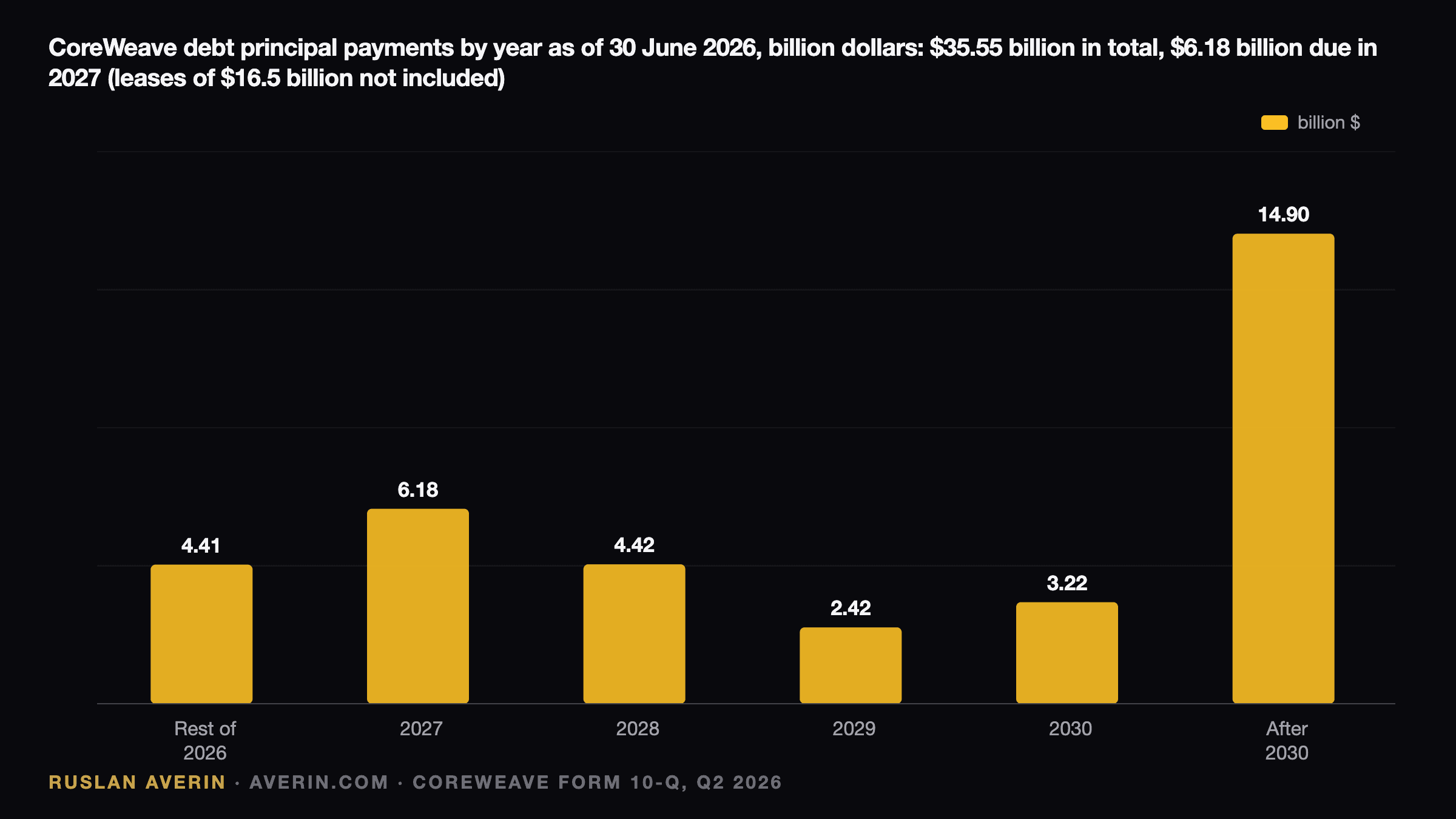
The $4.4 billion for the rest of 2026 compares with $5.52 billion of cash at the end of June. Much of the near-term amount is amortisation of delayed-draw term loans (DDTLs), which the filing describes as secured on specific customer contracts and repaid "as contracted cash flows are generated". The heavier wall is 2027 at $6.2 billion, and the unsecured notes, which are the ones trading near 15%, mostly mature from 2030 to 2032.
The interest bill
Second-quarter revenue more than doubled to $2.575 billion. Operating loss was $49 million. Net interest expense was $640 million, up from $267 million a year earlier, and the net loss was $626 million.
Contractual interest alone was $592 million in the quarter, about 23% of revenue. Adjusted EBITDA was $1.51 billion, a 59% margin, which covers net interest about 2.4 times. That is thin for a company still spending heavily: net cash used in investing was $14.9 billion in the first half, against $3.7 billion of operating cash flow.
The price of money is the core of the problem. The effective interest rate is about 10% on the senior notes, 11% on equipment financing and 15% on the oldest DDTL. On Wednesday CNBC quoted the 9.625% notes due 2032 at a 14.8% yield and the 9.75% notes due 2031 at around 14.9%; by Thursday the 2031 bond yielded 15.78%. The five-year credit default swap spread touched 1,140 basis points before settling near 1,038, up 16% on the week. S&P rates CoreWeave B+.
The backlog argument
Chief executive Mike Intrator answered in a memo obtained by CNBC: "We are confident in our backlog which more than supports all of our debt obligations." He said the market "misunderstands and acts irrationally".
The backlog is real money on paper. Revenue backlog was about $104 billion at 30 June, and CoreWeave added more than $25 billion of new commitments in early third quarter. Of the $103.7 billion of remaining performance obligations, 41% is expected to be recognised within 24 months and 39% in months 25 to 48. Deutsche Bank, which kept its buy rating, estimates that about two-thirds of the backlog sits with investment-grade counterparties including Microsoft, Meta, IBM and Caterpillar.
The concentration is the other side of that coin. In the second quarter the top three customers produced 36%, 26% and 10% of revenue. Meta committed up to $21.0 billion in March 2026, Jane Street about $6.0 billion in April, and an OpenAI order from September 2025 is worth up to $6.5 billion. Nvidia, whose chips make up all of CoreWeave's GPU fleet, bought $2.0 billion of shares at $87.20 in January; Friday's close is 29.6% below that price.
What the selloff is really about
Gavan Nolan of S&P Global Market Intelligence put it plainly: nobody questions that the demand is real; the question is "whether the cash flows will ultimately arrive". Evercore ISI's desk said the market was "basically saying 'no mas' to AI debt without operating cash flow support."
In analyst Ruslan Averin's view, this is a cost-of-capital story, not a demand story. CoreWeave earns a 5% adjusted operating margin and borrows at around 10%. When new unsecured money costs 15%, every new data centre funded that way has to earn more just to stand still. A hot CPI print and a 10-year Treasury yield above 5% make that gap wider, which is why the same week hit Oracle, Nebius and Korea's memory makers. Our KOSPI crash breakdown shows how far the read-through travelled.
What would break or save the thesis
I would watch five things:
- Third-quarter results in November. Freedom Capital Markets' Paul Meeks expects flat margins for June to September and guidance for a significant improvement in the fourth quarter. A miss there would hurt more than any bond print.
- Access to secured money. As long as contract-backed term loans keep pricing at SOFR plus 2.25–5.5%, the 15% unsecured yield is a mark-to-market signal, not the company's real funding cost.
- The 2027 repayments of $6.2 billion. These need to be met from contracted cash flows, not new unsecured issuance.
- Customer health. A delay or renegotiation by any of the three customers that make up 72% of revenue would test the backlog argument directly.
- Rates. The Fed decides on 28 October. Another hike would keep pressure on every leveraged AI builder; our Fed outlook after the hot CPI sets out the odds.
The bear case is simple: if AI spending slows before the backlog turns into cash, the equity sits behind $35.6 billion of borrowings and $16.3 billion of leases. The bull case is that $104 billion of contracts, two-thirds with investment-grade names, eventually pays for all of it. This week the market priced the first case.
Related: Nasdaq's worst week since June, the AI capex and revenue gap and Oracle's 86% capex jump.