
Progressive reports September and third-quarter 2026 results before the open on Wednesday 14 October, the date the company itself gave in its August release. The shares closed on Monday 12 October at $220.28. That is 3.3% below the last close of 2025, $227.72, but the price comparison flatters the decline: on 2 January the stock went ex-dividend for the $13.50 annual dividend plus the regular $0.10. Counting the $13.90 of dividends paid in 2026, holders are roughly 3% ahead for the year.
Progressive is unusual among large insurers because two thirds of the quarter is already public. It publishes results every month. So the question for Wednesday is narrower than at a bank: what September looked like, and what the quarter says about the trade-off between growth and margin.
Update, 15 October 2026: the results
Progressive reported on 14 October as scheduled. Third-quarter GAAP EPS was $4.37 against $4.45 a year earlier, a cent under the $4.38 consensus. That comparison is misleading: the consensus excludes realised investment results, and the quarter carried $170 million of pretax net realised losses, $231 million of them in September. By my arithmetic, at the 21% statutory tax rate, EPS before those losses was about $4.60, roughly 5% above the consensus. Net premiums written were $22.30 billion, up 4%, and the quarterly combined ratio was 88.7 against 89.5.
| Metric | Consensus | Actual |
|---|---|---|
| Q3 EPS | $4.38 (excluding realised gains) | $4.37 GAAP; about $4.60 before realised losses (my estimate) |
| September combined ratio | about 92 (preview bar) | 90.0 |
| September premium growth | 5% in July (preview bar) | 2% |
| Commercial Lines combined ratio, September | 97.5 in August | 90.8 |
| Isaias loss estimate | expected comment | none |
The margin answer was good. September ran at 90.0, against 100.4 a year earlier when the $950 million Florida credit hit, and Commercial Lines fell back to 90.8. The growth answer was not. Net premiums written rose only 2% in September, personal auto just 1% in both channels, and direct auto policies fell to 16.85 million from 16.88 million at the end of August. Book value per share slipped to $59.51 as net unrealised losses on fixed maturities widened by $1.66 billion in the month.
There is no management quote: the release said "The company has no additional commentary regarding September's results," and gave no estimate for Isaias. The quarterly call is on 3 November.
The shares closed on 14 October at $213.46, down 4.2% from $222.88 on 13 October, after opening at $206.97.
What it changes. I had the margin as the main risk; the market sold growth instead. I read the drop as the price of rate cuts that no longer buy volume. If October premiums are also close to flat, about 3.6 times book value becomes hard to defend.
What the consensus expects
Yahoo Finance shows a consensus of $4.38 a share from 19 analysts, with a range of $3.99 to $4.72, and revenue of $22.5 billion. Zacks, quoted on Nasdaq, has $4.35 from 10 analysts and counts eight upward revisions in the past four weeks against one cut. Both figures exclude realised investment gains: Zacks puts the year-ago quarter at $4.05, while Progressive's reported GAAP figure for the third quarter of 2025 was $4.45.
The year-ago base is soft. In September 2025 Progressive booked a $950 million policyholder credit expense, because its Florida personal auto profit for 2023–2025 was expected to exceed the state's statutory limit. September 2025 ended with a combined ratio of 100.4 and the quarter at 89.5. Any growth in reported EPS this year starts from a quarter that carried that charge.
July and August: growth intact, margin thinner
July and August are already known. Net premiums written were $7.44 billion in July and $7.61 billion in August, up 5% and 6% year on year. The combined ratio was 86.8 in July against 85.3 a year earlier, and 89.3 in August against 83.1. GAAP EPS was $1.65 and $1.63, against $1.85 and $2.07 in 2025.
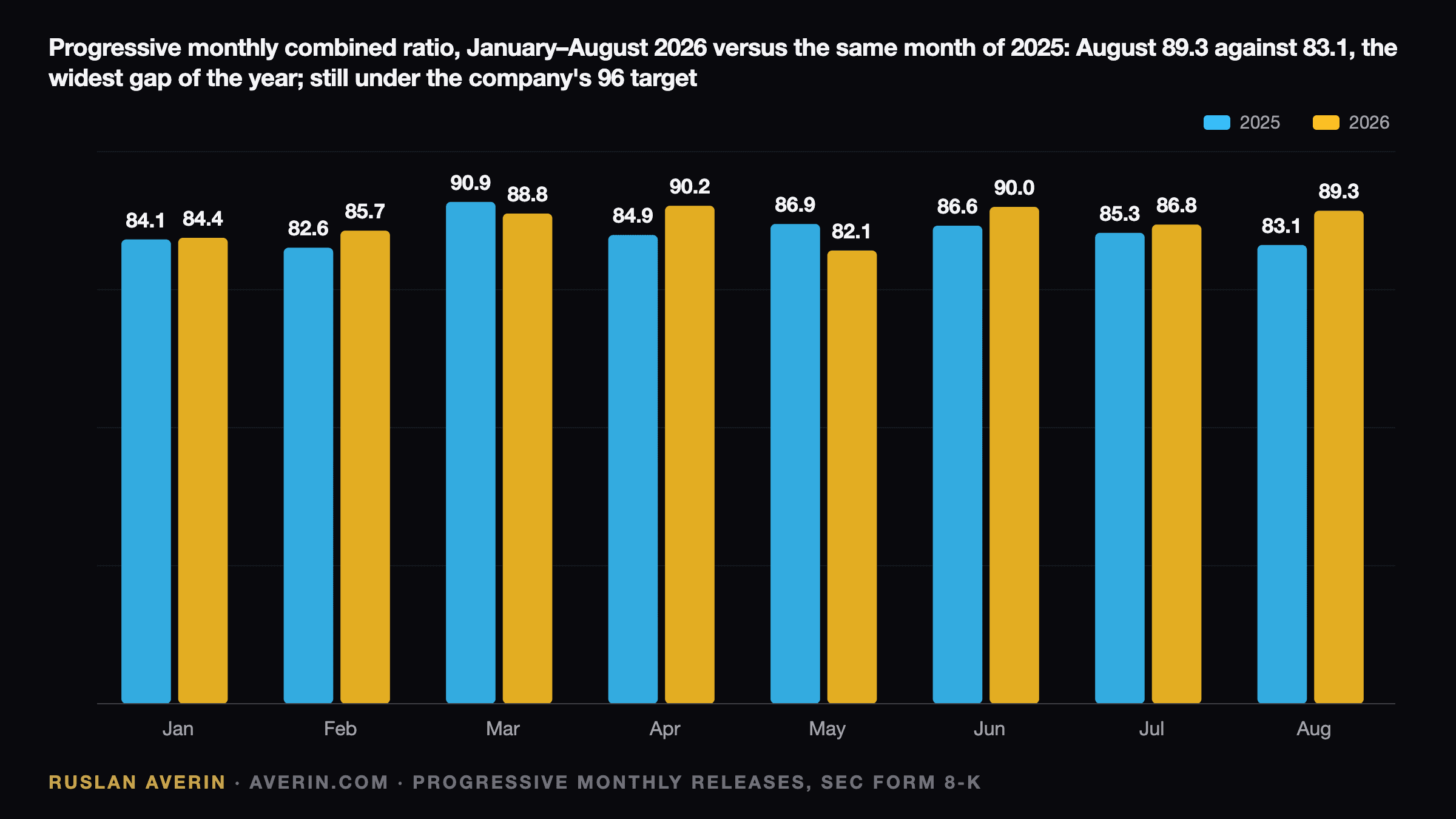
The August gap of 6.2 points is the widest of the year, and catastrophes do not explain it. The net catastrophe loss ratio was 1.9 points in August and 2.1 in July. The pressure sits in two places. Commercial Lines ran at a 97.5 combined ratio in August, above the company's long-standing goal of 96. Direct personal auto ran at 90.5, against 85.9 in the agency channel.
By my arithmetic, stripping out realised gains, July and August together earned about $3.20 a share. To reach the $4.38 consensus, September has to add roughly $1.18. On August's cost structure that is consistent with a September combined ratio of about 92. In other words, the street has left some room for a weaker month, but not for a bad one.
Rate cuts, advertising and the growth question
Policies in force reached 40.5 million at the end of August, up 7%. Direct auto grew 9% to 16.88 million policies and agency auto 7% to 11.34 million. A year earlier, in September 2025, those growth rates were 17% and 13%. Growth is still strong, but it is half the pace of last year.
Progressive is paying for that growth in two ways. First, price: in the second quarter it cut personal auto rates by less than 1% countrywide, and average written premium per personal auto policy fell 2% year on year, according to its 10-Q. Second, marketing: advertising spend was $1.4 billion in the second quarter, up 16%, and $2.9 billion in the first half, up 18%. The company says it will keep advertising as long as it stays on track for its calendar-year profitability goal and can acquire customers at or below target cost.
Meanwhile claim costs are rising. Total personal auto severity rose 4% in the second quarter, with bodily injury up 7%, which the company put down to higher medical costs, more large losses and more attorney-represented claims. Frequency fell 2%. Lower prices combined with rising severity is exactly the mix that pushed the combined ratio from 83.1 to 89.3. I would read the September commentary for any sign that the rate cuts are being paused.
Catastrophes: a quiet quarter, and Isaias after it
The third quarter was light on hurricanes. Every Atlantic storm before Isaias was a tropical storm, according to the National Hurricane Center archive. Two reached the US coast in the quarter, both in Louisiana: Bertha on 22 July and Edouard on 1 September. August's release cited catastrophe losses from severe weather across the US, not a single large event.
Isaias is a fourth-quarter event. NHC advisories ran from 6 to 11 October, and the storm came ashore near Destin on the Florida Panhandle on the night of 9–10 October with winds of about 105 mph. It will not show up in third-quarter numbers, but any early estimate in the September release will move the stock. Progressive's property reinsurance program, renewed on 1 June, has a $75 million retention for the first event in Florida and $300 million for the first event elsewhere. Personal auto, however, is not reinsured outside regulated programs, so flooded and damaged cars stay on Progressive's own books.
Capital, buybacks and the annual dividend
Book value per share was $60.92 at the end of August, and trailing 12-month return on equity was 33.4%. At Monday's close the stock trades at about 3.6 times book. Rising yields have cost the bond portfolio: net unrealised losses on fixed maturities were $1.80 billion, $1.95 billion worse than in December. Investment income still grew, reaching $346 million in August at a 4.3% book yield.
Progressive is also buying back stock steadily, which it barely did in 2025. It bought 650,241 shares in July at an average $209.46 and 630,912 in August at $210.93, after about $1.05 billion of open-market purchases in the first half, against $12 million a year earlier.
The board sets the annual variable dividend in December based on the capital position. For 2025 it was $13.50 a share, up from $4.50 a year earlier. Strong quarters feed that number, so the third quarter matters to income investors as much as to the multiple.
How the stock got here, and the scenarios
The stock's closing high for 2026 was $234.48 on 13 July. Two days later the June release came out, showing a 90.0 combined ratio and premium growth of 3% for the month, and the shares fell 9.4% to $205.22. The low close of the year was $190.40 on 29 May. Since 30 September, when the stock closed at $207.31, it has risen 6.3%, including a 1.3% gain on Monday, the first session after Isaias made landfall.
In analyst Ruslan Averin's view, four numbers decide the reaction:
- The September combined ratio against about 92. At 90 or below, the consensus looks conservative and the August spike reads as a one-off.
- Net premiums written growth. Anything near or below July's 5% would say the rate cuts and advertising are buying less growth.
- Commercial Lines. A second month near 97.5 would turn a segment issue into a pricing problem.
- Any comment on Isaias. A loss estimate near the Florida retention is manageable; large auto losses are the open risk.
If September looks like July, I would expect a modest move, because the stock has already recovered 6% into the print. The asymmetric case is a combined ratio above 92 together with slowing premium growth. That would raise the question the market sold off on in July: whether Progressive is cutting prices into rising severity.
Related: the JPMorgan Q3 2026 preview, the Bank of America Q3 2026 preview and the earnings season playbook.