
On Thursday 8 October the Bank of England named the four animals that will appear on its next series of banknotes: the European hedgehog, the buff-tailed bumblebee, the barn owl and the Atlantic puffin. They will replace the historical figures on today's notes, Winston Churchill on the £5, Jane Austen on the £10, J.M.W. Turner on the £20 and Alan Turing on the £50.
The headline travelled fast, including in Ukraine, where searches for "banknote" jumped. Most of the coverage stopped at the hedgehog. For anyone who holds pounds in cash, the useful questions are different: when the new notes arrive, whether the current ones stop working, and what to do with the old notes they already have.
What exactly was announced
Each of the four animals will go on one denomination. The Bank has not said which animal goes on which note; that will be announced closer to launch. The notes may also carry other natural imagery, including some of the shortlisted animals that did not make the final four.
The front of the notes does not change in principle. The Bank says the next series "will continue to include a portrait of the monarch", which today means King Charles III.
The timing is vague by design. The Bank says the first denomination will be launched "over the next few years", because designing, testing and printing a banknote takes several years. No date and no first denomination have been named. None of the announcements put a price on the redesign either.
How the animals were chosen
The process ran in three steps. In July 2025 the Bank started work on a new series, with counterfeit resilience as the stated goal, and asked the public to pick a theme. That consultation drew more than 44,000 responses. In March 2026 the Bank announced nature as the theme, nominated by 60% of respondents.
A panel of UK wildlife experts then drew up a shortlist of 18 animals in three groups: mammals; birds; and amphibians, insects and fish. The public vote ran from 3 June to 3 July 2026 and received 478,531 responses, the most the Bank has ever had for a banknote imagery consultation, with 2,549,003 individual selections.
The results by votes:
- Buff-tailed bumblebee: 360,399, the most of any animal
- Barn owl: 270,596
- European hedgehog: 259,665
- Red fox: 244,651
- Common kingfisher: 211,277
- Atlantic puffin: 183,137
The puffin had fewer votes than the fox and the kingfisher. The Bank chose it as the most popular marine animal, saying it adds variety, makes the denominations easier to tell apart and represents the coastline. The vote was advisory, not binding.
Why Churchill goes, and who objected
The decision to drop historical figures drew criticism long before the animals were named. In June, Reform UK leader Nigel Farage said that "replacing Winston Churchill with a picture of a beaver on our banknotes... is the definition of woke". Robert Jenrick, Reform's Treasury spokesman, accused the Bank of wasting resources, and Conservative MP Tom Tugendhat said the Bank was going for "bland neutrality".
The Bank's answer has two parts. The theme came from the public consultation, not from separate focus-group research. And it needs to stay ahead of counterfeiters, who have become better at reproducing faces. Chief Cashier Victoria Cleland said the near half-million responses showed that "cash still matters". She hands over to Rhys Phillips on 19 October.
How much cash Britain still uses
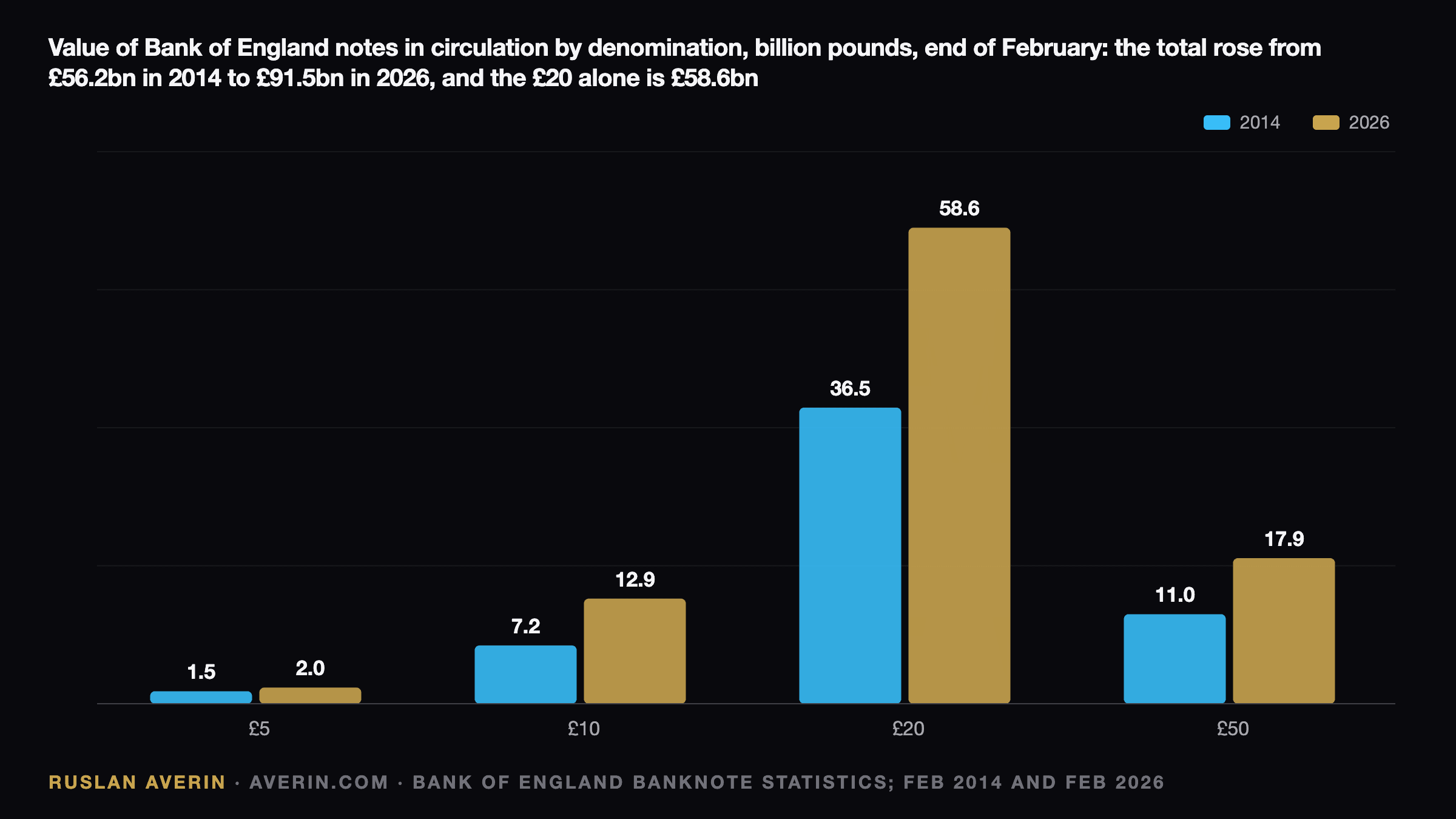
Two sets of numbers pull in opposite directions. Britons pay with cash far less often. According to UK Finance, cash accounted for 3.9 billion payments in 2025, or 8% of all payments, down from 9% in 2024 and 45% in 2015. Some 19 million people, about a third of adults, use cash once a month or less.
Yet the stock of notes keeps growing. At the end of February 2026 there were 4,984 million Bank of England notes in circulation, worth £91.5 billion, up from 3,071 million notes worth £56.2 billion in 2014. The £20 dominates: £58.6 billion, or about 64% of the value. Cash is used less for shopping and held more as a reserve, at home and abroad. The Bank still counts about one person in seven who prefers to pay with cash.
Are current notes still valid
Yes. Nothing in the announcement withdraws any note. Churchill, Austen, Turner and Turing polymer notes remain legal tender, and so do notes with Queen Elizabeth II. The King Charles III notes, issued from 5 June 2024, circulate alongside the Queen's notes, and the Bank prints them only to replace worn notes and meet extra demand.
When the animal series arrives, the old polymer notes will co-circulate for a while. History says the end comes eventually. Recent dates when Bank of England notes ceased to be legal tender:
- Paper £5 (Elizabeth Fry): 5 May 2017
- Paper £10 (Charles Darwin): 1 March 2018
- Paper £20 (Adam Smith) and paper £50 (Boulton and Watt): 30 September 2022
The rule that matters for savers: "There is no deadline to exchange old banknotes with the Bank of England." A note that has stopped being legal tender keeps its face value; it just has to go through the Bank, a UK bank or the Post Office.
What holders of pounds abroad should do
For Ukrainians and others who keep pounds in cash outside the UK, the practical steps are simple.
First, check what you hold. Paper notes are the problem; polymer notes, including all Churchill, Austen, Turner and Turing notes, are fine for now. Exchange offices outside the UK often refuse withdrawn notes or pay well below face value.
Second, use the Bank's postal service for withdrawn notes. Send them to Dept NEX, Bank of England, Langston Road, Loughton, Essex IG10 3TN with the exchange form, copies of photo ID and proof of a permanent address, which may be outside the UK. Above £700, supporting documents on the source of the money are mandatory: bank statements, a will or probate, a signed gift letter. The Bank pays by sterling cheque or by SWIFT transfer to an account abroad that accepts sterling. It charges no fee for SWIFT, but intermediary banks may. Expect delays of up to 90 working days, and send the parcel tracked and insured, because it travels at your risk.
Third, if you are in London, the counter at Threadneedle Street is open Monday to Friday, 9:30am to 3pm, and can pay into a UK or overseas account. Original ID and proof of address are required, and the Bank runs anti-money-laundering and sanctions checks. Anyone carrying £10,000 or more into Great Britain must declare it to customs, and the Bank asks for that form.
For £300 or less with photo ID, the Post Office is the quickest route; 51 branches swap old notes for people without a UK bank account.
Will Churchill and Turner notes become collectible
Not the ones in your wallet. Collectors pay for low serial numbers and special series, not for ordinary circulated notes. When the Churchill £5 was launched, the Bank's charity auction with Spink on 3 October 2016 sold note AA01 000017 for £4,150 against an estimate of £800–£1,200; 601 notes raised £203,820. In 2024 the auction of the first King Charles notes raised £914,127, 11.7 times their £78,430 face value: a £10 numbered HB01 00002 fetched £17,000, and £5 notes with serials ending 88 and 888 fetched £2,200 and £2,400.
About 399 million £5 notes and 2,932 million £20 notes are in circulation. Being the last series with those portraits will not make a standard note rare. In analyst Ruslan Averin's view, the pound in cash is a reserve, not an investment: the real risk for holders abroad is not the hedgehog but keeping withdrawn paper notes that local exchangers will not take at face value.
Related: where to hold hryvnia savings, the dollar at 45 hryvnias and savings and the ECB's digital euro for banks.