On Monday 21 September the European Central Bank switched on Pontes, a bridge that lets banks settle trades in tokenized securities with central-bank money instead of stablecoins or commercial-bank deposits. Christine Lagarde described it in one sentence: "Pontes is, to summarize it quickly for you, it's a digital euro made available for banks so that they can transact amongst themselves using tokenized assets and distributed ledger technology."
The launch got a line in most news feeds and a headline in the Russian-language ones. It deserves more than that, because it is the first time a major central bank has put its own money on the rails that dollar stablecoins have had to themselves. Here is what Pontes does, who is on it, and what it changes for investors who will never touch it directly.
What Pontes is
In the ECB's own definition, Pontes is "the Eurosystem's distributed ledger technology solution that links market DLT platforms and TARGET Services to settle DLT-based wholesale transactions in central bank money". In plain terms: a bond or share lives on a blockchain run by a private operator, the cash leg settles in the reserves banks already hold at the central bank, and the two legs are tied together so that either both settle or neither does.
Piero Cipollone, the Executive Board member in charge, put the mechanism this way in August: "Transactions could be executed conditionally and atomically, meaning that the cash and asset legs are either settled together or not at all." That all-or-nothing settlement, delivery versus payment, is the whole point. Today it requires a central securities depository in the middle. With Pontes, the ledger itself can do it, and the money on the other side is as safe as money gets.
Settlement is dual: participants can use cash tokens on the Eurosystem's own DLT platform or settle through T2, the existing real-time gross settlement system, and finality comes when the T2 leg completes. It is wholesale only. Access requires a T2 account, and the platforms that can connect are central securities depositories, operators under the EU's DLT pilot regime, payment systems, authorised clearing houses and supervised financial institutions. There is no retail product here.
Who is on it
At launch 13 financial institutions joined, according to CoinDesk, and four DLT operators were connected: Axiology, which runs on Ripple's XRP Ledger, Cashlink, Clearstream, the Deutsche Börse settlement arm, and SWIAT, the bank-owned platform started by DekaBank. Deutsche Bank and Santander have been reported as live participants. The ECB itself has not published a full list.
The pricing is designed to pull people in. "To support its early adoption, we will offer attractive pricing conditions, charging only one-off onboarding fees for the initial launch," Cipollone said on 26 August. Full capability, including longer operating hours, is not due until 2028. The ECB is also preparing to invest a small share of its own funds in tokenized securities settled through Pontes, starting with euro-denominated public-sector and supranational bonds, which gives issuers a buyer from day one.
Pontes did not come from nowhere. Between May and November 2024 the Eurosystem ran exploratory work with 64 participants across nine jurisdictions, completing 58 use cases and settling almost €1.6 billion in central-bank money. The longer-term programme is Appia, whose roadmap was published in March 2026 and which is due to deliver a blueprint for a tokenised European financial market in 2028. In Cipollone's words: "With Appia, we are building a road from today's financial system to tomorrow's tokenised markets, firmly grounded in central bank money."
Why now: the dollar got there first
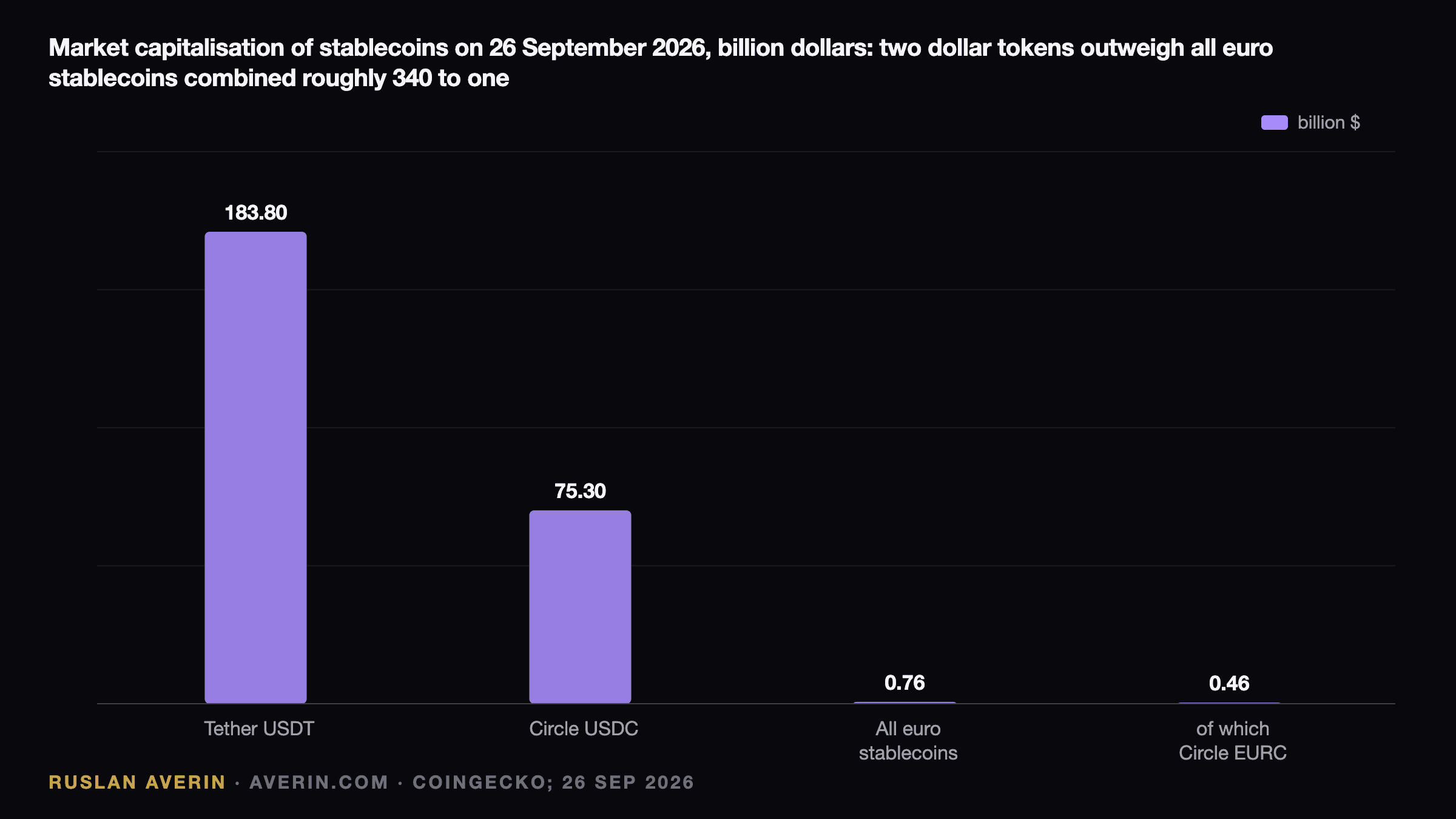
The chart above is the reason. On 26 September Tether's USDT had a market capitalisation of about $183.8 billion and Circle's USDC about $75.3 billion. All euro-denominated stablecoins together were worth about $762 million, of which Circle's EURC was about $459 million. Dollar stablecoins outweigh euro ones roughly 340 to one.
That matters because tokenized markets settle in whatever cash is on-chain, and today that cash is dollars. The US passed the GENIUS Act for dollar stablecoins in 2025; tokenized US Treasury funds hold about $14.9 billion, according to rwa.xyz, against roughly $748 million in the largest tokenized euro government-debt product. The ECB counts tokenized traditional assets on public blockchains growing from €4.7 billion to €23.3 billion between March 2025 and March 2026, and European issuers have placed close to €4 billion of DLT-based bonds since 2021.
If European tokenized bonds and funds settled in dollar stablecoins, part of the euro area's financial plumbing would run on private dollar liabilities. Appia's stated goals include "strategic autonomy" and keeping "the euro's international relevance". Pontes is the first piece of hardware behind those words.
The US is moving on its own track. DTCC ran its first production trades in tokenized equities, ETFs and Treasuries in July with JPMorgan, BlackRock and Goldman Sachs, and the SEC approved a Nasdaq pilot for tokenized share trading in March. The difference is the settlement asset: in the US it is private tokens, in the euro area it is now the central bank's own money.
What it means for investors
Directly, nothing for now. Pontes is a wholesale rail, and no retail investor will open an account on it. Indirectly, four things follow.
First, the operators. Clearstream is one of four connected platforms, which puts Deutsche Börse at the centre of euro tokenization rather than on the outside of it. Euroclear, Euronext and SIX are not among the first four, and how quickly they connect is worth watching. No listed exchange's shares moved on the launch in a way reported by the press, so the market has not priced any of this yet.
Second, the stablecoin issuers. A euro-area bank settling a tokenized bond now has a risk-free alternative to USDC or EURC for the cash leg. That does not hurt Tether or Circle in their core dollar markets, but it caps how far euro stablecoins can grow inside the regulated banking system, and it complicates the case for bank-issued euro stablecoins.
Third, the crypto networks. Axiology's presence makes the XRP Ledger the first public-chain technology connected to euro central-bank settlement. That is a technical foothold, not a demand story for the XRP token: the settlement asset on Pontes is central-bank money, not a crypto token.
Fourth, the digital euro. Pontes is separate from the retail digital euro, which is still in legislative negotiation between the Parliament and the Council since July; the ECB is preparing a pilot in 2027 and targets first issuance in 2029 if the law is adopted. For now, as Lagarde put it, banks have a digital euro and the public does not.
In analyst Ruslan Averin's view the ECB has done the one thing a central bank can do in a market it does not want to cede: make its own money available where the trading happens, at a price designed to win the first users. The deposit rate is 2.50% after the ECB's increase on 10 September, and the next meeting is on 28–29 October. Whether Pontes succeeds will be measured not in rates but in volumes, and the ECB has not yet published any.
Related: the three central-bank hikes in 72 hours, what the Clarity Act means for Coinbase and the 10-year Treasury at 5%.