The number that put the dollar at the top of Ukrainian Google searches on Thursday was 45,000. RBC-Ukraine's morning rates roundup carried the headline "1,000 dollars already for 45,000 hryvnias", and the figure is real: PUMB's cash selling rate was exactly 45.00 that morning. It is also one bank. The average across banks was 44.42 to buy and 44.92 to sell, exchange offices quoted 44.70–44.85, PrivatBank sold at 44.84, monobank at 44.83, and the NBU set the official rate for Friday at 44.66, up six kopecks. A thousand dollars at the average bank rate cost 44,430 hryvnias. The hryvnia is weaker than it has been all summer, but it is not at a record: the official low was 44.98 on 11 June, and cash rates first crossed 45 that month.
What is different from June is what stands behind the number. Analysts tracking the market note that the demand for dollars is now structural, the supply from abroad has thinned, and the central bank is paying for the gap out of reserves at a pace it cannot sustain indefinitely. This piece is about the mechanics, the forecasts and what an ordinary saver can do about it.
Where the rate is and how it got there
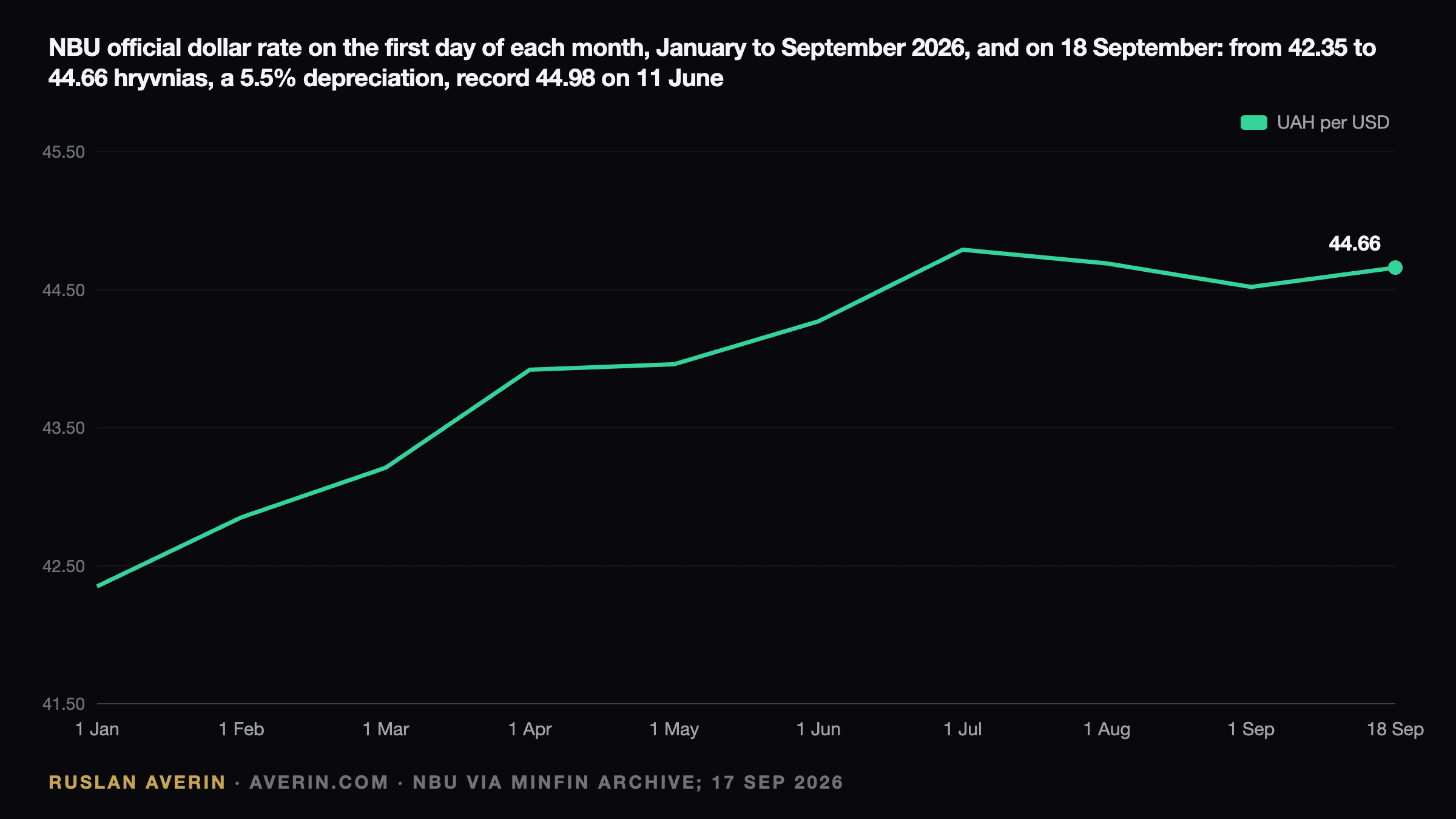
The dollar started 2026 at 42.35 hryvnias. It was 43.21 on 1 March, 43.96 on 1 May, 44.27 on 1 June, 44.79 on 1 July, 44.69 on 1 August and 44.52 on 1 September. Friday's 44.66 is a 5.5% rise for the dollar since January and 8.3% over twelve months, from 41.18 on 17 September 2025. The euro has done less: 49.79 in January to 51.23 now, up 3.3%, with a high of 52.25 on 24 August. The zloty is at 11.83.
September itself has been a saw-tooth rather than a slide. The official rate dipped to 44.46 on 2 September, rose to 44.73 on 5 September, fell back to 44.47 on 8 September and has climbed since: 44.55, 44.62, 44.64, 44.60, 44.66. The interbank closed Thursday at 44.68–44.71. Globus Bank's Taras Lesovyi called the mood "cognitive dissonance: prices are rising, yet exchange rates remain relatively stable", and that stability is the National Bank's doing.
What the NBU is selling and why
The central bank has sold more than $1 billion net every week for eight weeks. The series from index.minfin: $1.01 billion in the week of 20–24 July, $1.14 billion, $1.02 billion, $1.10 billion, $1.19 billion, $1.27 billion, a record for the run of $1.33 billion in the week of 31 August–4 September, and $1.19 billion in the week to 11 September. August as a whole cost $4.8 billion, the third month above $4.7 billion after $5.09 billion in June and $4.79 billion in July; the NBU bought back $0.45 million. Since January it has sold $33.9 billion. The nine-week run was already the subject of an earlier piece; the tenth week is now in the books.
| Source of the gap | Figure | Period |
|---|---|---|
| Goods trade deficit | $39.7 billion (imports $66.3B, +26%; exports $26.6B, +1.1%) | January–August 2026 |
| Net FX purchases by households | $562 million (July $446.6 million), 12th month of net buying | August 2026 |
| NBU net FX sales | $4.8 billion; $33.9 billion since January | August 2026 |
| International aid received | $2.11 billion (July $5.71 billion; Q2 $18.0 billion) | August 2026 |
| Inflows to government FX accounts | $927 million, of which World Bank $894 million | August 2026 |
| International reserves | $48.66 billion, −5.0% in August, −15% since January | 1 September 2026 |
| Interbank imbalance | client purchases $385.6M a day vs sales $221.7M a day | week to 11 September |
The August reserves release explains itself: "This dynamic is due to a reduction in international financial assistance while FX interventions stayed close to July's level." Aid to the government's accounts was $927 million in the month; interventions were $4.85 billion; debt service took $722 million. Reserves fell from $51.2 billion to $48.66 billion, about four months of imports, and are down $8.6 billion since January. On Thursday the NBU acknowledged "risks to public finances from lower-than-expected international financing in July–August" and said it expects "a significant part of the external financing to be caught up" if the promised tranches arrive. The EU's second macro-financial instalment of about €3.7 billion is "expected in September"; its receipt had not been confirmed as of Thursday.
The demand side has three parts. Importers are buying ahead of winter: Lesovyi points to "energy resources, fuel and equipment ahead of the autumn-winter period", with diesel up about 22% in a month at the pump and A-95 up 9%, and the September export outlook for grain cut from 43 to 38–40 million tonnes after the port strikes. Households are buying because the NBU let them: the online purchase limit was raised from 50,000 to 200,000 hryvnias a month on 11 August, and non-cash purchases jumped 40% in August to $552 million. And the interbank has a daily deficit of about $164 million between what clients buy and sell, which Serhiy Mamedov of Globus Bank puts at 15–20% of excess demand over supply.
Former NBU Council chair Bohdan Danylyshyn's critique, published on 15 September, is the one the central bank has to answer: "A high key rate has not removed the structural shortage of currency... A high rate can restrain part of the demand, but it does not unblock the ports." He also counts consumer lending growing 36.3% a year, which is imported goods bought on credit.
What the NBU did on Thursday
The rate decision is covered in full separately; the FX-relevant part is that the National Bank raised the key rate from 15.5% to 16%, effective 18 September, and wrote that the move "will support the attractiveness of hryvnia assets and the stability of the FX market". Governor Andriy Pyshnyi warned that "the inflation trajectory in the coming months may be higher than the previous forecast envisaged" and the release added that "in the event of stronger inflationary pressure the regulator may resort to a further increase". The Council confirmed on 3 September that the regime stays "managed flexibility": the NBU "will allow two-way fluctuations", smooths excessive swings and "does not plan to return to a fixed rate".
The government's own numbers are in the draft 2027 budget submitted to parliament this week: an average of 47.1 hryvnias per dollar next year and 48.3 at the end of 2027, against 45.7 assumed for 2026. The Finance Ministry calls it "a calculation parameter, not a forecast or a target for the NBU", which is true and also tells a saver what the Treasury is planning around. How the budget is to be financed is its own story.
The forecasts, in one place
| Forecaster | September | End-2026 | 2027 |
|---|---|---|---|
| Globus Bank, Taras Lesovyi | 44.7–45.4; cash up to 45 | — | — |
| Globus Bank, Serhiy Mamedov (17 Sept) | 44.6–45.4 | 45.5–46.5 | — |
| ICU, Taras Kotovych | 44.5–45.0 | 45.8 | 49.8 |
| Andriy Shevchyshyn | cash 45.20–46.00 (base case) | — | — |
| CES consensus, six houses | — | median 46.0 (range 45.6–46.3) | median 49.0; Dragon 49 / 53 |
| Government, draft budget 2027 | — | average 45.7 | average 47.1; end-year 48.3 |
| IMF, WEO | — | average 45.4 | average 47.5 |
| NBU, July forecast | — | reserves $69.7 billion | reserves $73.7 billion |
Two things stand out. First, nobody with a published number expects the rate to strengthen; the mildest view, the government's 45.7 average for 2026, is already behind the tape. Second, the disagreement is about the speed, not the direction: 45.8–46.5 by December is a further 2.5–4% from here, and the budget's 48.3 for end-2027 is about 8% over fifteen months. The NBU's own reserves forecast of $69.7 billion for year-end assumes about $54 billion of direct budget support in 2026, and $31.3 billion has arrived through August. Whether the remaining $22 billion lands in four months is the single variable that decides which column of the table is right.
What it does to prices
August inflation was 8.1% year on year, up from 7.7% in July and 7.2% in June, with transport prices up 23.8% and core inflation also at 8.1%. Fuel is the transmission belt: on 17 September A-95 averaged 89.13 hryvnias a litre and diesel 98.56 across the large networks, with BRSM and Socar adding 2 hryvnias in a day, and Ukraine "depends to a significant extent on imported petroleum products". Every kopeck on the dollar goes into the pump price within days and into the shelf price within weeks. Wages are still ahead: the average was 32,243 hryvnias in July, up 21.7% nominal and 12.9% real over the year, though July was the first monthly fall in six months.
What a saver can do
The arithmetic for a household with spare hryvnias is in the table below, using the 17 September rates.
| Instrument | Gross yield | Tax | Net yield | Break-even depreciation |
|---|---|---|---|---|
| 12-month UAH deposit, UIRD index | 13.99% | 23% | 10.8% | 10.8% |
| 12-month UAH deposit, best offers | up to 17.5% | 23% | 13.5% | 13.5% |
| 1-year UAH OVDP, 15 Sept auction | 15.17% | 0% | 15.17% | 15.17% |
| 2.4-year UAH OVDP to February 2029 | 16.10% | 0% | 16.10% | 16.10% a year |
| 12-month USD deposit, UIRD | 1.13% | 23% | 0.87% | — |
| 12-month EUR deposit, UIRD | 0.46% | 23% | 0.35% | — |
The last column is the depreciation over the holding period at which the hryvnia instrument merely matches holding dollars in a drawer. Against the consensus 46.0 for December, about 3% from 44.66, every hryvnia instrument wins by a wide margin over a dollar deposit at 0.87% net. Against the budget's 48.3 for the end of 2027, about 8% a year, the tax-free OVDP at 15–16% still wins; the taxed deposit at 10.8% wins by less, and only if the budget's path is not exceeded. Against Dragon Capital's 53 scenario, roughly 19% over fifteen months, nothing in hryvnias keeps up, which is why that scenario is labelled alternative. Analysts at averin.com have made the same comparison for the apartment market, where prices are in dollars and rents in hryvnias, in a separate piece on Kyiv prices.
Three practical points. Individuals may buy up to 200,000 hryvnias of non-cash currency a month through banking apps, and there is no NBU cap on cash purchases at bank counters. Interest on deposits is taxed at 18% plus the 5% military levy; income on government bonds is not taxed at all, which is the whole reason the OVDP line beats the deposit line. And the choice is not binary: a saver who expects the budget's path can hold the 16.10% bond to 2029 and still come out ahead of 48.3, while a saver who expects a shock keeps the dollar part in cash, because the yield on it is nothing anyway.
In analyst Ruslan Averin's assessment the 45 in the headline is the top of the September range, not the start of a move, for as long as the NBU keeps selling a billion a week; the number to watch is not the cash rate but the reserves print on 7 October, which will show whether the September aid arrived. A reading below $47 billion with the interventions unchanged would mean the central bank is defending the level with money it does not expect to replace, and that is when the forecasts in the 46–47 column start to look conservative.
Related: the NBU's decision to raise the rate to 16%, the preview of that decision, nine weeks of dollar sales and the Fed's hike and the stronger dollar.