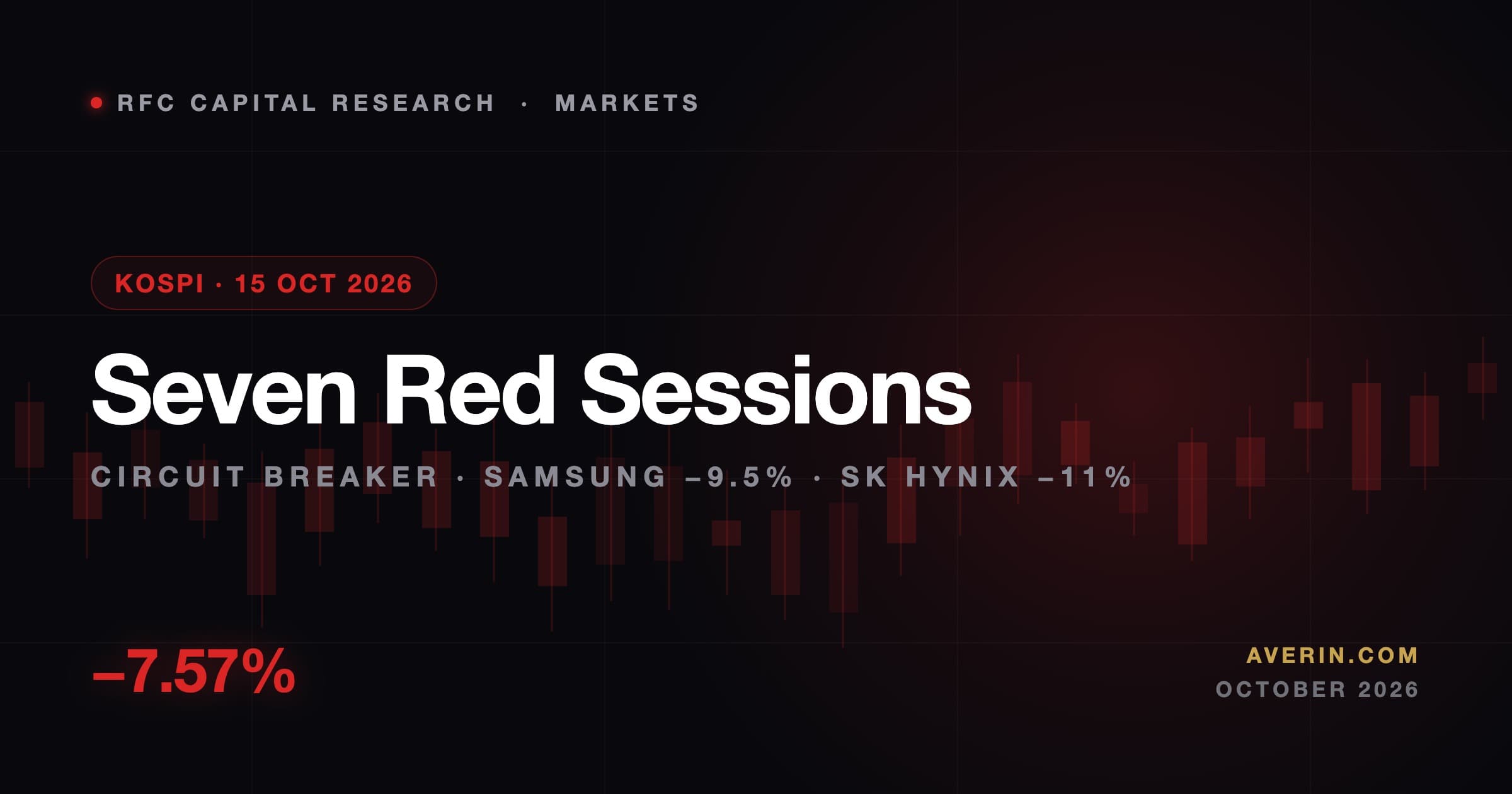
The KOSPI closed on Thursday 15 October 2026 at 5,554.22, down 454.59 points or 7.57%. It was the index's seventh straight losing session and its lowest close since 7 April. The Korea Exchange triggered a sell-side sidecar at 9:07 a.m. and a market-wide circuit breaker at 12:38 p.m., halting all trading for 20 minutes. The Kosdaq fell 7.65% to 760.82, with its own sidecar at 9:12 a.m. and circuit breaker at 12:23 p.m.
Two days ago our South Korea economy overview had the KOSPI at 6,035 and asked how much of the chip boom was already in the price. Thursday gave a blunt answer.
The day in numbers
The index opened sharply lower and kept falling into the halt. It lost nearly 400 trillion won of market value in one session, according to the Korea Times. It was the tenth KOSPI circuit breaker of 2026 and the first since July, Seoul Economic Daily reported. The sidecar was the 27th of the year.
The two chip giants did most of the damage:
- Samsung Electronics closed at 210,000 won, down 9.48%.
- SK hynix closed at 1,262,000 won, down 11.06%.
- Samsung Electro-Mechanics fell 15.36%, Hanmi Semiconductor 11.63% and SK Square 10.21%.
Defensive names rose: Samsung Biologics gained 5.50%, Yuhan 5.09% and KT&G 3.96%.
Foreign investors were net sellers of 3.6243 trillion won on the main board, about $2.7 billion at Thursday's exchange rate. That made eight straight sessions of foreign net selling. Institutions bought a net 1.69 trillion won and individuals 1.29 trillion won. On the Kosdaq, foreigners were small net buyers of 215.8 billion won.
Seven sessions, 20.7%
The streak began on Tuesday 6 October, after the KOSPI closed at 7,003.74 on Friday 2 October. The daily losses were 0.89%, 1.98%, 2.62%, 3.65%, 5.46%, 0.44% and 7.57%. In total the index fell 20.7% in seven sessions, and the Korea Times estimates that more than 1,100 trillion won of market value was erased.
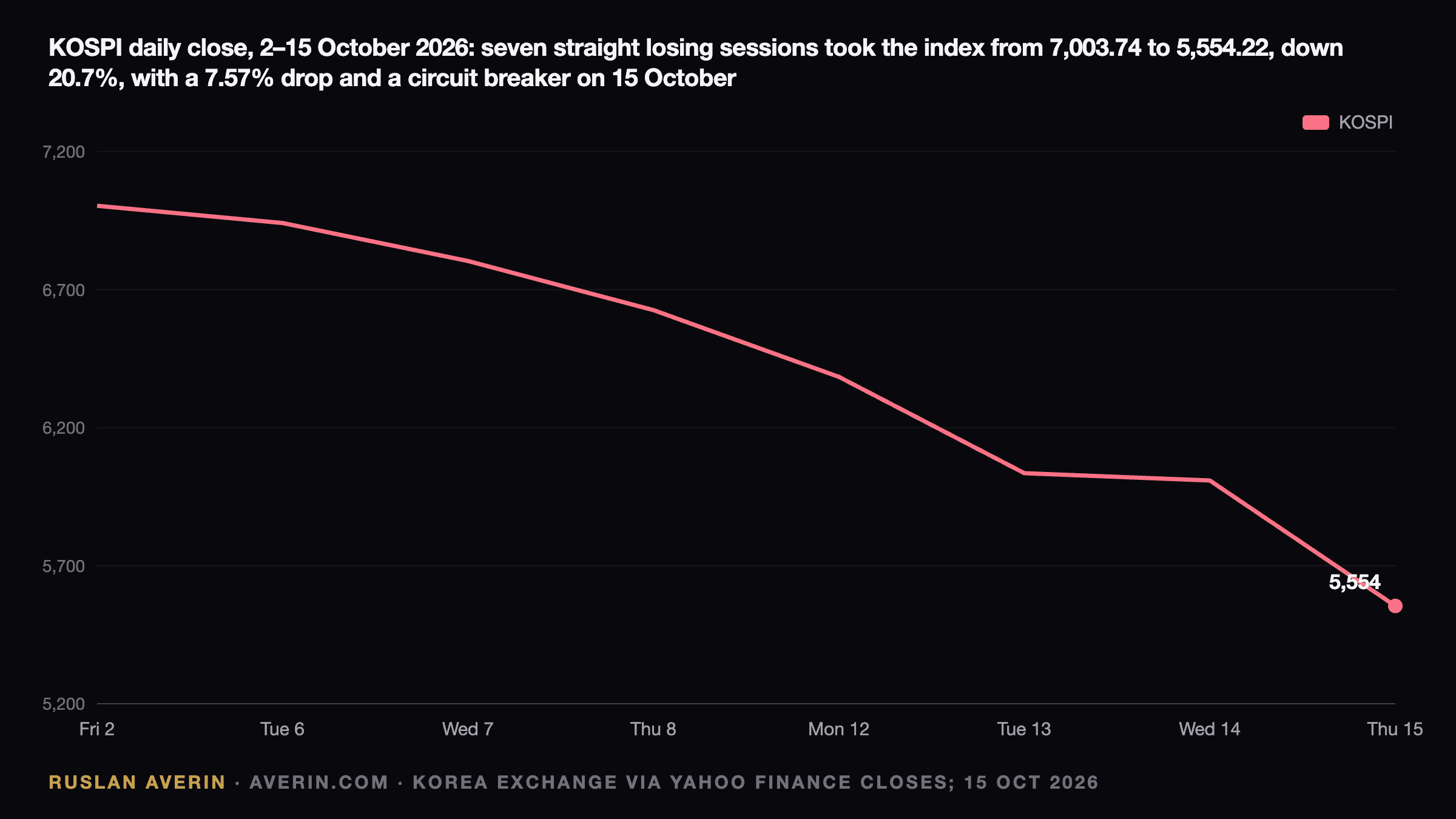
The drawdown from the top is larger. The KOSPI's record close was 9,114.55 on 22 June, and Thursday's close is 39.1% below it. Measured from the intraday peak of 9,385 on 19 June, the Korea Times puts the fall at 40.4%. Samsung Electronics is 42.1% below its 18 June close of 362,500 won, and SK hynix is 56.8% below its 22 June close of 2,919,000 won. Over the seven sessions alone, Samsung fell 23.9% and SK hynix 31.5%.
Why it happened
Three pressures arrived in the same week.
China's memory challenge. On Tuesday 13 October the KOSPI fell 5.46% after China's ChangXin Memory Technologies (CXMT) announced it had commercialised a new DRAM architecture. That went to the core of the Korean bull case: Samsung and SK hynix have been priced as the scarce suppliers of memory for AI.
Hot US inflation. On Wednesday 14 October the BLS reported that the US consumer price index rose 0.6% in September and 3.7% over 12 months, up from 3.4% in August. Gasoline rose 9.1% in the month. Core inflation was 2.6% year on year and 0.3% month on month, above forecasts. That revived talk of another Fed hike: Seoul Economic Daily cited CME FedWatch putting the probability of an October move at 49.3% at one point on Wednesday. Our CPI preview set out the consensus going into the release; the miss was in core. The 10-year Treasury yield closed at 5.19% on Wednesday.
Doubts about AI returns. Higher yields hit the companies that borrow to build data centres. On Wednesday CoreWeave fell 15.46% to $65.78, Oracle fell 8.83%, and the Nasdaq Composite dropped 1.88% to 26,692.87. Nvidia lost 3.16% to $221.30. When the market starts asking whether AI capital spending earns its cost of capital, the suppliers at the top of that chain fall hardest, and Korea's two memory makers are the purest listed play on it.
Japan, Taiwan and TSMC
The selling was regional. The Nikkei 225 fell 4.90% to about 64,426. SoftBank Group lost 9.33% and memory maker Kioxia 12.32%. Taiwan's TAIEX fell 3.41% to 46,969.87, and TSMC closed 2.01% lower at NT$2,440.
TSMC reported third-quarter results the same day, and the numbers did not read like an AI slowdown. Revenue was NT$1,494.24 billion ($46.72 billion), up 41.2% in dollars. Net income rose 68.7% to NT$763.06 billion, or NT$29.43 a share, and the gross margin was 66.4%. Fourth-quarter guidance is $52.3–54.3 billion of revenue at a 65–67% gross margin. Our TSMC Q3 2026 results breakdown covers the detail.
What Seoul said
The response came from the Financial Services Commission. Chairman Lee Eok-won convened an emergency stock market meeting with the Financial Supervisory Service and the Korea Exchange. Officials judged the speed of the decline and the selling excessive. They pointed to solid earnings in semiconductors, defence and shipbuilding, and to firm foreign exchange reserves and current account. They promised zero tolerance for price manipulation and illegal short selling, and contingency plans "if necessary". Lee warned that "investing on excessive debt and credit is dangerous", a pointed remark on margin borrowing.
The won was calm by comparison. It closed the Seoul daytime session at 1,344.6 per dollar, 6.3 won weaker, after briefly passing 1,350. Dealers attributed the move to dollar buying linked to foreign equity sales. A currency near 1,345 is still far stronger than the 1,550 area of June, so this is an equity shock, not a currency crisis.
What past circuit-breaker days say
A Level 1 circuit breaker fires when the KOSPI stays more than 8% below the previous close for one minute. Using Korea Exchange closes from Yahoo Finance, here is how the index moved over the following 21 trading sessions (about a month) and 63 sessions (about three months) after earlier breakers:
- 19 March 2020 (Covid panic): +30.2% after one month, +45.9% after three.
- 5 August 2024 (global carry-trade unwind): +5.7% and +3.7%.
- 4 March 2026 (US-Iran crisis): +2.8% and +60.2%.
- 8 June 2026 (chip sell-off on rate fears): +2.3%, then −6.5%.
- 26 June 2026 (fifth breaker of the year): −28.4% and −18.3%.
- 29 July 2026 (second straight breaker day): +19.9% after one month. Thursday's close is 1.9% below that day's 5,663.24.
The pattern is a split, not a rule. Breakers caused by a sudden external shock tended to mark the low within days. Breakers that came early in a repricing of earnings or rates, as in June, were followed by a further fall of about a quarter. Daishin Securities' Lee Kyoung-min notes that the 40.4% fall from the June peak is approaching the 43.7% median decline across seven earlier crises, including 1997 and 2008. On valuation, Seoul Economic Daily reports a 12-month forward P/E below 4.5 times, with a price-to-book of 1 times near the 5,200 line; Samsung Securities cites 5,000 as support.
What I would watch
In analyst Ruslan Averin's view, this sell-off looks more like June than like March 2020: it is driven by rates and by doubts about the AI earnings cycle, not by a one-day panic. That argues against treating the circuit breaker itself as a bottom signal. I would watch four things:
- TSMC's call and the AI capex read-through. A record quarter and a higher fourth-quarter guide answer the demand question for now. The test is whether that steadies Samsung and SK hynix on Friday.
- Nvidia and the AI borrowers. CoreWeave's 15% fall shows where the stress is. Further weakness in AI credit would keep pressure on memory stocks regardless of TSMC.
- The Fed meeting on 27–28 October. The target range is 3.75–4.00%. A second hike after the September move would test valuations again; a pause would ease the yield pressure. Our Fed outlook after the hot CPI covers the odds.
- Foreign flows. Eight sessions of net selling, 3.6 trillion won on Thursday alone. The first day foreigners turn net buyers on the main board would be more informative than any single index move.
Related: South Korea's economy under Lee Jae-myung, the US CPI September 2026 preview and the September AI slowdown warning and chip sell-off.