Will the Fed raise rates in October 2026? On Tuesday 13 October CME FedWatch put the chance of a hike at the 27–28 October meeting at about 22%. The September consumer price index, published on 14 October, roughly doubled that: by 12:20 p.m. ET FedWatch showed 41.5%, according to 24/7 Wall St. A hold is still the base case, but no longer a comfortable one.
The headline was not the shock. Annual inflation rose to 3.7% from 3.4% in August, against a 3.6% consensus, and prices rose 0.6% on the month. The surprise was core CPI: up 0.3% on the month and 2.6% on the year, against 0.2% and 2.5% expected. It is the second 0.3% core reading in a row, which the Fed cannot treat as a fuel story. Our CPI preview had flagged that line as decisive.
The CPI details that matter
Energy. The energy index jumped 5.2% in September and is up 20.4% on the year. Gasoline rose 9.1% on the month, seasonally adjusted, and 34.2% year on year. That explains most of the gap between headline and core. Food was flat on the month and up 2.5% on the year.
Shelter. The largest component of the basket rose 0.4%, after 0.3% in August, and 3.2% on the year. Rent of primary residence rose only 0.2% and owners' equivalent rent 0.3%, so the faster shelter reading came from the smaller lines outside the two rent measures. Rents themselves are not accelerating.
Services excluding housing. Services less energy services rose 0.4% on the month and 3.1% on the year. Transportation services rose 0.6%, after 0.5% in August, and airline fares rose 1.2% on the month and 22.4% on the year. Medical care services rose 0.3%. This is where fuel costs leak into core prices with a lag.
Goods. Core goods rose 0.3% on the month, the fastest in the three months shown, but only 0.7% on the year. Used cars rose 0.7%.
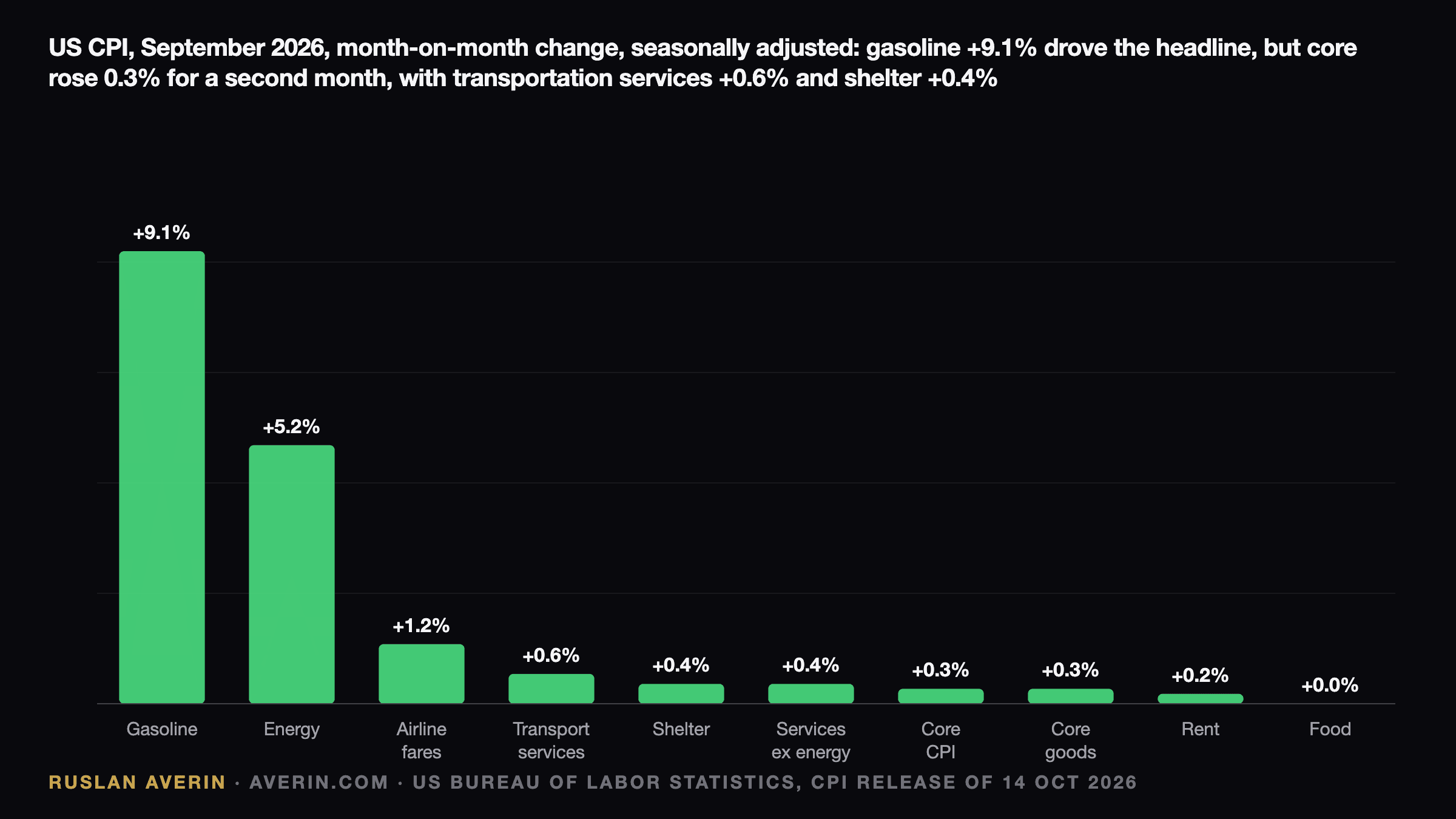
In analyst Ruslan Averin's view, the report is hot where it matters for policy and benign where it matters for the long run. Rents at 0.2% a month do not describe a spiral; transportation services at 0.6% and two straight 0.3% core readings describe an energy shock that is starting to spread.
What the market prices for 27–28 October
Pricing moved sharply and partly reversed. According to 24/7 Wall St., the CME FedWatch probability of a quarter-point hike on 28 October was 22.1% before the report and 41.5% at 12:20 p.m. ET. KuCoin's market wrap put the peak near 55%, settling around 40%. Realtor.com, in an article syndicated by Yahoo Finance, cited FedWatch at 35% later in the day. On Polymarket, the odds of an October hike briefly spiked to nearly 50% and settled closer to 30%.
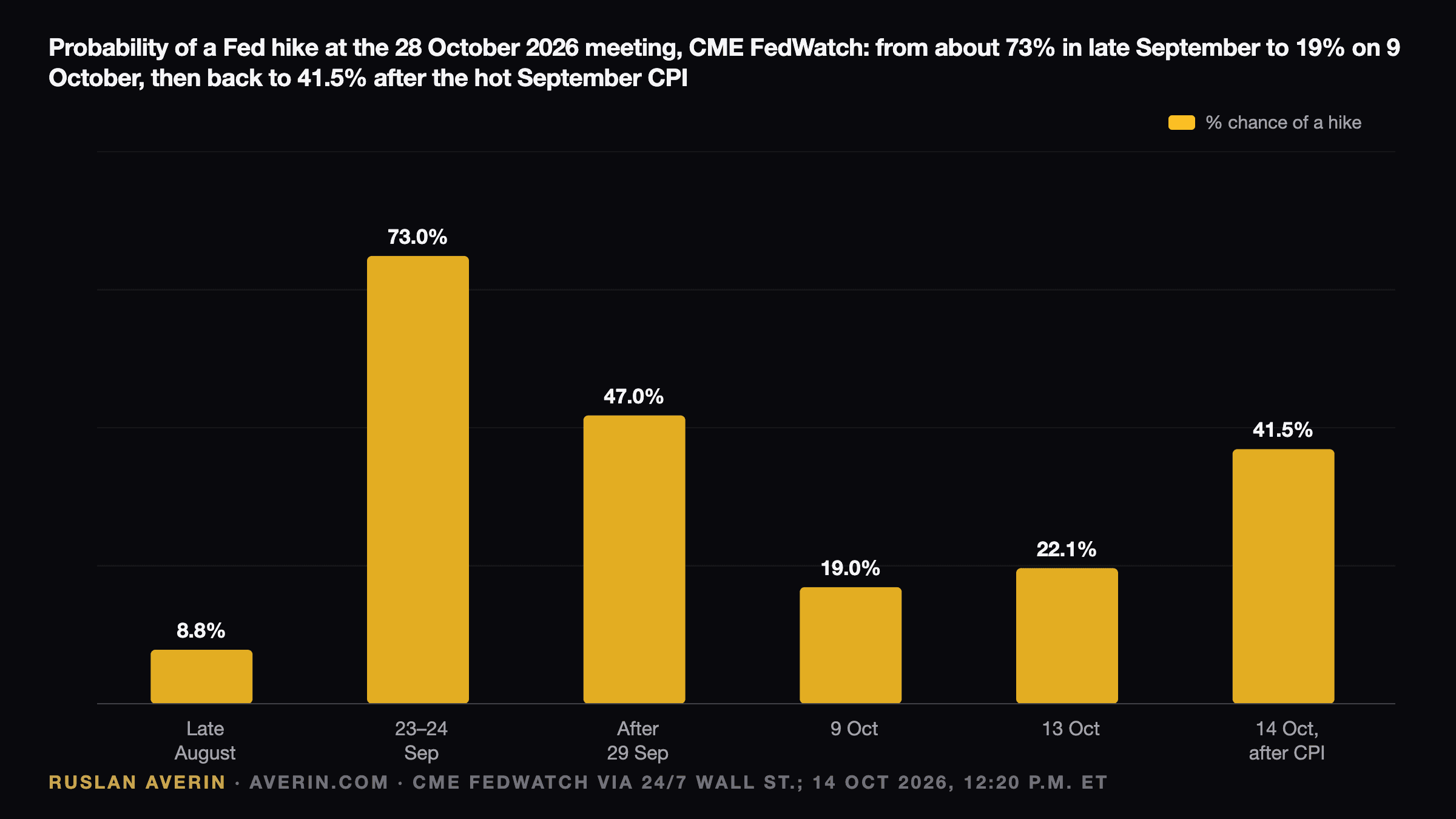
Odds were near 70–73% on 23–24 September and fell to about 19% by 9 October after a softer PCE report. The market had moved the next hike to December: on 9 October futures priced about 70% for a hike by the 8–9 December meeting, according to FXStreet. A move to 4.00–4.25% is already expected by year-end; the October question is about timing.
What the Fed decided in September and has said since
On 16 September the FOMC voted 12–0 to raise its target range by a quarter point to 3.75–4.00%, the first increase since July 2023 and the first under Chair Kevin Warsh. The dot plot moved the median for the end of 2026 to 4.1%, and 16 of 18 participants projected at least one more hike this year. Details are in our 16 September report. The minutes, released on 7 October, showed most officials expect another hike by year-end.
Since then the debate has been about when, not whether:
- Governor Christopher Waller said on 8 October that more hikes are needed but "don't have to come at back-to-back meetings", as reported by FXStreet.
- St. Louis Fed President Alberto Musalem said rates should rise over the next six to nine months.
- Cleveland Fed President Beth Hammack, a voter this year, told Barron's on 12 October that more tightening is needed and that she favours smaller, more frequent moves, without naming a meeting.
- New York Fed President John Williams said this week that only one additional hike should be necessary this year, according to Realtor.com.
Before the CPI release, Vice Chair Philip Jefferson, Waller and Williams had all signalled no rush. Warsh speaks late on Thursday 15 October New York time, at a fireside chat with IMF Managing Director Kristalina Georgieva in Bangkok. The blackout begins on Saturday 17 October, so it is the chair's last chance to steer expectations.
The election-eve angle
The FOMC announces its decision on Wednesday 28 October. The US midterm elections are on Tuesday 3 November, six days later. According to 24/7 Wall St., the Fed has raised rates within seven days of an election only once since 1990: the 75 basis point hike on 2 November 2022, six days before that year's midterms. UBS strategist Simon Penn called an October hike "politically untenable" on 29 September.
The Fed's position is that it does not factor the electoral calendar into policy. The 2022 precedent shows it can act on election eve, but core inflation then was running at 6.6%, not 2.6%. With the next move framed as a question of timing, waiting until 9 December costs little and avoids the optics. That is the strongest argument for a hold.
How markets reacted on 14 October
Stocks had their worst day since July, as AP reported. The S&P 500 closed at 7,718.94, down 1.1%, its fifth loss in six sessions since a record high. The Nasdaq Composite fell 1.9% to 26,692.87 and the Russell 2000 fell 1.9% to 2,729.53. The Dow lost only 0.1%, closing at 51,621.48. AI stocks led the decline.
The bond market flattened. On US Treasury par-yield data, the 2-year rose to 4.82% from 4.79%, while the 10-year slipped to 5.19% from 5.21% and the 30-year to 5.52% from 5.56%. The front end priced a faster Fed; the long end priced the cost to growth. The dollar index touched 102.88 intraday, up as much as 0.7%, and ended near 102.55, according to Trading Economics. December gold fell 1.7% to $4,107.90, while WTI crude rose 1.0% to $95.09.
What it means for mortgages, savers and borrowers
- Mortgages. Mortgage rates follow the 10-year, not the Fed. The Mortgage News Daily 30-year fixed index ended 14 October at 7.45%, down 0.01 on the day, below its 52-week high of 7.61%. A Fed hike would not by itself lift mortgage rates if long yields keep falling on growth fears. Our preview of September existing-home sales looks at what these rates mean for buyers.
- Savers. The 3-month Treasury bill yielded 4.28% on 14 October, above the top of the Fed's range, so short-term cash already earns more than 4%. A hike in October or December would lift money market and savings yields by about a quarter point.
- Borrowers. Credit cards and home equity lines track the prime rate, which moves with the Fed. Each quarter-point hike adds about $25 a year in interest per $10,000 of variable-rate balance.
The scenario logic
Our analysts see three paths for 28 October:
- Hold with a hawkish statement (base case). The range stays at 3.75–4.00%, with a December move signalled.
- Hike to 4.00–4.25%. More likely if Warsh leans that way on Thursday or the producer price index on 15 October runs hot. The curve would flatten further.
- Hold with a softer tone. Only if the next data run cool; it would help the 10-year and mortgages most.
Related: our September CPI preview, the 10-year Treasury at 5% and existing-home sales and mortgage rates.