
Ukraine enters the winter of 2026/27 with about 16 billion cubic metres (bcm) of gas in underground storage, the largest volume since 2020. Serhii Fedorenko, acting chairman of the Naftogaz management board, gave the figure in an interview with Reuters published on Friday 16 October, as reported by LB.ua and UNIAN.
The government's own minimum for getting through the heating season is 13.2 bcm. A year ago the country started the season with less than 14 bcm. The cushion is therefore larger than last winter, but the risk has also grown: Russia has attacked Naftogaz facilities more than 400 times since the start of 2026, twice as often as in the whole of 2025.
For households the second half of the story is the bill. The price of gas for the population stays frozen at UAH 7.96 per cubic metre until 30 April 2027.
How much gas is in storage
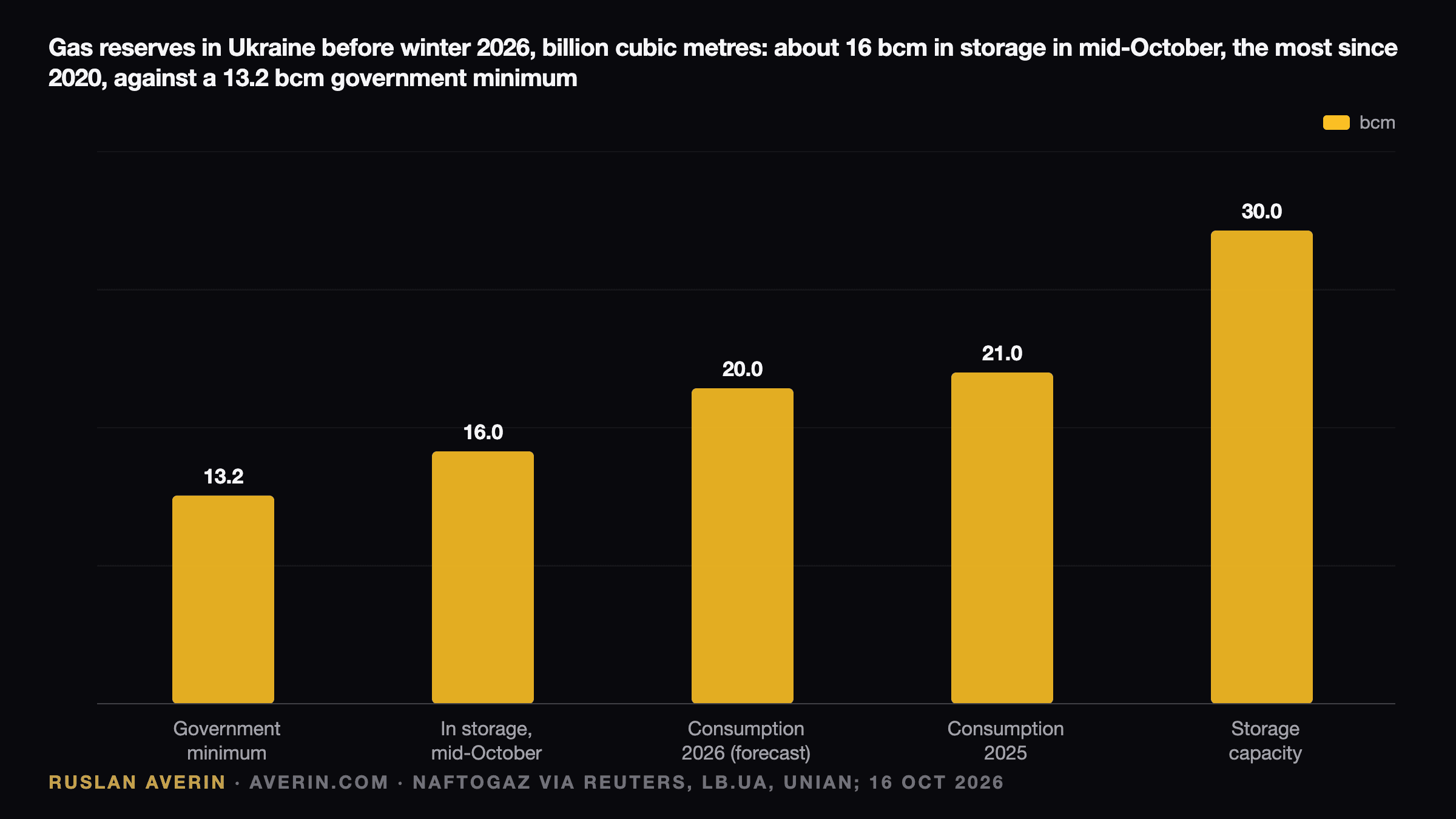
The key numbers from the Naftogaz interview and the government balance:
- In storage: about 16 bcm in mid-October, the most since 2020.
- Government minimum: at least 13.2 bcm to pass the winter.
- Last season: the 2025/26 heating season started with under 14 bcm.
- Consumption: Fedorenko expects about 20 bcm in 2026, down from 21 bcm in 2025.
- Storage capacity: about 30 bcm, the largest underground storage system in Europe.
Independent estimates give a similar picture. Volodymyr Omelchenko of the Razumkov Centre put the volume at almost 15.8 bcm a few days earlier, 2.6 bcm above the required minimum and 1.2 bcm above the target level in the forecast balance. He wrote that the 2026/2027 gas balance shows the country fully supplied for the autumn-winter period.
Part of the drop in consumption is not good news. UNIAN notes that demand fell largely because Russian strikes hit industrial infrastructure and some enterprises stopped working.
Will the gas be enough for winter
On paper, yes. Storage is about 2.8 bcm above the 13.2 bcm minimum, and annual consumption is expected to be about 1 bcm lower than in 2025. Storage is not the whole winter supply: it is the buffer between winter demand and what domestic fields and imports can deliver each day. The bigger the buffer in November, the longer the system can absorb a loss of production in January.
Three factors decide whether 16 bcm is enough:
- Attacks on production. More than 400 strikes on Naftogaz assets this year targeted gas production, processing and transport, and thermal power plants in frontline regions. Every lost well has to be replaced from storage or imports.
- Weather. A long cold spell raises daily withdrawals. The government minimum is designed for a normal winter, not a severe one.
- Imports. Naftogaz has already contracted more than 1 bcm of imported gas for this season, about 25% of it liquefied natural gas (LNG), with deliveries planned from December to March. Purchases started earlier than usual.
Fedorenko told Reuters that the company is strengthening protection of its facilities. Kyiv has also offered the European Union the use of about a third of Ukraine's storage capacity for European gas reserves.
In analyst Ruslan Averin's view, the 16 bcm figure buys time rather than certainty: the 2.8 bcm margin over the minimum is roughly one-seventh of a year's consumption, so a winter with heavy losses of production would still need extra purchases in Europe.
Imports: from record volumes to a smaller top-up
Last year looked very different. Naftogaz imported a record 7.8 bcm over 2025 and the first quarter of 2026, after strikes cut domestic output and storage fell to its lowest level in years. This season the contracted import volume is a fraction of that, which is the clearest sign that the starting position has improved.
The LNG share matters for cost and logistics. LNG arrives at European terminals and travels to Ukraine through neighbouring pipeline systems, which adds regasification and transit costs compared with pipeline gas bought close to the border. A 25% share of contracted imports is a hedge against pipeline disruptions rather than the main source of supply.
Ukraine sold gas abroad for the first time since 2022
The comfortable stock level allowed a step that would have been unthinkable a year ago. On 15 October private companies sold about 12.75 million cubic metres of gas at the first export auction of the Ukrainian Energy Exchange, Ukraine's first gas export since 2022, according to ExPro Consulting data cited by UNIAN.
- Price: €69–69.03 per MWh, about 21% below the starting prices.
- Total: about €9.36 million, with all offered gas sold.
- Gap with the domestic market: the export price was 89% higher than the domestic price.
The rules are narrow. Private producers may export no more than 15% of their monthly production, only from 1 March to 30 November, and only when there is no demand on the domestic exchange. Exports are fully banned from 1 December to 28 February. Omelchenko says the state can stop exports immediately at the first real threat of a shortage, and that the revenue should help protect gas production from attacks.
For households, the export volume is too small to affect supply: 12.75 million cubic metres is less than 0.1% of the gas in storage.
Gas price for households: UAH 7.96 until April 2027
The household price does not change this winter.
- Naftogaz "Fixed" plan: UAH 7.96 per cubic metre including VAT, valid until 30 April 2027. Naftogaz confirmed the price again on 12 October. The plan can end earlier only if a customer switches to another tariff.
- Who pays it: Naftogaz supplies about 98% of Ukrainian households, more than 12 million consumers, according to Kyiv Post.
- Distribution is extra: the fee for gas delivery is billed separately at the rate of the local gas distribution operator.
- Public service obligations: on 28 September the Cabinet of Ministers extended the special obligations (PSO) mechanism on the gas market until 31 March 2027, Prime Minister Serhii Koretskyi announced. Naftogaz Trading sells gas to heat and hot water suppliers serving households at UAH 7,420 per 1,000 cubic metres.
What that means in money, for illustration: a flat that uses 10 cubic metres a month for cooking pays about UAH 80 for the gas itself. A private house that burns 100 cubic metres in a cold month pays UAH 796, and a house that uses 1,500 cubic metres over the season pays about UAH 11,940, before distribution. Households that need help with these bills can apply for a housing subsidy; heating costs are counted from 16 October 2026 to 15 April 2027.
What to watch in the coming weeks
- The 1 November level. The injection season normally ends around the start of November. The level at that point will be the real starting stock for winter.
- Withdrawals in December and January. The faster the stock falls in the first cold weeks, the more imports Naftogaz will need in the second half of winter.
- Strikes on production in Kharkiv and Poltava regions, the main gas-producing regions, where Naftogaz has reported repeated attacks.
- The household price after 30 April 2027. The 7.96 price and the PSO are temporary. Any change would come after the heating season, and the gap with export prices shows the pressure on the next government decision.
Related: frosts, heating dates and household tariffs, power outage schedules and backup power costs and Winter Support of UAH 19,400.