A draft Cabinet of Ministers resolution that would tighten the rules for reserving employees of critical enterprises became public on Monday 12 October 2026. It cuts the maximum share of reservable staff for defence-industry and energy companies from 100% to 85%, and for utilities that supply heat and water or collect waste from 75% to 60%. It also changes how the quota base is counted, which affects every critical employer, not only those two groups.
The text was published by MP Yaroslav Zhelezniak, first deputy chair of the parliamentary finance committee, who said sources had confirmed it was authentic. Forbes Ukraine, citing two government sources, reported that the changes were discussed and could reach a government meeting as early as 13 October. At the time of writing this is a draft, and the adopted version may differ.
What the draft changes
According to the summary published by Minfin, the draft has four parts:
- Limits. Defence industry and energy: maximum reservation cut from 100% to 85% of military-liable employees. Heat supply, water supply and waste collection: from 75% to 60%.
- Quota base. Employees who already have a deferral on other grounds, such as students, carers or fathers of three children, would no longer be counted in the headcount from which the quota is calculated.
- Coordination centre. A 17-member centre under the Cabinet, including representatives of security and law-enforcement agencies, would recommend granting or withdrawing critical status and approving limits above 50%.
- Criteria deadline. Ministries and regional administrations would have to update sector criteria of criticality by 20 October.
Zhelezniak noted that the draft does not set deadlines for the centre's decisions, does not describe its criteria and does not provide a way to appeal its recommendations. It also does not say what happens to employees already reserved above the new limits.
How the quota base change works
The general rule, set by Resolution No. 692 of 30 May 2026, allows a company to reserve no more than 50% of its military-liable employees. Zhelezniak's own example: a company with 100 such employees could reserve 50. Under the draft, if 20 of them already have deferrals on other grounds, the base becomes 80 and the quota 40.
Applying the same arithmetic to the higher limits shows why business groups reacted. With the same 100 employees and 20 deferrals, a defence or energy company could reserve up to 68 instead of 100, and a utility up to 48 instead of 75.
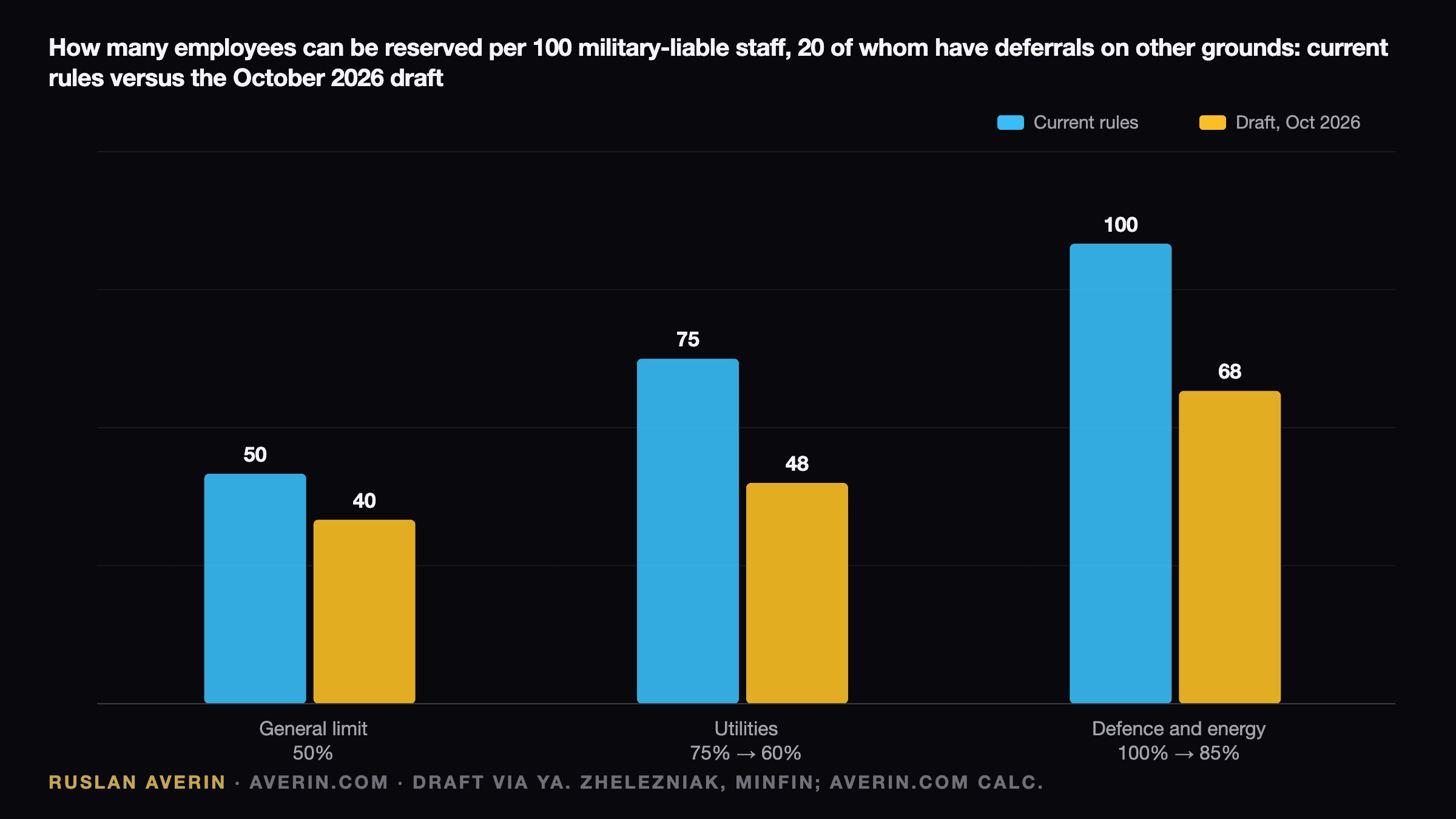
The practical effect is measured against the 80 employees who actually need reservation. Under current rules a defence or energy company can cover all 80; under the draft, 12 would be left without it. A utility could cover 75 of 80 now and 48 under the draft, so 32 would be left without reservation. For an ordinary critical company the gap widens from 30 to 40 people.
The wage threshold for critical status
Pay is the other condition. Resolution No. 692 raised the main wage criterion to UAH 25,941 a month, three minimum wages of UAH 8,647, according to Ministry of Economy explanations reported by Debet-Kredit. Enterprises in frontline territories keep the lower threshold of UAH 21,618. The ministry said the changes apply from 2 June, and companies had to reconfirm critical status by 1 September; Resolution No. 862 of 1 July amended the rules.
The threshold is set to rise again. Interfax-Ukraine reported on 18 September that, under the draft 2027 state budget, reservation would require an average salary from about UAH 28,600.
For context, the average wage of full-time employees in August 2026 was UAH 31,892, up 23.1% year on year and down 1.1% from July, according to the State Statistics Service as reported by TSN. The current threshold is about 81% of that national average. Pay differs sharply by sector: UAH 79,170 in information and telecommunications, UAH 19,109 in education, and UAH 48,705 on average in Kyiv.
Who is affected and how many people
Minister of Economy Oleksii Sobolev said in May that more than 1.3 million employees were reserved at critical enterprises, about 12% of the 10.5 million people in work, and that these enterprises provide 60% of all budget revenues, Liga reported.
The direct impact of the limit cut falls on defence manufacturers, energy companies and municipal utilities for heat, water and waste. The base change reaches every critical employer whose staff includes people with deferrals on other grounds.
Business associations responded within a day. The European Business Association asked the government to publish the proposals, assess their effect on the economy and consult business before any decision. Defence-industry groups, including the National Association of Ukrainian Defense Industries, Technological Forces of Ukraine and the Council of Gunsmiths, called for keeping the 100% limit for the defence industry because of risks to defence contracts. The Union of Ukrainian Entrepreneurs said it would send a formal request to the ministry.
Labour shortage and wage pressure
The draft lands in a tight labour market. In the Grc.ua labour market barometer with forecasts for 2026, more than half of companies named the shortage of workers as the main problem, and over 40% of employers pointed to a gap between candidates' pay expectations and what they can offer. Average wages rising 23.1% in a year is the result of that competition.
The EBA listed the risks it sees: shortages of qualified staff, rising operating costs, disrupted production, difficulty fulfilling contracts and lower tax revenues. In analyst Ruslan Averin's view, the base change is the less visible but broader part of the draft: it lowers the number of reservable employees even at companies whose headline limit stays at 50%.
The cost for business
The wage rule makes reservation a payroll decision. A reserved employee paid exactly at the UAH 25,941 threshold costs the employer about UAH 31,650 a month once the 22% unified social contribution is added. If the threshold rises to about UAH 28,600 in 2027, the cost becomes about UAH 34,890, roughly UAH 3,240 more per worker a month, or about UAH 38,900 a year.
For a company with 100 reserved employees paid at the threshold, that is close to UAH 3.9 million a year in extra payroll cost, before any raises needed to keep pay above the line. Exceeding the limit also has a procedure: under Resolution No. 692, a company must apply through Diia within 10 working days to annul reservations above the limit, and breaching it can cost the company its critical status.
Timeline
- 30 May 2026: Resolution No. 692 adopted; in force from 2 June.
- 1 July 2026: Resolution No. 862 amends the rules.
- 1 September 2026: deadline to reconfirm critical status.
- 12 October 2026: draft with the 85% and 60% limits published.
- 13 October 2026: possible government consideration, according to Forbes Ukraine's sources.
- 20 October 2026: deadline for updated sector criteria under the draft.
- 1 January 2027: wage threshold expected to rise with the new minimum wage.
What employers and employees should check
Employers should recount the base without staff who have deferrals on other grounds and compare the result with the new 85%, 60% or 50% limit. They should check that each reserved employee's pay stays above UAH 25,941 and budget for about UAH 28,600 from January. Any sector criteria published by 20 October may change whether a company remains critical at all.
Employees should check in Diia that their reservation is active, whether their employer is in an affected sector, and whether their salary meets the threshold. The draft does not yet say what happens to reservations above the new limits, so the final text of the resolution is the document to watch.
Related: frozen VAT refunds and the budget gap, the capital spending freeze and the 2027 budget and inflation of 10% in Ukraine.