
There will be no UAH 5,000 banknote for now. On 12 October deputy governor of the National Bank of Ukraine Volodymyr Lepushynskyi said, in comments to Novyny.LIVE reported by TSN, that the regulator has no plans to issue the note because there is no real need for it in cash circulation. He added that the NBU introduces new denominations only on the basis of actual cash demand and the growth of the economy, and that it sees no preconditions for a return to the 1990s.
The statement came five weeks after the UAH 2,000 note went into circulation, while the hryvnia sits near its record low and inflation has reached 10%. Those three facts together explain why the rumour keeps coming back. The NBU's own cash statistics explain why it is not happening.
What the NBU said about 5,000 and 2,000
The answer on 12 October repeats an earlier one. On 18 November 2025 the NBU called a viral video of a "new UAH 5,000 note" fake. The item in the video was a 2008 presentation sample named after Panteleimon Kulish, made by the NBU's Banknote and Coin Factory to show its printing technology. It carries no denomination, is marked as not a means of payment and was handed out only in souvenir booklets. The NBU said then that it was not developing a 5,000 design and would tell the public if the denomination range changed.
It did change, one step up. On 4 September 2026 the NBU put the UAH 2,000 note into circulation, with a portrait of the poet and dissident Vasyl Stus. Governor Andriy Pyshnyi gave the reason: UAH 1,000 notes made up more than 55% of the total value of banknotes in circulation, which in central-bank practice signals the need for a higher denomination. The NBU said the note would enter circulation gradually and that it planned to produce "several million" of them during 2026.
So far the uptake is small. According to the NBU's banknote statistics, 366,100 notes of UAH 2,000 worth UAH 732 million were in circulation on 1 October. Economichna Pravda, citing the NBU, rounded this to about 400,000 notes and UAH 700 million, or 0.01% of all banknotes.
UAH 973 billion in cash, and who holds the value
Total cash in circulation was UAH 973 billion on 1 October, up UAH 46.7 billion, or 5%, since the start of the year. Banknotes account for UAH 962.5 billion of that, in 2.63 billion notes; the rest is coins.
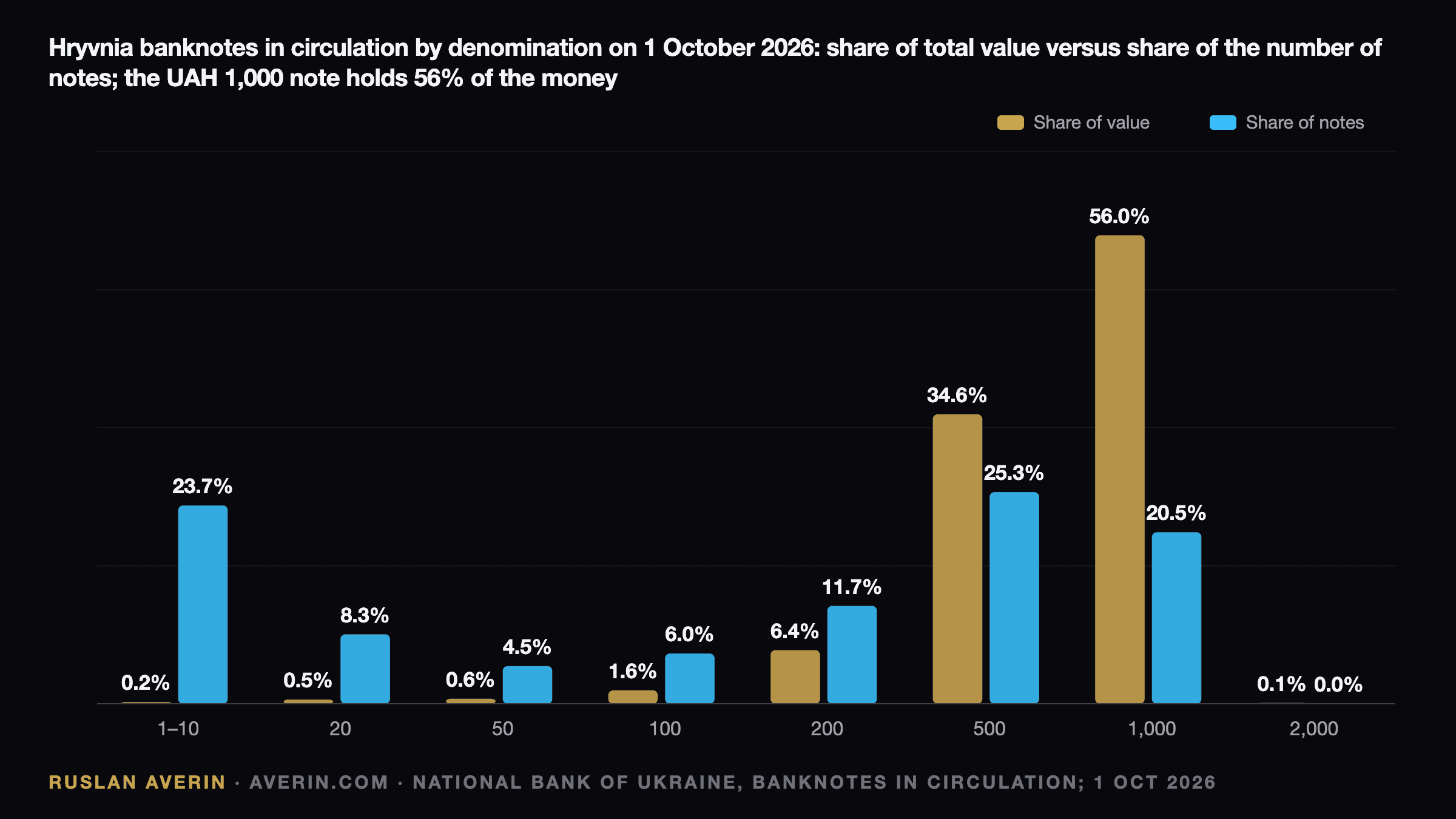
The structure is lopsided:
- UAH 1,000: 539 million notes, 20.5% of all notes but 56.0% of the value.
- UAH 500: 666 million notes, the most common note at 25.3% of the count, and 34.6% of the value.
- UAH 200: 11.7% of notes, 6.4% of value.
- UAH 1 to 100 combined: 42.5% of all notes but only 2.9% of the value.
Two notes therefore carry 90.6% of the money. That is the real argument for the 2,000: the business of moving, counting and storing cash is now about these two denominations. The NBU has also stopped printing new UAH 200 notes from 2023 and UAH 100 notes from 2024, according to Minfin, using old stocks when needed.
The UAH 1,000 note took over in four years
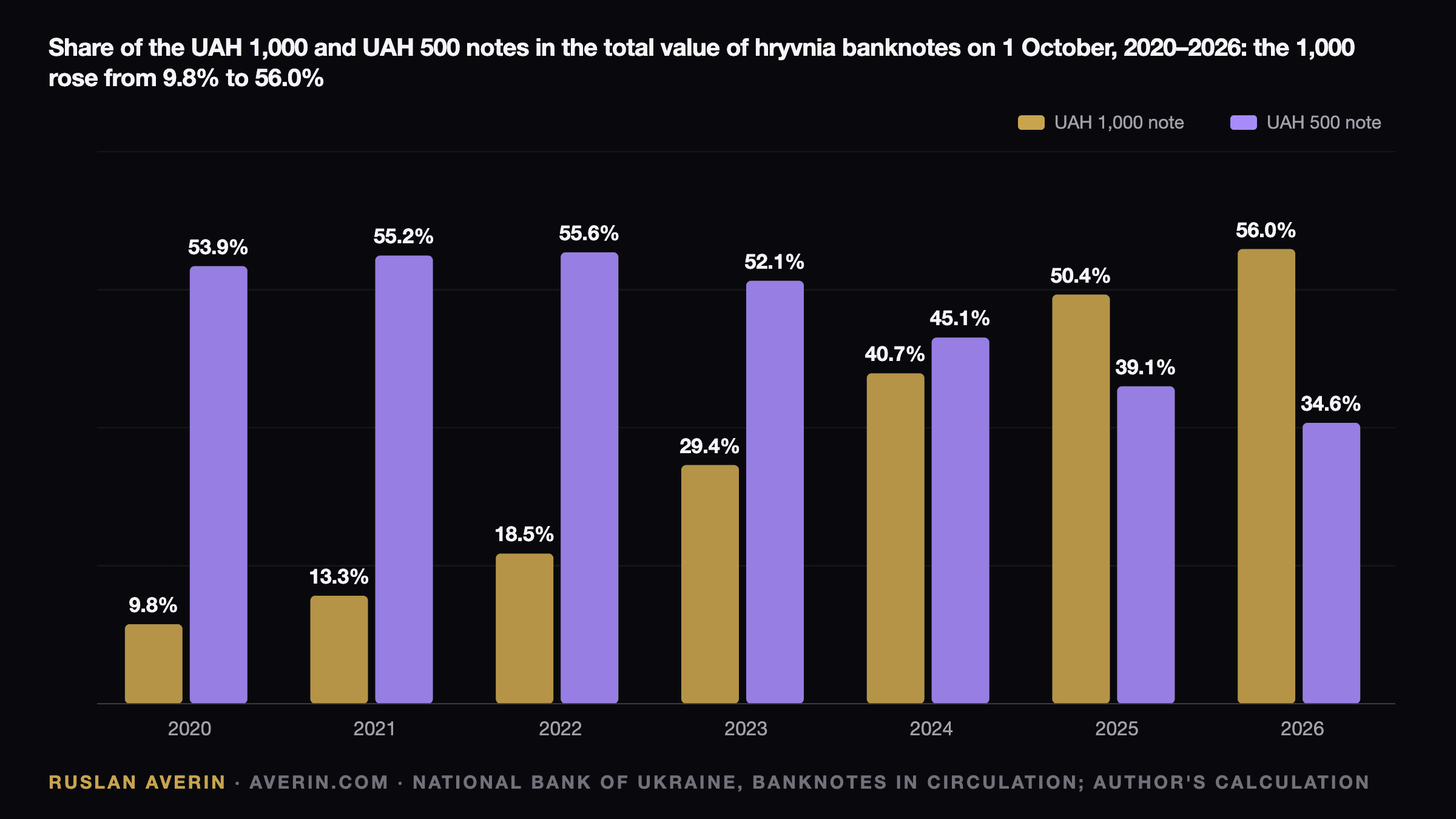
The UAH 1,000 note was introduced in 2019. On 1 October 2022 it still held 18.5% of banknote value, and the UAH 500 held 55.6%. The UAH 1,000 overtook the UAH 500 by value in January 2025. Over the last twelve months the value of UAH 1,000 notes rose 21.3%, while the value of UAH 500 notes fell 3.3%.
Overall, banknotes in circulation rose 9.2% between 1 October 2025 and 1 October 2026, and 54.6% since 1 January 2022, before the full-scale invasion. The average banknote is now worth about UAH 366, against about UAH 211 at the start of 2022. In September the value of banknotes in circulation actually fell, from UAH 971.5 billion on 1 September to UAH 962.5 billion on 1 October.
Why big denominations get rumoured
The rumour has a simple source: prices and the exchange rate. Consumer inflation reached 10.0% year on year in September, up from 8.1% in August, according to the State Statistics Service, with prices up 2.1% in the month alone. Core inflation was 8.8%. The NBU raised its key rate to 16% on 17 September.
The hryvnia hit its weakest official level of 45.0564 per dollar on 6 October. The official rate for 13 October is UAH 44.95. At that rate the new UAH 2,000 note is worth about $44.50, and the UAH 1,000 about $22. A UAH 5,000 note would be worth about $111, roughly one $100 bill.
When the most valuable note in a country is worth less than half of a $100 bill, people paying for a car, a deposit on a flat or a generator in cash end up carrying thick stacks. That is a convenience problem, and the 2,000 is the NBU's answer to it.
How the hryvnia compares abroad
Large central banks are moving the other way. The European Central Bank decided in May 2016 to stop producing the €500 note, citing concerns that it could facilitate illicit activities, and ended its issuance around the end of 2018; it remains legal tender. The largest euro note still issued, the €200, is worth about UAH 10,048 at the NBU's official euro rate of UAH 50.24 for 13 October. Even a UAH 5,000 note would be worth half of it.
The contrast with Russia is also useful. Cash outside the Bank of Russia rose 20.9% in a year, to 22.23 trillion rubles on 1 October, as covered in the piece on Russians choosing cash over bank accounts. Hryvnia banknotes grew 9.2% over the same period, close to the 10% inflation rate. In real terms, Ukraine's cash stock was roughly flat; Russia's grew.
The Bank of England's redesign of its notes with animals is a reminder that most central banks change notes for security and design, not for size.
Are hyperinflation fears justified?
The numbers say no. In 1993, according to the NBU, inflation on the karbovanets reached about 10,000% a year. The largest karbovanets note, 1,000,000, was issued in 1995. The September 1996 reform replaced the karbovanets with the hryvnia at 100,000 to 1.
Today's 10% is a thousand times smaller. The standard academic definition of hyperinflation, by the economist Phillip Cagan, is prices rising more than 50% in a single month; September's monthly rise was 2.1%. Cash itself is not growing faster than prices.
What the numbers do show is gradual erosion. At 10% inflation, UAH 10,000 kept in cash loses about a tenth of its purchasing power in a year. In analyst Ruslan Averin's view, that is the practical question for households, not the size of the largest note: how much cash to keep for blackouts and emergencies, and where to hold the rest. The NBU's next rate decision later in October and its new macro forecast on 29 October will set the tone.
Related: inflation at 10% in September and what it means for deposits, the dollar at 45 hryvnia and NBU interventions and the NBU's September hike to 16%.