
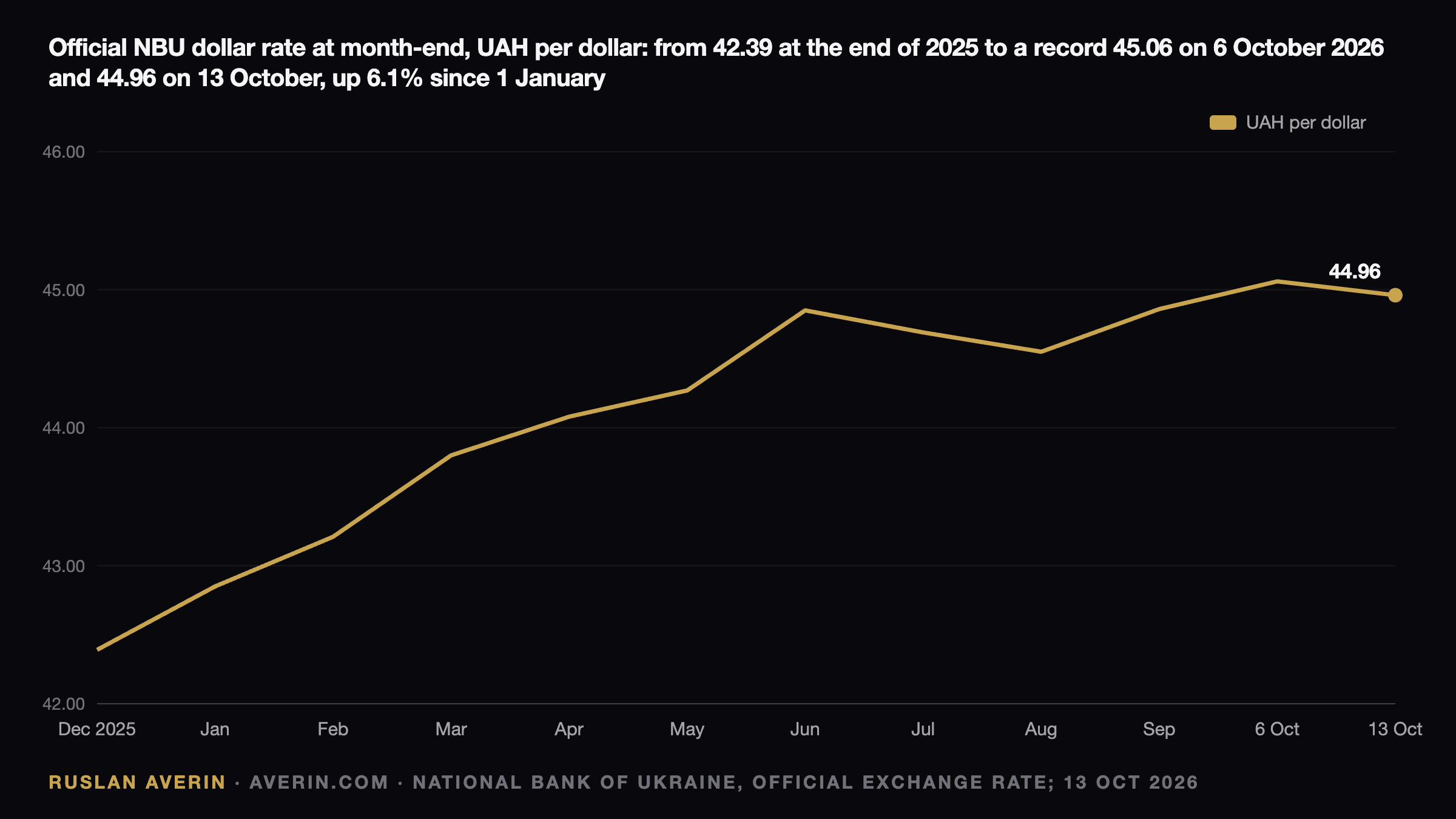
The National Bank of Ukraine set the official rate for Tuesday 13 October at UAH 44.9567 per dollar, up 7 kopecks on the day. A week earlier, on Tuesday 6 October, the official rate reached UAH 45.0564, the weakest level for the hryvnia in its history. It recovered to 44.85 by Friday, then slipped again.
In September we wrote about the first time the dollar touched 45 in exchange offices. In October 45 has become the official number, and it took about $1.25 billion a week of NBU dollar sales to keep it there rather than higher.
Update, 15 October 2026: a new record, then a pullback
On Wednesday 14 October the official rate reached UAH 45.0802 per dollar, a new low for the hryvnia that beat the 45.0564 of 6 October. It lasted one day. For Thursday 15 October the National Bank set UAH 44.9801, 10 kopecks lower, and the euro at UAH 50.3453, down from 50.4380.
| Date | Official rate, UAH/$ | Cash, buy / sell |
|---|---|---|
| 13 October | 44.9567 | 44.76 / 45.30 |
| 14 October | 45.0802 | 44.86 / 45.37 |
| 15 October | 44.9801 | 44.78 / 45.29 |
Cash quotes are Minfin's morning market averages. On 15 October the interbank opened at 44.99–45.02, so the dollar is hovering at 45 rather than breaking away from it.
The latest intervention figure is still the week of 5 to 9 October: $1,248.8 million sold, the thirteenth week above $1 billion. Data for this week is due on Monday 19 October.
Two new facts matter. On 11 October the NBU adopted a third package of credit support measures, in force from 14 October: receivables under defence and energy contracts now count as collateral with a coefficient of 0.75 instead of 0.3, and inventories can secure loans of up to 18 months. The key rate stays at 16% until the 29 October decision. And Finance Minister Serhiy Marchenko told parliament that the general fund received almost UAH 50 billion less than planned in January to September, UAH 32 billion of it in August and September; the full-year gap could reach UAH 70 billion.
What it changes: I read the 14 October record as drift, not a break. The NBU let the rate through 45 and pulled it back the next day. The revenue gap is the bigger signal, because until partner money arrives the reserves carry the load. My December range of 45 to 46 stands; ICU's year-end forecast of 45.8, published on 15 October, sits inside it.
Where the rate stands on 13 October
The official rate has moved 6.1% since 1 January, from UAH 42.35, and 8.1% over twelve months, from UAH 41.60 on 13 October 2025. It passed 44.8 at the end of June, eased to 44.55 by the end of August and climbed to 44.86 in September.
The cash market sits a little wider. In the week to 9 October the average cash rate was UAH 44.66 to buy and UAH 45.09 to sell, according to Interfax-Ukraine. Buying $1,000 in cash costs about UAH 45,090.
The euro moved the other way: UAH 50.24 on 13 October, down from a record 52.25 on 24 August, as the dollar strengthened against the euro abroad.
Thirteen weeks above $1 billion
In the week of 5 to 9 October the NBU sold $1,248.8 million on the interbank market and bought $0.07 million. That is $63.9 million, or 4.9%, less than the week before, and the thirteenth consecutive week above $1 billion. The run began on 13 July; together those thirteen weeks add up to about $15.3 billion.
Since 5 January the NBU has sold a net $40.02 billion. In all of 2025 it sold a net $36.06 billion. With almost three months still to go, 2026 is already the largest year of interventions since the full-scale invasion began.
The cost shows up in reserves. On 1 October international reserves were $47.1 billion, down 3.2% in September, after the NBU sold $5.45 billion during the month. Partners sent $890.4 million into the government's accounts through the World Bank; a separate $3.81 billion from the EU under the Ukraine Support Loan went to defence and is not counted in reserves. The NBU says $47.1 billion covers four months of future imports and is "sufficient to maintain the stability of the currency market".
Who is buying the dollars
Companies are the bigger buyer. From Monday to Thursday last week legal entities bought a net average of $156.6 million a day, down from $217.2 million a day in the same days of the previous week. Households bought a net $46.9 million a day, down from $50.5 million.
Three forces sit behind the corporate demand.
Energy and fuel imports. Fuel prices were 46.2% higher in September than a year earlier, according to the NBU's inflation commentary. Most of that fuel, and part of the winter gas and electricity, is imported and paid for in foreign currency. Globus Bank's Taras Lesovyi names energy risks and "gradual growth in import demand" as the main pressure on the interbank market in October.
The external balance. The balance of payments ran a deficit of $9.66 billion from January to August, the worst for that period since at least 2010, with $3.1 billion in August alone, according to Minfin.com.ua.
Budget financing. Finance Minister Serhiy Marchenko told the Verkhovna Rada on 12 October that Ukraine needs almost $27 billion from partners by year-end, part of it tied to laws not yet passed. To keep cash for defence, pensions, wages and social payments, the government suspended UAH 18 billion of VAT refunds, deferred about UAH 39 billion of spending to year-end and left UAH 46 billion of payments unprocessed on the treasury account. The full story is in our piece on the VAT refund freeze.
The VAT freeze cuts two ways. Exporters owed refunds are short of hryvnia and tend to sell more foreign earnings, which supports the hryvnia this month. The deeper signal is negative: until the aid arrives, every $1.2 billion week of NBU sales comes out of reserves.
Forecasts to the end of the year
The NBU does not publish an exchange-rate forecast. It runs managed flexibility, selling dollars to smooth swings in both directions. The key rate is 16% after the hike on 17 September (what that decision changed). The next rate decision and a new macroeconomic forecast are due on 29 October, with the full Inflation Report on 5 November. September inflation of 10.0%, well above the NBU's July path, makes another hike a live option; see the inflation piece.
Banks. Taras Lesovyi of Globus Bank expects the interbank dollar at UAH 44.7–45.3 and cash at 44.8–45.4 until 18 October, and the euro at 50–51.5 on the interbank market.
The budget. The 2026 state budget was built on an average rate of UAH 45.7. The actual average official rate from 1 January to 13 October is about UAH 44.10, so the budget assumption is still well above reality. The draft budget for 2027 assumes an average of UAH 47.1 and UAH 48.3 at the end of 2027.
In my view the base case for December is a rate between 45 and 46, not a jump. The NBU has the reserves to keep selling at the current pace into the new year, and it has shown it will. The risk scenario is a delay in the $27 billion: if aid slips into 2027 while energy imports peak in winter, the NBU would have to choose between faster reserve losses and a weaker hryvnia, and it has signalled it prefers gradual moves to a defended line.
Hryvnia or dollars: what the numbers say
The rates on offer on 12–13 October:
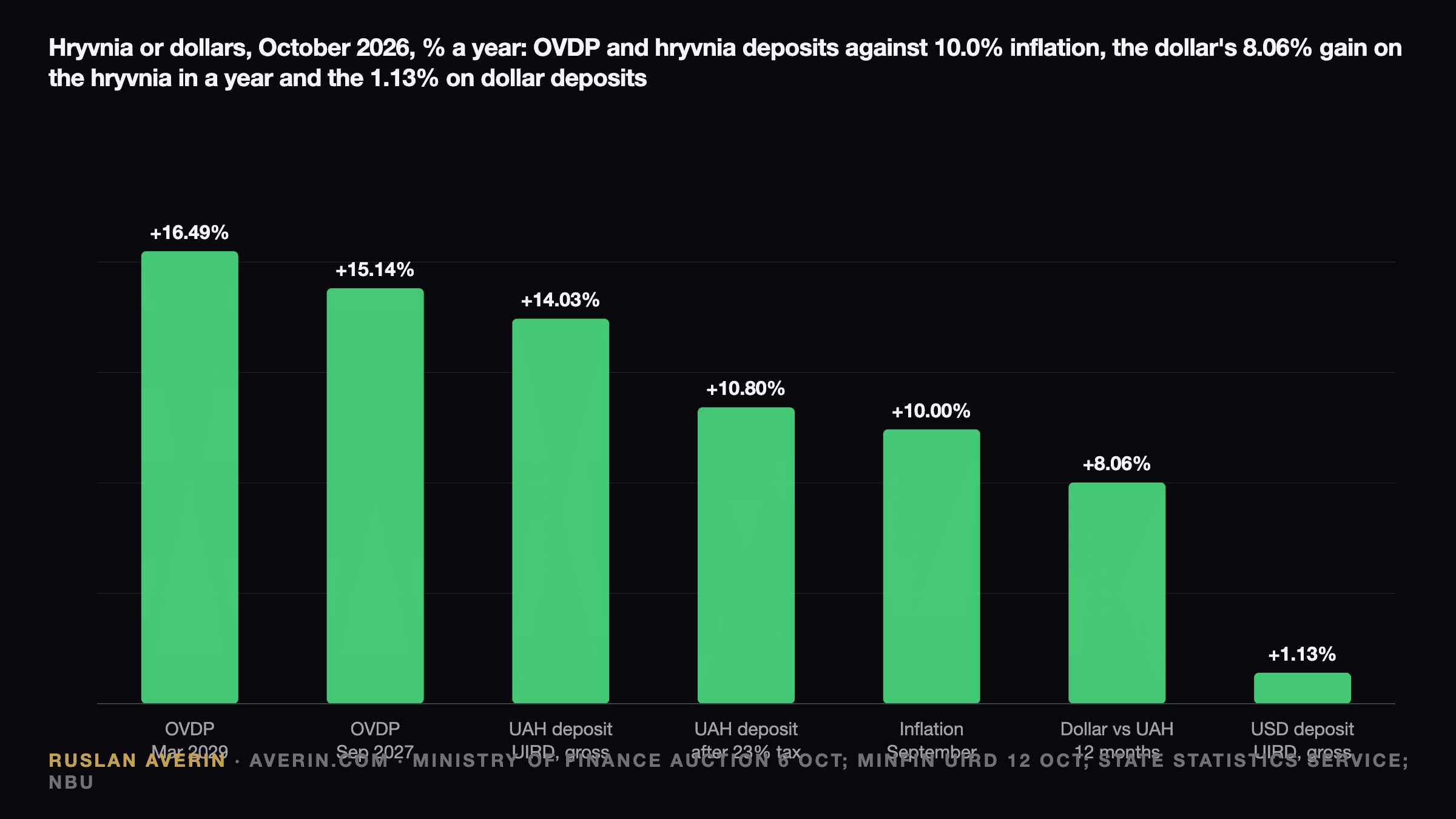
- Hryvnia deposits. The UIRD 12-month index for hryvnia deposits is 14.03%. After the 23% tax on deposit income (18% personal income tax plus 5% military levy) that is about 10.80%.
- Hryvnia OVDP. At the 6 October auction the Ministry of Finance sold bonds maturing in September 2027 at a weighted average 15.14%, and bonds maturing in March 2029 at 16.49%. Interest on OVDP is not taxed. Households held UAH 167.5 billion of OVDP on 1 October, a record.
- Dollar deposits. The UIRD 12-month index for dollar deposits is 1.13%, or about 0.87% after tax. In September and October the Ministry of Finance placed only hryvnia bonds; at the 30 June and 7 July auctions it sold euro bonds at 3.18% and 3.08%.
The comparison is a breakeven. A one-year hryvnia deposit at 10.80% net beats a dollar deposit unless the dollar ends the year above about UAH 49.4. A one-year OVDP at 15.14% beats it unless the dollar goes above about UAH 51.3. Both levels are above every forecast quoted here, including the 2027 budget's year-end 48.3, which is fourteen months away.
Inflation is the other test. With prices up 10.0% in a year, a net deposit return of 10.80% is a real gain of under 1%. OVDP at 15.14% leave a real gain of about 4.7%. The dollar, meanwhile, gained 8.1% against the hryvnia over the last twelve months and paid almost nothing on top.
In analyst Ruslan Averin's view, the numbers favour hryvnia instruments for money that will be spent in hryvnia within a year. Dollars remain the hedge against a sharp devaluation and for spending priced in dollars, such as travel or tuition abroad. The breakeven arithmetic supports splitting savings rather than betting on one rate. What would change that: a 29 October decision that falls behind inflation, or a further slip in partner financing.
Related: the dollar at 45 in September and the forecasts to 2027, nine weeks of NBU dollar sales and the NBU's 16% key rate decision.