
On Wednesday evening Maksym Shkil, the owner of Autostrada, Ukraine's largest road builder and Kyiv's largest infrastructure contractor, wrote on Facebook: "Today the state, in one day, without warning, discussion or dialogue, stopped funding all capital expenditures." Autostrada, he said, was "forced to stop work on all sites". A few hours earlier Roksolana Pidlasa, who chairs the parliamentary budget committee, had described the same decision in a podcast in the bureaucratic register: the Ministry of Finance "amended the budget schedule and deferred some September, October and November spending to December. First of all capital spending: construction and reconstruction, including hospitals; shelters in hospitals and schools; energy protection; social housing." For September alone the deferred amount is 39 billion hryvnias, and she was candid about what December means: "it means they will not be financed at all this year, because it will simply be impossible to do".
Our analysts have followed the financing gap since the draft 2027 budget appeared on Monday, in the piece on who pays for 2027. This is what it looks like when the gap arrives early. The state is not out of money; it is out of the money it had planned to receive by now, and the first thing it stops paying for is concrete.
What was stopped, and what was not
The decision was not one event but a sequence. On 1 September Prime Minister Serhiy Koretskyi announced "a strict regime of economy of budget funds that are not assigned to defence needs", saying the government had "already found 70 billion hryvnias of savings" for the army and that "there will be no problems with pensions and salaries". In early September unprotected spending, meaning repair, reconstruction and construction, was paused, while salaries, social benefits and transfers to local budgets were not. On 10 September finance minister Serhiy Marchenko told the Rada finance committee that "we have reached the limit" and set out the order of payment: "revenues will come in, and first of all we finance the security and defence sector. Then, as soon as financing appears, we finance all other expenditures. This will apply not only to the state budget but to all budgets, including local ones. Any support programmes, capital construction and others will effectively be suspended until we have enough liquidity." From 15 September, according to deputy Olha Vasylevska-Smahliuk, only three lines were being funded: social spending, public-sector salaries and the military. On 17 September the schedule was formally rewritten.
| What | Status from 17 September | Source |
|---|---|---|
| Construction and reconstruction, incl. hospitals | deferred to December | Pidlasa |
| Shelters in hospitals and schools | deferred to December | Pidlasa |
| Energy protection, resilience plans, winter preparation | deferred to December, 39 bn UAH from September | Pidlasa, EP |
| Social housing | deferred to December | Pidlasa |
| Support programmes for business | suspended until liquidity allows | Marchenko |
| Public-sector salaries, pensions, social benefits | paid | Pidlasa, Koretskyi |
| Military pay and defence procurement | paid first | Marchenko |
| Local budgets, capital items | same restrictions | Marchenko |
Minfin has not commented on Autostrada's statement and Kyiv's city administration has not reacted publicly. What is known is what stops in the capital: the metro extension to Vynohradar, under a 13.8 billion hryvnia contract Autostrada signed in 2024 after the previous contractor was dismissed with 4 billion already paid, and which Mayor Klitschko had promised to open by the end of 2027; the 1.2 billion hryvnia overhaul of Kharkivske highway, 5.4 kilometres under way since October 2025; and the rebuild of the Chernihivska interchange, started in April. Shkil's own aside is worth keeping: in "a colossal budget deficit" some projects are "inflated in terms of scope of work and, accordingly, budget", and every estimate should be re-examined. Kyiv, for its part, signed a 2 billion hryvnia credit line with Ukrgasbank on Thursday for winter preparation, which is the city financing what the state was supposed to.
Why September
The budget was not failing on its own revenues. January to July: revenues 3,249 billion hryvnias, expenditures 3,437 billion, a deficit of 187 billion, 3.6 times smaller than a year earlier. But 1,001 billion of those revenues, 30.8%, were international transfers, up 4.6 times year on year; without them domestic revenues covered 65.4% of spending and the gap was 1,188 billion. Defence and security took 2,470 billion, 71.9% of all spending and about 221 billion more than every domestic revenue combined. Former NBU Council chair Bohdan Danylyshyn, who assembled those figures on Thursday, drew the conclusion the ministry is now living: "the state of public finances is not yet a crisis, the budget is being executed with a creak... But the January–July figures show that this stability has a very high external dependence. If external financing is delayed, the domestic market will not be able to replace it quickly and painlessly in the required volume."
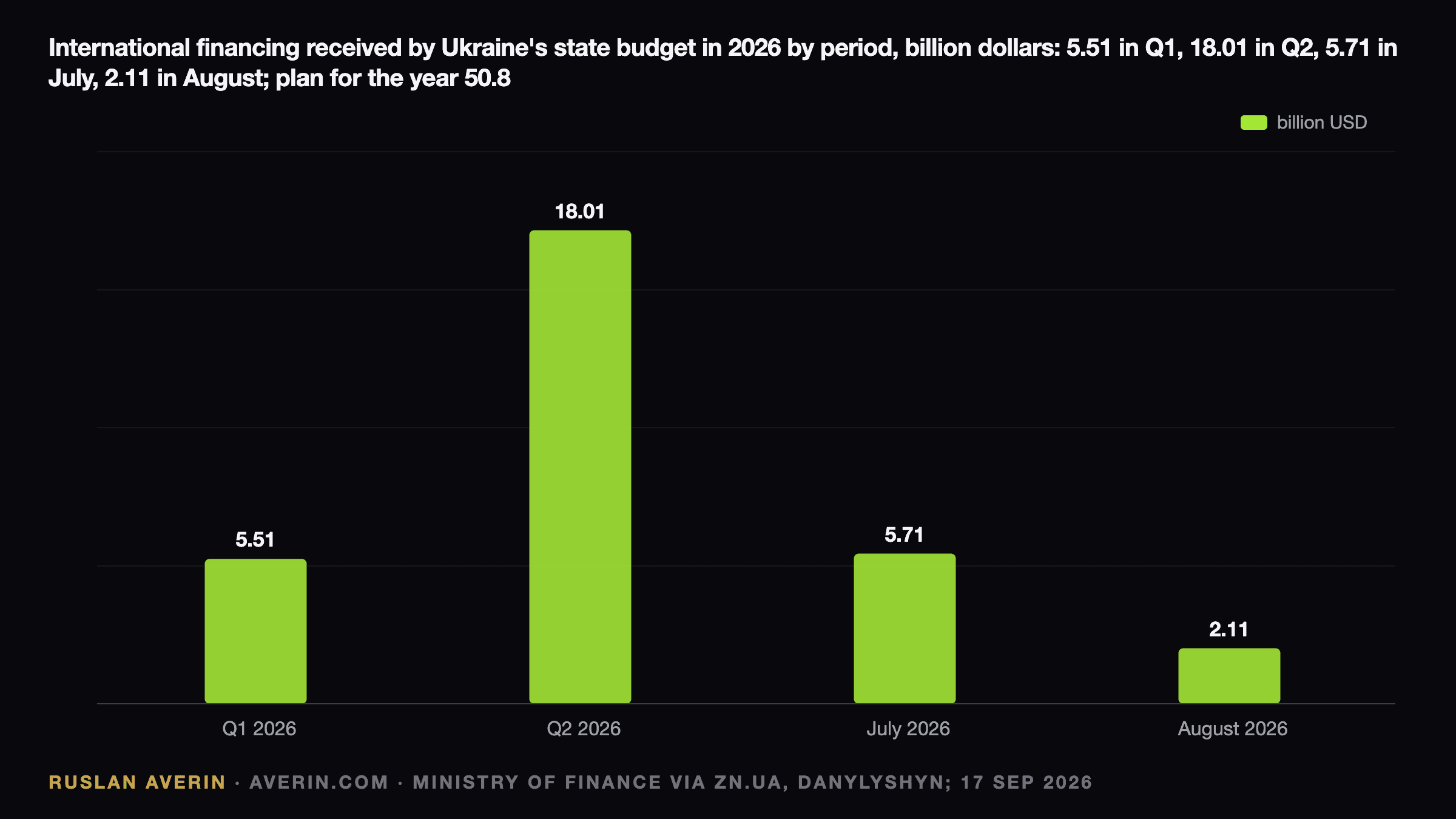
External financing was delayed. The Ministry of Finance's own series: $5.51 billion in the first quarter, $18.01 billion in the second, $5.71 billion in July, $2.11 billion in August, $31.34 billion for the year so far against a plan of $50.8 billion. Pidlasa's version is blunter, "we planned $50.8 billion and received about $21 billion", presumably counting budget support only. In 2025, 41% of the year's aid arrived in the fourth quarter; the same back-loading in 2026 has met a budget that spends 491 billion hryvnias a month.
Three smaller things happened at the same time. Tax revenue to the general fund was 947 billion hryvnias after eight months, 33.1 billion below plan, with August the worst month of the year: domestic excise down 12%, dividends from state companies down 17%, and VAT alone, Pidlasa says, "under-collected by $1.35 billion in eight months", a quarter of it in August after the stoppage of Zaporizhstal and the port attacks. Koretskyi estimated on 12 September that the attacks could cost the budget about 70 billion hryvnias of tax. And the Treasury single account, the state's current account, fell 47% in August to about 378 billion hryvnias by analyst Andriy Shevchyshyn's estimate, "enough for roughly two months" without external money. Marchenko warned on 15 September that public-sector salaries could be delayed if inflows to the account fell further.
Which tranches are stuck, and on what
The blocked money has names. The IMF staff visit led by Gavin Gray, which began on 31 August, ended on 15–16 September without a staff-level agreement on the second review of the $8.1 billion programme approved in February; the Fund did not compromise on the law imposing VAT on parcels under €150, and there was no public statement. At stake is about $692 million after the second review and about $970 million after the third, $1.66 billion this year. The same parcel law is a condition of the EU's €3.7 billion instalment under the €90 billion Ukraine Support Loan. Pidlasa's timeline: "the law should have been passed by the end of August, then the tranche would have come in mid-September. It was passed in mid-September, so at best the money will come at the end of October, two months late. But spending was calculated on that money." The Rada gave the parcel bill its first reading on 16 September, 216 votes, at the third attempt, with the VAT itself not starting before July 2027.
The rest of Pidlasa's list from 15 September: the president's signature on the digital-platforms tax law, passed on 9 June and worth about 14 billion hryvnias; the independence of the energy regulator; the completion of the Accounting Chamber. Koretskyi told the G7 and EU ambassadors on 15 September that "a significant part of $29.5 billion" of international financing to the end of the year was at risk, that the government "must implement 42 decisions", and that parliament would receive a schedule of deadlines; the reform deadline has been moved to 15 October. On 1 September he had counted 17 bills the government had not yet submitted and 14 of 26 in parliament not on the agenda. Brussels' position, from Valdis Dombrovskis on 11 September: "First of all we need to establish exactly what these additional financing needs are, and then discuss with the Ukrainian authorities how to finance them." Kyiv had not filed a formal request. The €3.3 billion Ursula von der Leyen announced on Wednesday for missiles and drones is defence procurement from the same loan, not budget support, and follows €6.1 billion approved for air defence in August; it does not pay for shelters or the metro.
What is arriving: $841 million of World Bank budget support under a Canadian guarantee, earmarked for pensions; 1 billion Norwegian kroner, about €90 million, through the Ukraine Facility, Norway being the first non-EU country in that instrument; the NBU's July forecast of about $54 billion of direct support for 2026 still stands on paper. The central bank's wording on Thursday, in the release that raised the key rate to 16%, was as close as the NBU comes to a warning: "against the background of lower than expected official financing in July–August, fiscal policy was more restrained and international reserves declined... The restoration of the regularity and sufficiency of international assistance is critically important for the stability of public finances and for price stability." Reserves were $48.66 billion on 1 September, down 5% in the month, and the NBU is selling about $5 billion a month to hold the hryvnia at 44.66.
The domestic market cannot fill it
The obvious substitute is domestic borrowing, and the numbers say why it is not one. Government bonds raised 343.5 billion hryvnias from January to August and 296.5 billion went to redemptions; net new money was 46.9 billion, meaning 86.3% of issuance refinanced old debt. Danylyshyn: "net borrowing from OVDP is tens of times smaller than the budget gap without international transfers", and "it is easier for banks to put liquidity into government debt than to lend to production projects with war risks". This week's auction on 15 September raised 2.01 billion at 15.17% for one year and 16.10% for 2.5 years, the same paper that individuals now hold 163 billion of. Monetisation by the central bank is not on the table: the NBU said nothing of the kind on Thursday, and Minfin.com.ua's analysts wrote that "direct financing of the deficit by the National Bank would create inflation and exchange-rate risks and should not be the baseline solution". The 2027 draft prices new domestic debt at about 14.8% and external at 5.4%, which is the whole reason the budget is built on the second.
What it means for 2027
The draft budget submitted on 15 September is the same structure one year on. Revenues 5.648 trillion hryvnias, of which 2.493 trillion are grants from the EU loan, the Ukraine Facility and ERA; expenditures 7.272 trillion; a deficit of about 1.62 trillion, 15% of GDP; security and defence 4.885 trillion, 43.8% of GDP and two-thirds of spending, with 3.762 trillion for the Ministry of Defence and 2.30 trillion for weapons, up 1.4 billion in nominal terms, which is a real cut. The external financing need is $52.6 billion, of which about $20 billion is confirmed and $32.6 billion, in Pidlasa's words, "is still not confirmed". Macro assumptions: GDP growth 1.3%, inflation 8%, an average exchange rate of 47.1 and 48.3 at year-end, a minimum wage of 9,546 hryvnias against 8,647 in 2026. Marchenko on Wednesday: "not a single state body's budget request is fully satisfied", and "our internal capabilities are exhaustible, they are limited, we cannot count on a significant increase in revenues".
The capital lines that were frozen this week reappear next year at modest sizes. Public investment projects: 116 billion hryvnias, 76.4 billion of it from partners, 3.9 billion more than in 2026. The road fund, abolished for three years, is partly restored at 52.8 billion, but most of it goes to repay debts from the 2019–2021 "Great Construction"; roads got 12.6 billion in 2026, enough, by the road agency's own account, for 15% of the network. Shkil again: "the collapse we had in spring with the roads is a direct consequence of three years of living without the fund." Energy gets 97.3 billion, 60 billion of it for protecting and restoring plants and for distributed gas generation; regions 133.6 billion, up 42.2 billion, mostly for resilience plans; єОселя 45 billion, up 27.9 billion. More than 131 billion of the revenue side exists only if parliament raises VAT by one point and fuel excise by four, which Pidlasa personally rates "unlikely"; the 21% VAT proposal to fund a 58.7 billion war-risk insurance fund has not been decided, and the NBU estimates it would add 0.4–0.7 points to inflation. First reading is expected in late October, amendments are due by 1 October.
Economist Oleh Pendzyn's reading of the draft is the harshest on record: "the main question in this budget is where the money will come from, because the situation is absolutely catastrophic", with money for military pay in 2026 "left for two months". Ivan Us of the National Institute for Strategic Studies puts the same point without adjectives: "any delays on the part of partners put the execution of civilian expenditures at risk." The IMF's own numbers, as reported by Minfin.com.ua, have 2026 growth at 1–1.6%, year-end inflation at 10.5%, a deficit without grants of about 2.15 trillion hryvnias or 21% of GDP, and a financing gap of $136.5 billion for 2026–2029.
What our analysts conclude
The team's reading is that 17 September is not a fiscal crisis but a cash-flow event with a political cause, and that the distinction matters for what happens next. The budget is executing; the deficit is a third of last year's; the money that is missing is money that partners have committed and conditioned on laws the Rada has been slow to pass. When the parcel law and the digital-platforms signature clear, about $2.4 billion from the IMF and the EU is released, the Treasury account refills and December, in Pidlasa's phrase, does not have to mean never. The cost in the meantime is real and falls on the least protected lines: a metro line that will now not open in 2027, hospital shelters not built before winter, a contractor that has to carry "wages of entire industries, loan interest, supplier payments" while "they have their own business plan and we are simply presented with a fait accompli".
Two structural points follow. Danylyshyn's proposal, a quarterly aid schedule for 12–18 months with a bridge mechanism for late tranches and three separate budget contours for current spending, defence and reconstruction, is the right architecture and it has been the right architecture since 2023; the September freeze is what its absence costs. And for a saver or an investor the episode confirms the ranking our analysts drew on Thursday: hryvnia government paper at 15–16% is priced for exactly this risk, the state will keep issuing it because the 2027 budget needs 544 billion of domestic borrowing, and the alternative uses of the same money, a Kyiv flat among them, depend on a construction sector that has just been told to stop. The next dates are 1 October for budget amendments, 15 October for the government's reform deadline, the end of October for the EU tranche if the laws pass, and 7 October for the reserves print that will show whether September's aid arrived at all.
Related: who pays for Ukraine's 2027 budget, the NBU's rate hike to 16%, the dollar at 45 and the reserves, ten weeks of NBU dollar sales and three central banks hiking in 72 hours.