
Ukraine's primary housing market goes into autumn with three numbers that point the same way. Developers expect finished flats to gain 7–10% per square metre in September–October and early-stage projects 3–5%. The state mortgage programme eOselya has lent 11.7 billion hryvnia since January, with 100 of last week's 146 loans going to new-builds. And on 15 September parliament passed, at first reading, a bill that lets displaced families add a mortgage to a housing voucher. Demand is being subsidised into a market whose costs are rising.
Investors tracking the Ukrainian market will want the detail rather than the headline, so this note sets out the cost side, the price side by city, the state credit flow week by week and the widening gap between the cheapest and the dearest one-room flats in the country.
Why the autumn repricing
The argument comes from the cost side. Marianna Bihunets, commercial director of the developer GAZDA, told 24 Kanal on 15 September that construction cost per square metre in the western regions has risen about 10% in the first eight months of 2026, that imported materials from Poland and the Czech Republic cost 10–15% more than Ukrainian ones which are being substituted, and that developers are building 2027 financial models on 47–48 hryvnia per dollar and 15–20% cost growth. Her forecast: "In September–October the average price per square metre in the most popular new-builds may rise by at least 3–5%", and for finished complexes "individual flats there may add 7–10%".
The official statistics agree on direction. The State Statistics Service's index of construction prices, as tracked by Minfin, rose every month of 2026: 1.1% in January, 1.8% in February, 9.4% in March, 3.1% in April, 1.9% in May, 1.5% in June and 1.2% in July, a cumulative 21.5% by July against 5.6% for the whole of 2025. The August reading is not yet published. The hryvnia was 44.62 to the dollar on 15 September; the NBU's key rate has been 15.5% since 30 July, with the next decision on 17 September.
What a square metre costs now
| City | Segment | Price per m², UAH | Change |
|---|---|---|---|
| Kyiv, September 2026 (LUN) | average minimum, all classes | 59,400 | +8.4% year on year |
| Kyiv | economy | 37,000 | −6.6% |
| Kyiv | comfort | 54,900 | +17.8% |
| Kyiv | business | 80,700 | +11.9% |
| Kyiv | premium | 143,400 | +4.4% |
| Kyiv, September 2026 (DIM.RIA) | average | 55,849 | range 32,741–211,770 |
| Lviv, June 2026 (LUN) | comfort / business | 61,600 / 69,700 | +23% / +20% |
| Odesa, June 2026 (LUN) | comfort / business | 38,100 / 57,600 | +2% / +27% |
| Dnipro, June 2026 (LUN) | comfort / business | ~41,000 / ~53,000 | +15% / +10% |
Two patterns stand out. Comfort class is where the price growth is, up 17.8% in Kyiv and 23% in Lviv, while economy class in Kyiv has fallen 6.6%. And the premium for a finished flat over one due for delivery by year-end is 20–30%, widening to 50–60% against projects scheduled for 2027. GAZDA expects 60–70% of active buyers in September–October to look for finished or nearly finished stock, and puts more than half of potential buyers in the western cities of Lviv, Uzhhorod, Ivano-Frankivsk, Lutsk and Ternopil.
eOselya: 11.7 billion hryvnia and counting
The state programme is now almost the entire Ukrainian mortgage market: 93–97% of new mortgages by bank and NBU survey counts, because commercial rates outside eOselya run from 16.99% to 20–23% with a 20% down payment. Inside the programme the rate is 3% for military, medics, teachers, scientists and security personnel and 7% for veterans, displaced people and families without housing, rising to 6% and 10% from the eleventh year, on loans up to 5 million hryvnia for up to 20 years.
| Weekly report | Loans | Million UAH | Loans since January | Billion UAH since January |
|---|---|---|---|---|
| 28 July 2026 | 141 | 278.0 | 4,815 | 9.4 |
| 3 August | 164 | 340.0 | 4,979 | 9.7 |
| 10 August | 117 | 258.6 | 5,096 | 10.0 |
| 17 August | 157 | 327.6 | 5,253 | 10.3 |
| 7 September | 172 | 365.3 | 5,763 | 11.4 |
| 15 September | 146 | 308.0 | 5,909 | 11.7 |
Last week's 146 loans were 100 on the primary market, 61 of them in buildings still under construction, and 46 on the secondary market; 81 borrowers took the 3% rate, 38 of them military and 30 veterans, and 65 took 7%, 47 of them families without housing and 18 displaced people. Kyiv region took 61 loans, Kyiv city 15 and Lviv region 13. The average loan works out at about 2 million hryvnia. Since October 2022 the programme has financed more than 28,000 families for 50 billion hryvnia; 43.7% of borrowers were aged 26–35, and Kyiv region and Kyiv city together account for just over half of all lending.
Bill 15335: vouchers plus mortgages
On 15 September the Verkhovna Rada voted 278 in favour of bill 15335 at first reading. It amends the laws on mortgages, property registration and notaries so that a displaced person from occupied territory, under Cabinet resolution 1176 of September 2025, can combine a housing voucher of up to 2 million hryvnia with a bank loan and pledge the purchased home as collateral. Resale and refinancing would stay prohibited except for foreclosure by the lender. War veterans and people disabled by the war come first.
The scale of the queue explains the vote. By July 42,987 families had applied for vouchers, 35,173 had been approved, and 3,296 had been funded for 6.59 billion hryvnia, with 3,228 purchases completed. The programme's need is put at 64 billion hryvnia; the Council of Europe Development Bank is contributing 80 million euros in two tranches, the first this September, enough for roughly 2,000 vouchers. In the large cities a voucher alone does not buy a flat, which is why the right to top it up with a mortgage matters. The bill still needs a second reading.
The cheapest and the dearest one-room flats
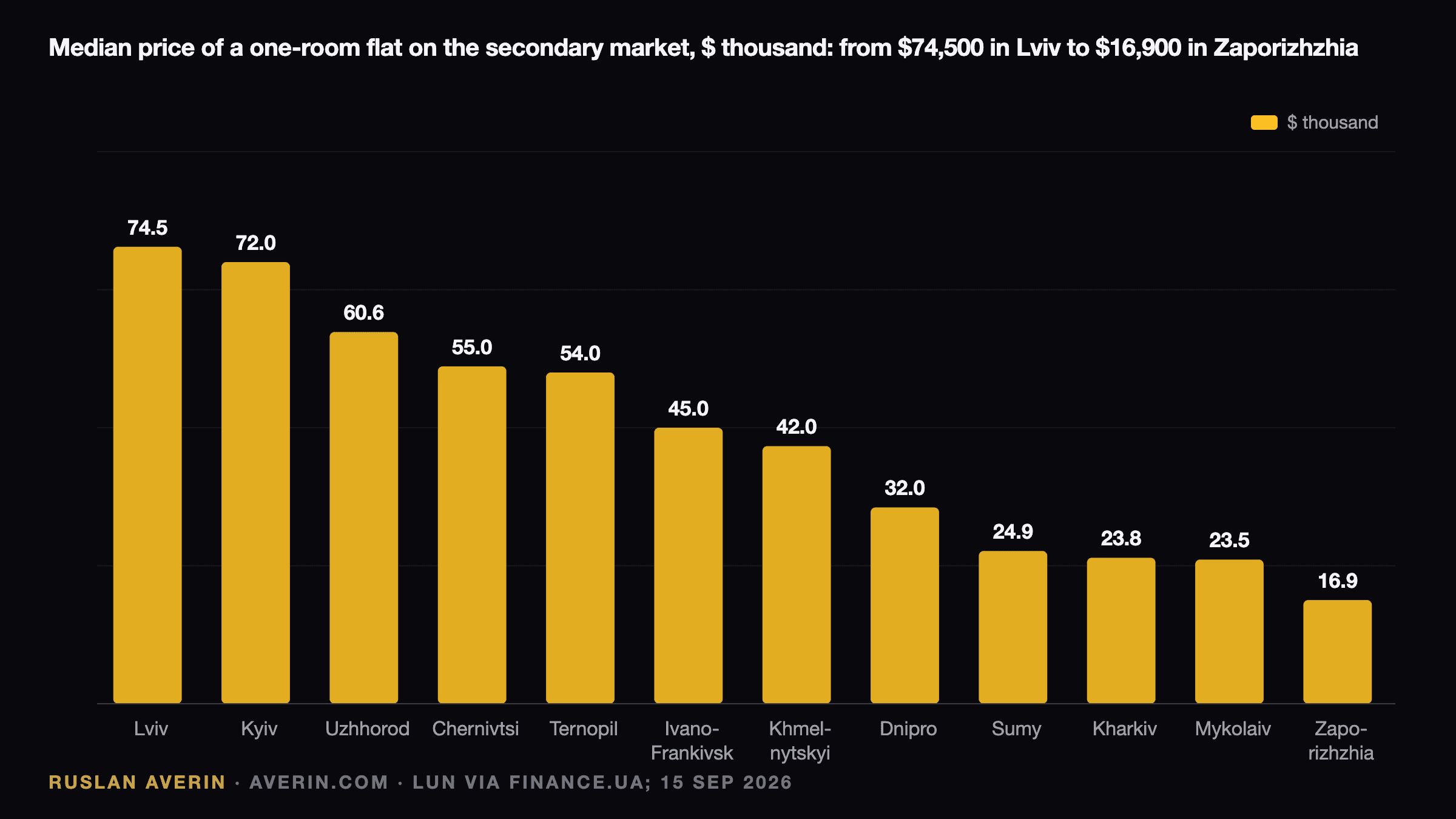
The regional spread is the widest it has been. By LUN's medians reported on 15 September, a one-room flat on the secondary market costs $74,500 in Lviv, up 16% in a year, and $72,000 in Kyiv, up 5%. Uzhhorod, Lutsk, Vinnytsia and Rivne sit at $56,700–60,600; Chernivtsi and Ternopil at $54,000–55,000 after rises of 28%; Ivano-Frankivsk about $45,000 and Khmelnytskyi about $42,000.
Then the map breaks. Dnipro is $32,000, down 8% in a year. Sumy is $24,900, Kharkiv $23,500–24,000, up 7%, Mykolaiv $23,500 and Zaporizhzhia $16,900, the lowest median among the regional centres. Sloviansk and Kramatorsk list at $3,000–14,000. DIM.RIA's regional averages for August tell the same story from the other end: Kherson region $15,500, down 9% in a month, Zaporizhzhia region $17,500, Mykolaiv region $20,000, against Kyiv city at $89,500 and Lviv region at $81,000, with Cherkasy, Chernivtsi and Zakarpattia regions posting the largest monthly gains at 7–10%.
The extreme is a house. UNIAN reported on 15 September a three-room village house of 50 square metres on 16 sotkas near the Dniester in Onut, Chernivtsi region, listed for $3,000; other houses in the region list at 5,000–12,500 euros, mostly old stock without gas, with a stove and a well. In the city of Chernivtsi itself the average private house is about $140,000.
What the numbers say together
Analysts reviewing the September data read it as a market splitting in three. In the western cities and Kyiv, subsidised credit and rising build costs push finished new-builds up 7–10% while economy-class stock stagnates. In the frontline regions prices are flat or falling in dollars, and a state voucher, once bill 15335 passes, becomes the only bridge to a purchase. And between them sits a state programme lending about 300 million hryvnia a week at 3–7% in a country where the central bank rate is 15.5%, which is why comfort-class new-builds in Kyiv have gained 17.8% in a year while the hryvnia has been defended with $1 billion a week of NBU dollar sales.
In analyst Ruslan Averin's view the autumn repricing is real for finished stock and marginal for the pit stage, where the 50–60% discount to completed flats already prices the 2027 cost inflation developers are quoting. A buyer with eOselya eligibility is paying 3–7% for money that costs the market 17–23%; the arithmetic of that subsidy is larger than any 7–10% autumn move.
Related: apartment prices doubled in seven years, eOselya's new rules from July 2026, buying at the pit stage in Kyiv and the full map of Ukraine's housing programmes.