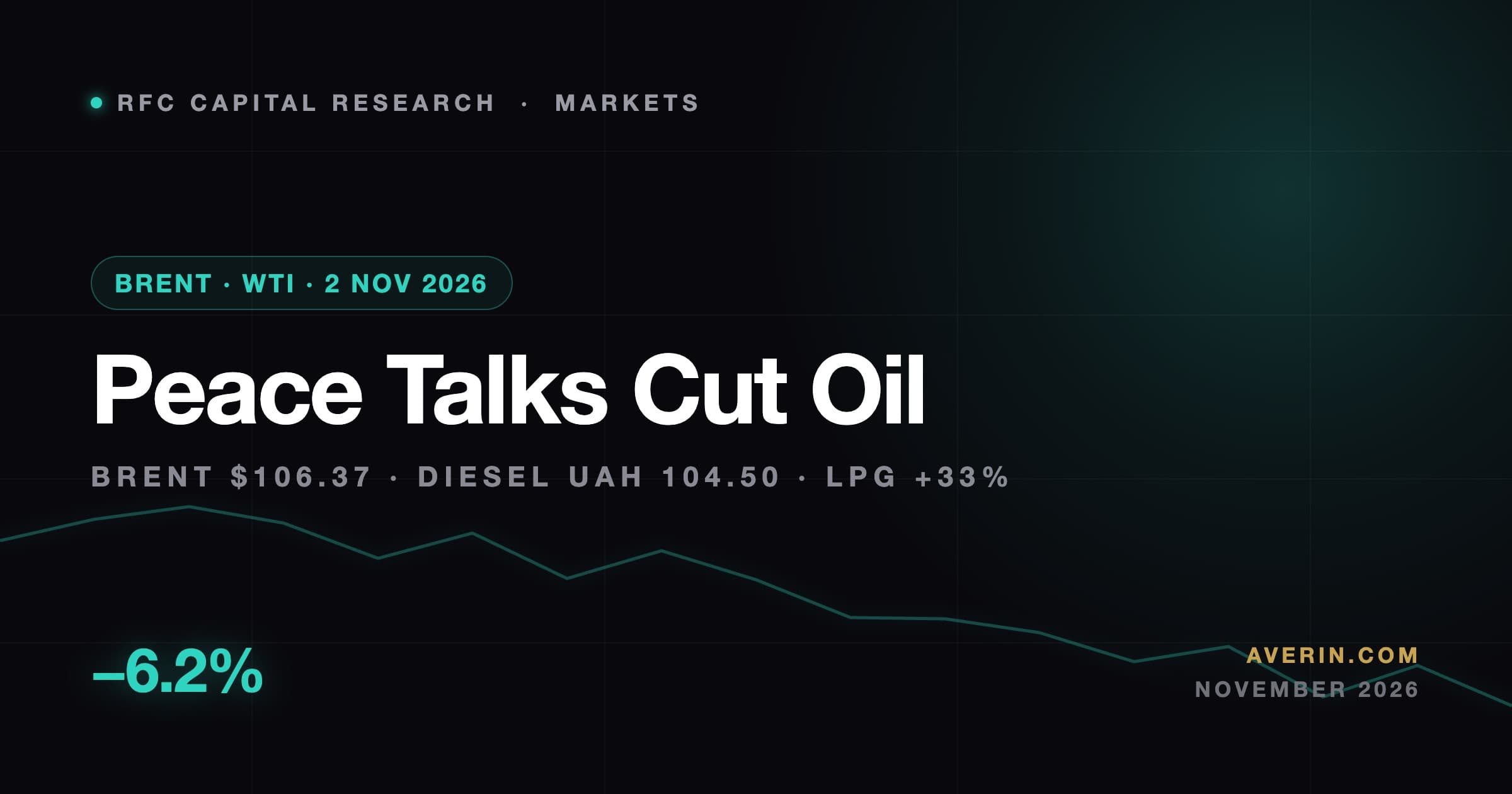
Oil prices fell sharply on Monday 2 November after three days of talks between Iran and Qatari mediators on a plan to end the US–Israel war on Iran and reopen the Strait of Hormuz. In trading on Monday, Brent for January delivery was down 6.2% at $106.37 a barrel and WTI down 6.2% at $97.63 at 8:40 a.m. ET, according to CNBC.
Financial analyst Ruslan Averin reads the move as a cut in the war premium, not a change in physical supply, and that matters for Ukrainian drivers: pump prices have not followed oil down before, and diesel and autogas rose fastest in October.
The numbers: Friday settlement, Monday trading
| Contract | Settled Friday 30 October | In trading on Monday 2 November | Source |
|---|---|---|---|
| Brent, January | $113.43 | $108.64 (−4.2%) at 10:20 GMT; $106.37 (−6.2%) at 8:40 a.m. ET | Reuters; CNBC |
| WTI, December | $104.12 | $99.71 (−4.2%) at 10:20 GMT; $97.63 (−6.2%) at 8:40 a.m. ET | Reuters; CNBC |
| Brent, December (expired) | $117.64 | — | CNBC |
The Friday settlements for the January Brent and December WTI contracts are those implied by Reuters, which reported Brent down $4.79 at $108.64 and WTI down $4.41 at $99.71 on Monday morning. The expiring December Brent contract settled at $117.64 on Friday, up 2.4%, CNBC said, close to the wartime closing high of $118.35 set in March.
The Monday prices are intraday quotes, not settlements.
What the Iran–Qatar talks are about
The war began on 28 February with US and Israeli strikes on Iranian targets, CNBC recalls; a preliminary agreement signed on 17 June broke down weeks later. President Trump has left open the possibility of renewed strikes after the midterms.
The current round started on Friday 30 October, when Qatari mediators held more than 12 hours of talks with Iranian officials in Tehran, CNBC reported citing a source familiar with the discussions. The talks moved to Doha over the weekend. Pakistan is mediating alongside Qatar, according to Al Jazeera.
The core is a two-day plan. Foreign Minister Abbas Araghchi said it would reopen the Strait of Hormuz within two days and restart peace talks with the US, but only if Washington meets Tehran's demands, Al Jazeera reported. Those demands, as listed by Al Jazeera:
- lifting recently imposed US sanctions;
- reinstating the oil waivers granted in June;
- reducing the US military presence in the region;
- recognising Hormuz shipping routes designated by Iran and Oman;
- ending the conflict on all fronts, including Israel's attacks on Lebanon.
Iranian negotiators left Doha on Sunday, and a draft proposal is circulating with a follow-up meeting possible, an official briefed on the talks told Reuters. Secretary of State Marco Rubio said he knew of no timeframe. "If there is a diplomatic solution, we would be open to it," he said, as quoted by Al Jazeera. Trump called the talks "going fine" but "not very reliable".
The risk did not disappear over the weekend. Iran's Revolutionary Guards said four tankers struck mines in Hormuz on Friday, a claim CNBC noted has not been independently verified. Kpler data cited by CNBC show crude exports through the strait fell to 7.3 million barrels a day in the week to Wednesday 28 October, more than 40% below the pre-war baseline.
What the banks say
Goldman Sachs raised its forecasts on Sunday 1 November. It now sees Brent at $105 and WTI at $94 in December, citing "high disruption risk", and builds in a global supply disruption allowance of 1 million barrels a day through 2027, CNBC reported. In its risk case, Brent could reach $140 in 2027 if Gulf output stays 3.5 million barrels a day below its 2025 average, Reuters said.
The buffer is thin. The chief executive of ADNOC said the world has drawn nearly 1 billion barrels from inventories since the war disrupted Hormuz shipping, according to Reuters.
My reading: Monday's drop prices a deal that has not been signed. Goldman's $105 December Brent is roughly where January Brent traded on Monday morning, so the market is already near the bank's base case. A signed agreement and real tanker traffic would be needed to push lower; a breakdown after Tuesday's vote would quickly bring back Friday's $113–118 levels.
Fuel in Ukraine: diesel and autogas set the pace
On Monday 2 November the national average was UAH 90.08 a litre for A-95, UAH 104.50 for diesel and UAH 58.41 for autogas, according to A-95 Consulting Group data published by Minfin.
| Fuel, UAH per litre | 1 October | 30 October | 2 November | Change since 1 October |
|---|---|---|---|---|
| A-95 | 89.27 | 90.07 | 90.08 | +0.9% |
| A-95 premium | 93.57 | 93.89 | 93.89 | +0.3% |
| A-92 | 85.98 | 86.47 | 86.35 | +0.4% |
| Diesel | 98.44 | 104.26 | 104.50 | +6.2% |
| Autogas (LPG) | 43.93 | 57.66 | 58.41 | +33.0% |
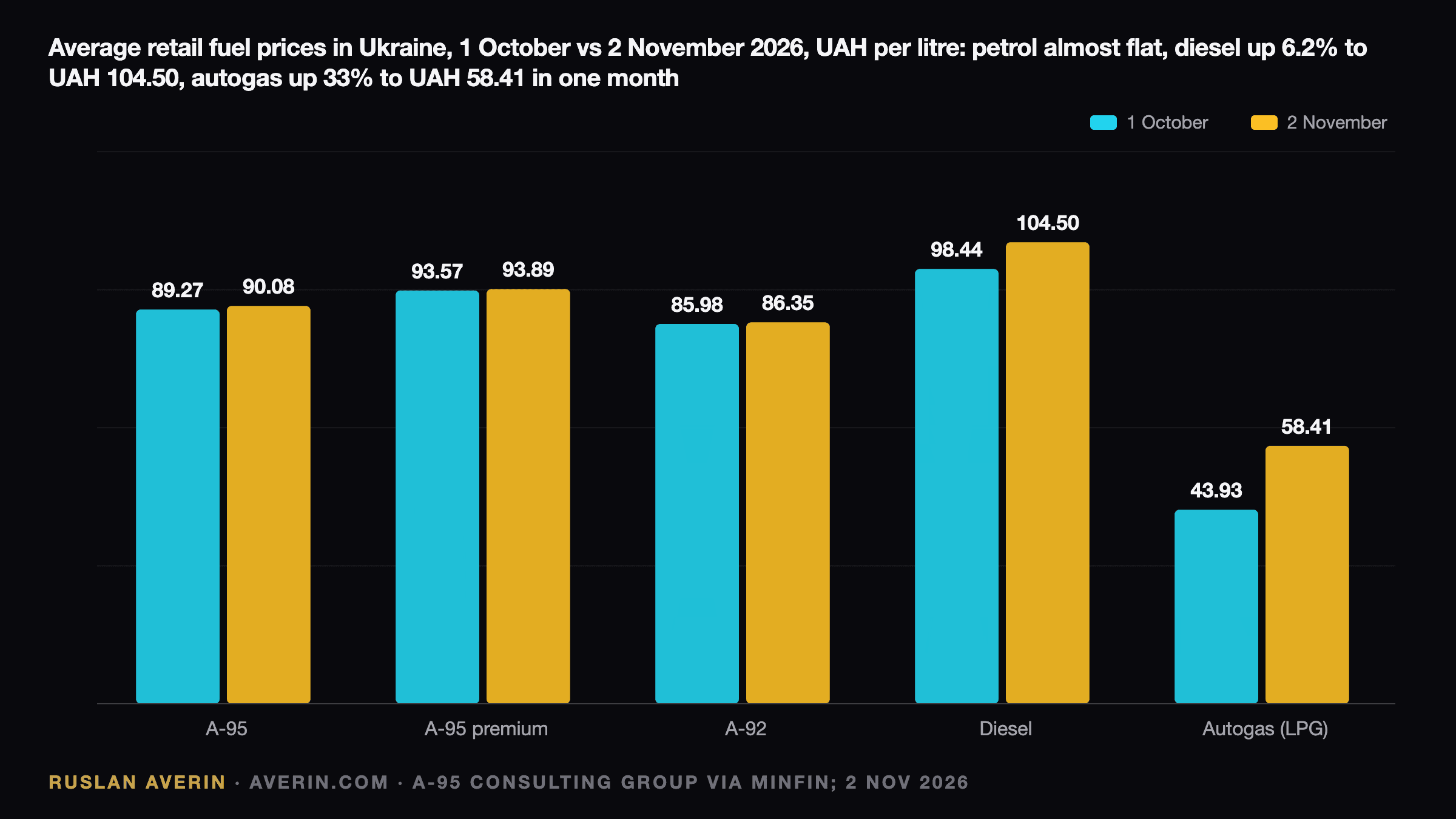
Petrol barely moved. Diesel added UAH 6.06 and autogas UAH 14.48 in a month. Autogas rose on every trading day from 5 October to 30 October, the Minfin series shows.
The National Bank of Ukraine sees fuel as the main driver of inflation. In its decision of Thursday 29 October, when it raised its rate to 16.5%, the NBU said inflation was "driven primarily by direct and second-round effects from the surge in fuel prices caused by the war in the Middle East". Headline inflation was 10.0% in September. The NBU now expects 12.5% at the end of 2026 and 7.3% in 2027, a slowdown it links to "the expected decrease in global prices for crude oil".
How cheaper oil reaches the pump, and why it is slow
A barrel holds 159 litres. At the NBU official rate of UAH 45.3526 per dollar for 2 November, each $1 change in a barrel is worth about UAH 0.29 a litre of crude (my calculation). The $7.06 fall from Friday's Brent settlement to the Monday quote at 8:40 a.m. ET is therefore about UAH 2 a litre before excise, VAT, refining and logistics.
Three things slow the pass-through:
- Ukraine imports fuel, not crude. Pump prices follow European product quotes and delivery costs, which lag Brent.
- The hryvnia. The official dollar rate rose to UAH 45.3526 on 2 November from 44.6819 on 1 October, according to the NBU, a 1.5% increase that offsets part of any oil decline.
- Margins. Oleksandr Sirenko of the consultancy Naftorynok told Fakty that retailers "traded at zero" on diesel for a long time and need to rebuild margins, so even if diesel quotes fall, pump prices are unlikely to follow. He expects autogas to cross UAH 60 a litre in November.
My base case for November: petrol roughly flat near UAH 90, diesel holding above UAH 100, autogas still rising. A durable drop in pump prices needs Brent to hold below about $105 for several weeks and a stable hryvnia. For the full price history and network-by-network prices, see the fuel prices in Ukraine hub.
What to watch next
- Tuesday 3 November: US midterm elections; renewed US strikes have been left open for after the vote.
- Washington's response to the two-day Hormuz plan and any follow-up meeting in Doha.
- Thursday 5 November: the NBU Inflation Report with the detailed October forecast, including fuel assumptions.
- Weekly Kpler and tanker data for Hormuz flows; a rise from 7.3 million barrels a day would be the first physical sign of de-escalation.
Related: Brent at $111 after the Shaybah strike, oil slides on US–Iran talks in September, Exxon and Chevron Q3 2026 results and the fuel shock and inflation.