In eight days the AI industry has had a resignation, a manifesto, a chorus of co-signatures, a presidential "hoax", and on Tuesday a rebuttal from Mark Zuckerberg that the New York Times headlined as taking aim at Anthropic. The stocks moved before most of it was written. The Philadelphia semiconductor index lost 5.86% on Monday, Oracle is down 28% for the year, and Meta, the company that said no to slowing down, is the one that went up.
I am not going to adjudicate whether an agent swarm can take over the internet in six to twelve months. I hold positions in this sector and my question is narrower: did anything in the last week change what the money is going to do?
The week, in order
| Date | Event |
|---|---|
| 8 Sept | Jacob Coxon resigns from Anthropic: labs are "racing straight to self-improving superintelligence and gambling with our lives"; 90 million views in a day |
| 10 Sept | Oracle guides FY2027 capex to $90–95 billion with a $40 billion raise; ORCL −5.4%, Micron −4.9%, SOX −2.7% |
| 12 Sept | Dario Amodei publishes "We Must Pace the Frontier"; Altman ("I agree with Dario"), Musk ("Dario is right") and Hassabis co-sign |
| 13–14 Sept | LeCun, Sacks, Burry, Palihapitiya and Beijing push back; Jensen Huang at the All-In Summit: "Slowing down is definitely the wrong strategy"; Trump by phone: "It's a hoax" |
| 14 Sept | SOX −5.86%; NVDA −3.4%, AMD −4.4%, AVGO −4.8%, MU −5.3%, TSM −3.5%, SMCI −8.4%, CRWV −6.8%; 10-year crosses 5% |
| 15 Sept | Zuckerberg's post; Alexandr Wang follows; META +0.7% to $670.24, +4.2% over three sessions; NYT: Meta's "Watermelon" model due "in the coming weeks" |
The essay is long and more careful than the headlines. Amodei's proposal is that frontier labs "slow the pace at which we improve the capabilities of AI models", starting with a unilateral step: third-party evaluators from METR embedded inside Anthropic with employee-like access. He is explicit that "pacing does not mean halting model training or technical progress". The frightening line, the one Fortune pulled, is the 6–12 month horizon for a persistent botnet doing "hundreds of billions of dollars in damage".
Zuckerberg's answer is that each lab paces itself. "Every lab has the responsibility and incentive to move at the pace required to train its models safely, and the ability to take its own actions to ensure that happens." Meta, he said, delayed Muse "for several months to focus on safety and security. We didn't call for everyone else to do this before we would." And then the sentence aimed across the bay: committing "the significant majority of compute towards serving people rather than racing towards recursive self-improvement is one of the best ways to ensure we develop this technology safely".
The market got the causality backwards
The tidy story is that Amodei wrote on Saturday and chips fell on Monday. The tape says otherwise. The sell-off began on Wednesday 10 September with Oracle's numbers: fiscal-2026 capex of $55.7 billion, up 162%, free cash flow of −$23.7 billion, a $90–95 billion plan for the year that started in June and $40 billion of new debt and equity to pay for it. That is not a slowdown story; it is a financing story, and it landed in the same week the 10-year Treasury went to 5% and Brent to $108. Bond yields, not essays, set the discount rate on a data centre that pays back in 2031.
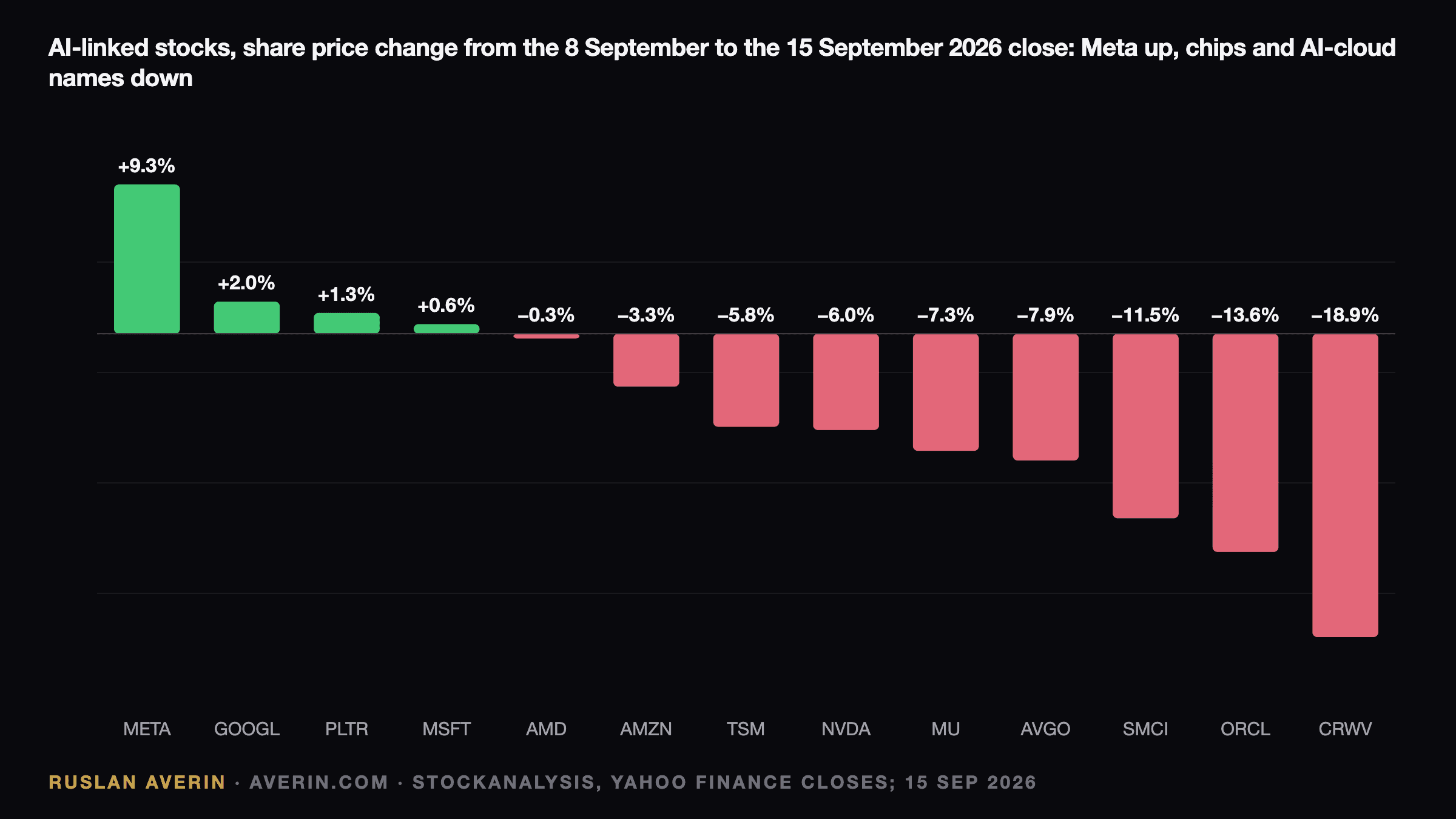
Two details confirm it. Cybersecurity stocks rallied on Monday, Okta +5%, CrowdStrike and Palo Alto +4.5%, which is what happens when the market takes Amodei's cyber warning literally. And Meta, the one large model builder that publicly refused to slow down, rose 9.3% in the week from 8 to 15 September while Nvidia fell 6.0%. If the market believed capability progress was about to pause, the company spending $130–145 billion this year on it would not be the winner.
Capex is not slowing, it is being refinanced
| Company | 2026 capex guidance | Previous | Date |
|---|---|---|---|
| Amazon | $220 billion | $200 billion | 30 July |
| Alphabet | $195–205 billion | $180–190 billion | 22 July |
| Microsoft | ~$175 billion (calendar 2026) | $190 billion before accounting change | 29 July |
| Meta | $130–145 billion | $125–145 billion; $115–135 billion in January | 29 July |
| Oracle | ~$70 billion net, $90–95 billion gross (FY2027) | $55.7 billion actual FY2026 | 10 September |
| Total, midpoints | ≈ $800 billion |
Every number in the second column was raised in the summer; none has been cut since. Amazon blamed "soaring memory chip prices" for its $20 billion increase, which is why Micron is up 225% for the year even after last week. Alphabet's CFO said 2027 capex will "significantly increase". Consensus for 2027 across the group is $920 billion, Goldman's base case is $1.1 trillion with an upside case of $1.4 trillion, and Morgan Stanley is at about $1.1 trillion. The suppliers confirm it from the other side: Nvidia's July quarter revenue was $96.2 billion, up 106%, with a $108 billion guide for the current quarter; Broadcom's AI semiconductor revenue was $16.7 billion, up 221%, with $21.7 billion guided.
What the essay could change is the mix, not the total. "Pacing" as Amodei describes it shifts hours from training the next frontier model to evaluating the current one; Zuckerberg's version shifts compute from training to "serving people", which is inference. Both are GPU-heavy. The names with the most to lose from a training pause are the ones leveraged to a single customer's training schedule, which is why CoreWeave, down 18.9% in the week and 40% from its high, and Oracle, with $300 billion of OpenAI commitments in the tally, took the worst of it. Nvidia at 17.6 times forward earnings did not.
Follow the incentives, then the revenue
The sceptics' argument is not a technical one. Michael Burry: "Let's all take a moment to understand how self-serving it is for OpenAI, Anthropic and other execs of big hyperscalers to talk of slowing things down." David Sacks: "stop pretending the motivation to slow down is purely altruistic. You face massive product-liability exposure if your products enable a truly damaging cyberattack." The company asking for a speed limit closed a $65 billion round at a $965 billion valuation in May, reported a run-rate of $65 billion in revenue at the end of July, up from about $9 billion at the end of 2025, and has filed confidentially for a listing this autumn at a reported $2 trillion target. Its competitor's chief executive co-signed the essay the same day while running a company with $1.15 trillion of compute commitments and a projected $27 billion cash burn this year.
I do not think the cynicism is the whole story, but it is the part an investor can price. A lab that already leads on enterprise usage, Anthropic was in 43.5% of businesses on Ramp's card data in August against 39.7% for OpenAI, benefits from a norm that makes the next model slower for everyone. A lab that is behind, and Meta's Llama 4 was passed by Chinese open models in the spring, benefits from no norm at all. Meta has Watermelon in training at "an order of magnitude more compute than Muse Spark", Connect on 23–24 September, and a paid agent, Hatch, at up to $199.99 a month. Zuckerberg's post is a product announcement in the grammar of a safety debate.
The demand evidence cuts both ways
The bear case on adoption is real and dated. The Census Bureau's business survey has 17–20% of US firms using AI, 37% of those with 250 or more employees. MIT's "GenAI Divide" study, from August 2025, found 95% of pilots produced no measurable profit-and-loss effect within six months. The bull case is more recent and comes from invoices: Microsoft reported more than 30 million paid Copilot seats and a $37 billion AI run-rate; ServiceNow crossed $1 billion of AI contract value; Salesforce's Agentforce is at $1.5 billion of annual recurring revenue, up 240%. Ramp's data has the median firm spending $11.95 per employee per month on AI, and the top 1% $7,400. The distribution is the story: a few companies are already paying real money, most are not yet.
That distribution is what a 5% 10-year punishes. The S&P 500 trades at 19.1 times forward earnings; Palantir at 91.2 and AMD at 45.6 need the adoption curve to steepen on schedule, and the Fed today is not going to help them. Micron at 6.4 and Nvidia at 17.6 need only for the 2026 budgets in the table above to be spent.
What I would do
Own the toll roads, not the racers. Nvidia and Broadcom get paid whether the compute goes to training or to serving; their risk is the financing of customers like Oracle, not the philosophy of Anthropic. I would not buy CoreWeave on the dip, because the thing it is leveraged to, one customer's training cadence, is precisely what the essay proposes to slow. Meta at 20.7 times earnings, up 1.5% for the year after a 9.3% week, is the interesting one: the ad business grew 27% last quarter and the AI spend is now framed as serving 3 billion people rather than chasing a benchmark, which is the framing the market rewarded this week.
In analyst Ruslan Averin's view the week's real lesson is that the AI trade has stopped being about whether the technology works and started being about who pays the interest. That question is answered at 14:00 ET today, not on X.
Related: the chip sell-off and the slowdown warning on 14 September, the 2026 hyperscaler capex cycle, Meta's AI advertising thesis and the 10-year at 5%.