The Federal Reserve announces at 14:00 ET today, and for the first time since 26 July 2023 the expected word is "raise". Futures price a quarter-point move to 3.75–4.00% at 91 to 93%, sixteen of twenty banks call it, and the 10-year Treasury spent Tuesday above 5% for the first time since July 2007. Kevin Warsh has been chair since 22 May; this is his first meeting where the decision, the dot plot and the press conference all point the same way.
I hold long Treasuries, so I have a view on the outcome and a bigger stake in the reaction. The number that matters to me is not the funds rate. It is what the 10-year does at 14:31.
What is on the table
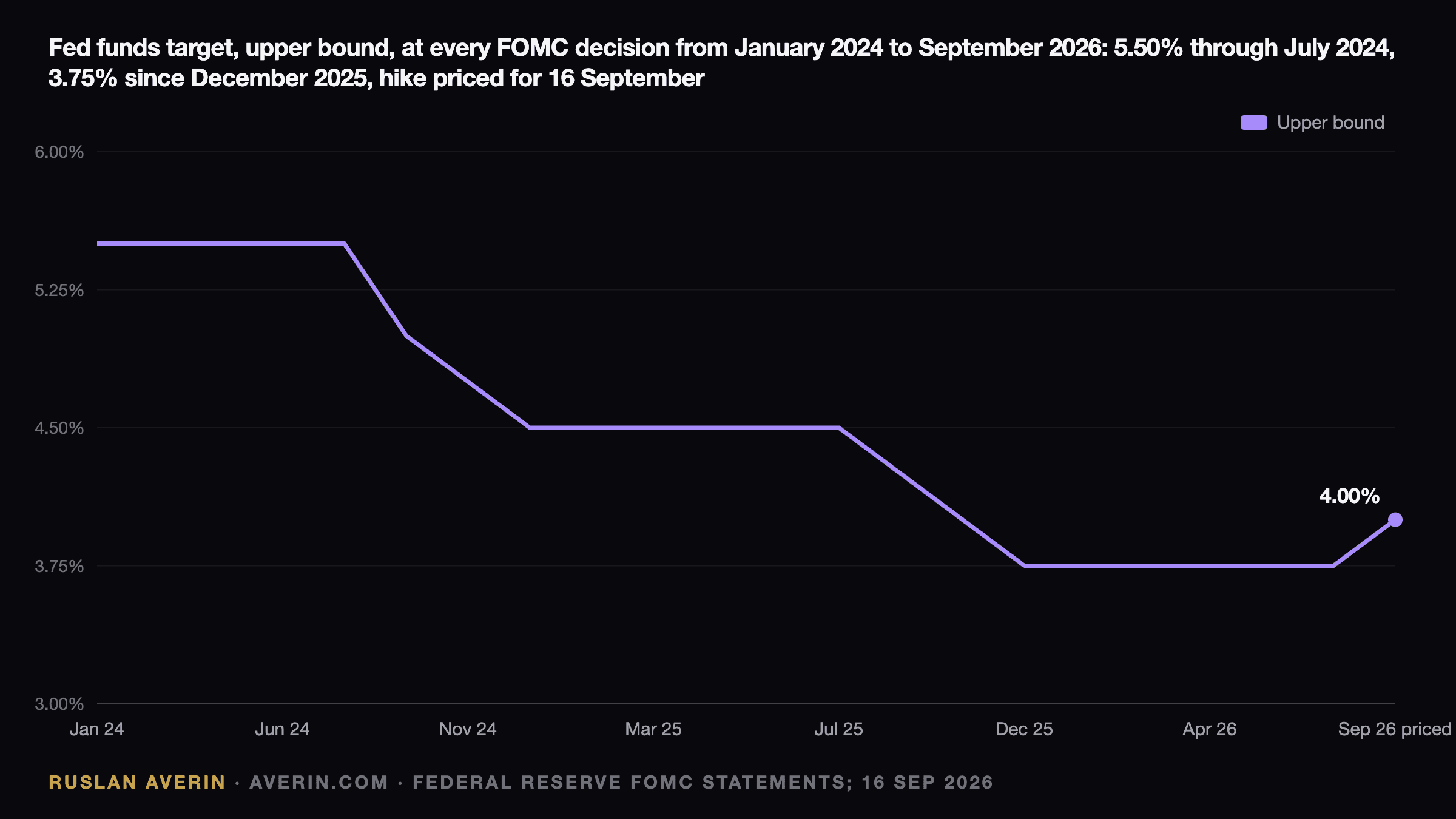
The target range for the fed funds rate has been 3.50–3.75% since the 10 December 2025 cut. The Committee held five times in 2026, and the votes tell the story of the drift: 10–2 in January with Miran and Waller wanting a cut, 8–4 in April with the most dissents since 1992, 12–0 at Warsh's first meeting in June, then 9–3 in July with Hammack, Kashkari and Logan voting to raise. The July minutes said "several" participants thought "policy tightening would likely be necessary if inflation did not decline". It did not.
| Indicator | June SEP assumption | Latest print | Direction for the Fed |
|---|---|---|---|
| PCE inflation 2026 | 3.6% | 3.7% y/y (July) | above |
| Core PCE 2026 | 3.3% | 3.3% y/y (July) | on target |
| CPI headline | — | 3.4% y/y, +0.4% m/m (Aug) | sticky |
| CPI core | — | 2.4% y/y, +0.3% m/m (Aug) | lowest since 2021 |
| Energy CPI | — | +16.3% y/y; gasoline +27.4% | shock |
| Unemployment 2026 | 4.3% | 4.1% (Aug), payrolls +162,000 | stronger |
| Brent | — | $108.75 settle, 15 Sept | +20% in September |
| 10-year Treasury | — | 5.041% high, ~5.00% close | highest since 2007 |
The awkward part is visible in the second and fourth rows. Core inflation is at a five-year low, headline is stuck at 3.4% because of oil, and the Saudi East-West pipeline has been shut since 11 September with no restart date. A central bank is not supposed to raise rates into a supply shock. This one is being asked to, because the bond market has already decided that 3.5% with $108 oil and a 3.7% PCE is not a restrictive setting. Mark Cabana at Bank of America put the choice bluntly: hike "or risk a disorderly selloff at the long end".
Three scenarios for 14:00
The rate is the smaller of today's two decisions. The larger one is the Summary of Economic Projections. In June the median dot for end-2026 was 3.8% and for end-2027 3.6%, with nine of eighteen participants already above the current range. The market has moved far past that: 4.18% implied for the December meeting, about 56 basis points across the next three, and a path toward 4.4–4.6% in 2027.
| Scenario | Probability | Statement and dots | 2-year | 10-year | Dollar and gold |
|---|---|---|---|---|---|
| A. Hike, hawkish dots | ~85% | +25bp; 2026 median 4.1% or above; 2027 raised; "further firming may be appropriate" | up 5–10bp | flat to lower; curve flattens | DXY above 100; gold toward $4,250; EUR/USD ~1.148 |
| B. Hike, one and done | ~7% | +25bp; 2026 median 3.9%; Warsh stresses supply shock and patience; Waller dissents | down 10–15bp | up; curve steepens | Dollar softer; gold $4,400–4,450; bitcoin $79,500–82,000 |
| C. Hold | ~8% | No change; hawkish trio dissents; statement promises action "if inflation does not decline" | down sharply | up 10bp or more on credibility | Dollar weaker; gold above $4,500; EUR/USD 1.165–1.17 |
The probabilities are my reading of the FedWatch numbers, the Robinhood prediction market (88 cents on a hike, 15 on a hold) and the bank calls; the market levels in the last column are the ranges FXEmpire published on 15 September for the same three cases. Scenario B is the one Robin Brooks of Brookings had in mind when he wrote that "there's no way he can live up to all the hikes priced, so the press conference will likely disappoint markets". It is also the scenario Goldman is implicitly in: a hike today, but still two cuts pencilled for 2027.
Why the long end, not the funds rate, is the trade
For a mortgage borrower, a homebuilder or a holder of long bonds, the funds rate is a rumour and the 10-year is the fact. Freddie Mac's weekly average was 6.76% on 10 September; Mortgage News Daily's daily index went 7.07%, 7.12%, 7.17%, 7.22% over the four sessions to Tuesday, the highest since January 2025. Lennar reports about two hours after the statement and will have to guide its November quarter against those numbers; I wrote up that setup yesterday.
Here is the part that is counter-intuitive and, in my experience, usually right. Scenario A, the hawkish hike, is the friendliest outcome for the long end. A Fed that raises and signals more takes inflation premium out of the 10-year and puts it in the 2-year; the curve flattens and the 30-year at 5.36% gets a bid. Scenario C, the hold, is the one that hurts: the 2-year rallies, but the 10-year sells off on credibility, exactly what Deka's Joachim Schallmayer told Handelsblatt this morning ("if the Fed does not act, uncertainty remains and long-term rates keep rising"). Der Aktionär's framing for the DAX is the same: resolve flattens the curve and supports exporters; reluctance steepens it and puts the index's 25,170 support at risk.
That is why I am not hedging the long Treasuries into the meeting. The outcome I fear for them, a dovish surprise, is also the outcome the Fed has spent three weeks steering the market away from. Warsh at Jackson Hole: "We must be confident that underlying inflation is moving to our objective, clearly and at sufficient speed. Otherwise, we have work to do."
What the tape says before the bell
Europe is trading the DAX view. The index closed at 25,402 on Tuesday, opened higher and sat at 25,459 at midday, up 0.2%, with the Stoxx 600 up 0.4% for its first gain in three sessions. S&P 500 futures are up 0.2% at 7,675 after Tuesday's close of 7,585.73, the sixth loss in seven sessions; VIX is 16.96. The dollar index is 99.65, EUR/USD 1.1539 and below its 100-day average, USD/JPY touched 155.43 overnight. Gold is $4,339 spot, up 1.3% from a $4,291.60 settle; the three-week slide from $4,603 that I described on Tuesday has paused, not reversed. Brent is $107.93 after the API reported a 7.1 million barrel build in US crude stocks; bitcoin is $75,800, down 1.5%.
The 2-year is 4.66%, the 10-year 4.99%. Thirty-three basis points of curve is the whole argument in one number: the market thinks the Fed goes to 4.5% and stops, and it wants a term premium on top of that for the deficit and the oil.
What history says about the day and the quarter
Fed days are not as dramatic as they feel. Since December 1999 the S&P 500 has moved +0.23% on average on decision days and finished higher 52.6% of the time; the average move in either direction is about 2%, versus 1.25% on other days. The last hike, 26 July 2023, produced a close of −0.02% on the S&P 500 and a 10-year at 3.887%, "little changed". The December 2015 lift-off gave stocks +1.5% on the day. The March 2022 first hike saw the indices give back most of their intraday gains after the statement and rally during the press conference.
The quarter after is a different matter. Goldman's Ben Snider counts seven hiking cycles over twenty years with an average 2% decline in the S&P 500 over the first three months; Schwab's series since 1946 gives an average six-month drawdown of 12.2%. The index is up 10.8% for 2026 on a forward P/E of 19.1 with earnings growth of 31.6% pencilled in for the calendar year. A 4% funds rate does not break that. A 5.5% 10-year would.
The rest of the week
Today is not the only decision. NAHB's builder index prints at 10:00 ET, four hours before the Fed; the August reading was 35. Lennar reports after the close with consensus EPS of $1.30 against $2.00 a year ago. Housing starts for August come on Thursday morning. The Bank of England decides on Thursday with Bank Rate at 3.75% and a hold as the base case, roughly a one-in-three chance of a hike. The Bank of Japan decides on Friday at 1.00%, with a rise to 1.25% about 63% priced. The National Bank of Ukraine meets on Thursday at 15.5%, having surprised with a hike in July. The ECB already moved on 10 September, its deposit rate to 2.50%, and said "inflation is set to remain well above target for an extended period". A synchronized tightening in a supply shock is the macro backdrop for everything from Treasuries at 5% to the AI capex debate.
What I would do
Nothing before 14:00, and nothing at 14:01. The first print of the statement moves the 2-year; the dot plot table, posted at the same minute, moves the 10-year; the press conference at 14:30 moves everything again. In analyst Ruslan Averin's view the useful discipline on a day like this is to decide in advance which of the three scenarios changes a position and by how much. For my long Treasuries the answer is: A, nothing; B, trim a quarter on the steepening; C, buy the sell-off, because a Fed that holds today hikes 50 in October.
Related: the September hike preview from 14 September, the 10-year at 5% for the first time since 2007 and gold under $4,300 before the Fed.