One day after the Federal Reserve, the National Bank of Ukraine decides. The Board meets on Thursday 17 September and the governor's briefing is at 14:00 Kyiv time. The key rate is 15.5% after a half-point increase on 30 July that most banks did not expect, and the central bank's own forecast has already told the market where it wants to go: 16% by the end of the year. The only question for Thursday is whether that happens now or at the next meeting in October.
What the NBU said it would do
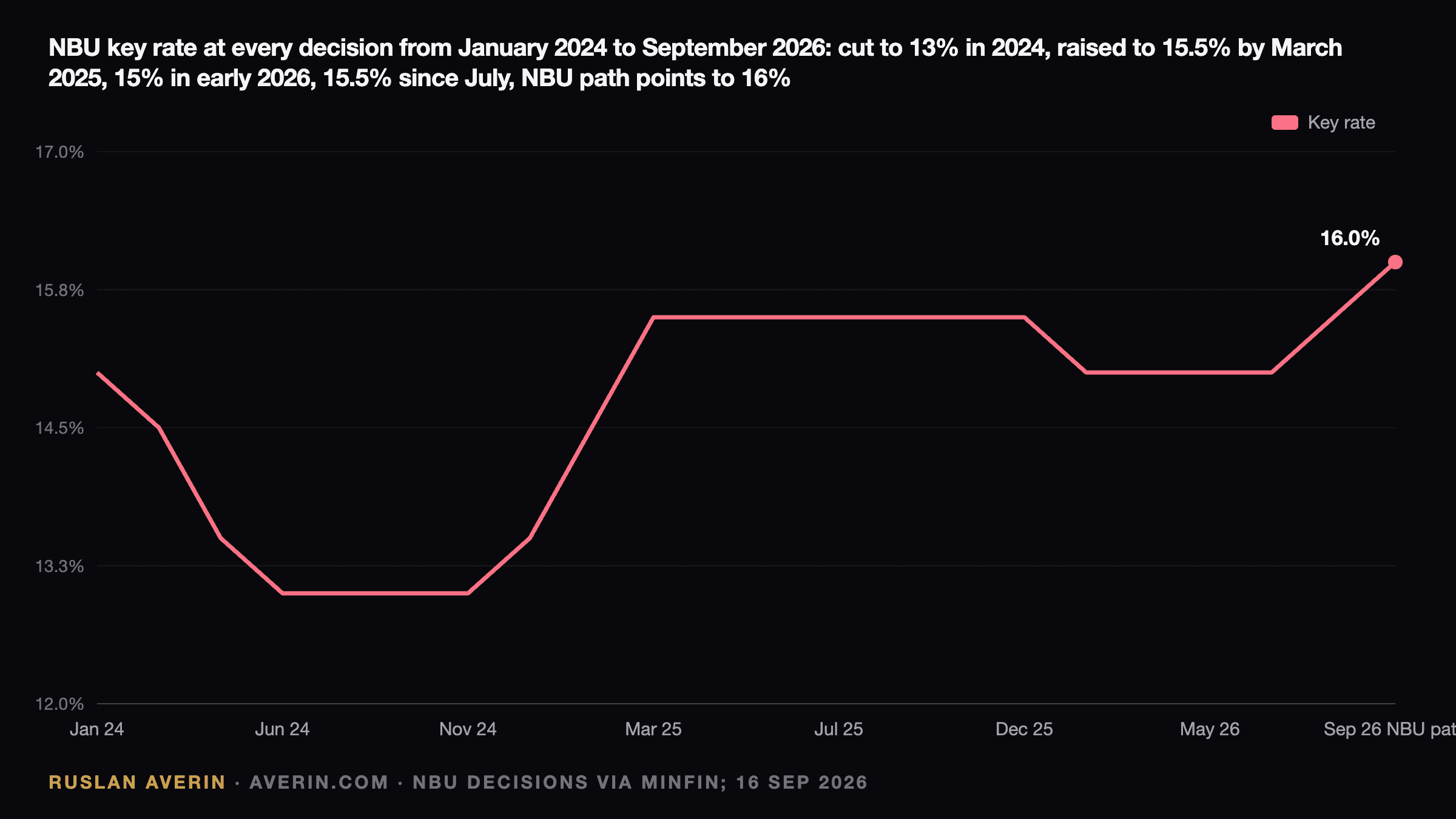
Governor Andriy Pyshnyi on 31 July: "The National Bank's forecast envisages that the key rate could be raised once more to 16% by the end of the year", adding in the same breath that "the forecast has never been and should not be taken as a commitment". The published path from the July Inflation Report is 16% in the fourth quarter of 2026, 16% through the first quarter of 2027, easing from the second quarter to 14% by the end of 2027 and 11.2% by the end of 2028. In April the path had been 15% until mid-2027. The monetary policy committee voted nine to two for the July increase and the majority "expects further tightening in 2026".
| Date | Decision | Level | Note |
|---|---|---|---|
| 30 January 2026 | −0.5 | 15.0% | first cut since 2024 |
| 20 March, 1 May, 19 June | hold | 15.0% | three holds |
| 30 July | +0.5 | 15.5% | vote 9–2; "unexpected" |
| 17 September | ? | 15.5% or 16.0% | NBU path: 16% in Q4 |
| October, December | — | — | two more meetings in 2026 |
Analysts who publish a view lean toward the hike. Dragon Capital wrote after the July meeting that it "now expects another 50bp hike in September, to 16.0%, before beginning an easing cycle in 2Q27". ICU's weekly note in early September called a mid-September increase probable. On the other side, Raiffeisen's Serhiy Pecherytsin argued in the spring that the rate could stay unchanged almost to year-end, and Bohdan Danylyshyn, formerly of the NBU Council, wrote on 9 September that August inflation "is mostly cost-driven, logistical, energy-related and administrative. This is not classic demand inflation." The bankers' survey the NBU normally runs before a meeting had not appeared by the afternoon of 16 September.
The inflation that forced the question
Consumer prices rose 8.1% in the year to August, from 7.7% in July and 7.2% in June, the low point. The monthly reading was only 0.1%, but the composition is uncomfortable: fuel up 38.7% year on year after the oil spike in late July, services up 13.4%, administered prices up 13%, transport up 23.8%. Core inflation is also 8.1% and rose 0.5% in the month. The NBU's comment on 12 September said August ran "slightly above the forecast trajectory" of the July report because of fuel and water tariffs. Its year-end forecast is 10%, raised from 9.4%, with 6.9% for 2027 and the 5% target reached only at the end of 2028. Business expectations for the next twelve months are 11.6%.
The monetary policy committee summary put the stakes plainly: "with an inert NBU stance inflation could not only return to double digits quickly but stay there". Against that, the real economy grew 0.4% year on year in the second quarter after a 0.6% contraction in the first, six regions were without power on 16 September after new strikes, and the government's own 2027 budget assumes growth of 1.3%. A central bank tightening into a supply shock is the same dilemma the Fed faces on Wednesday, with hryvnia numbers.
Five instruments, one decision
| Instrument | Where it stands, 15–16 September | If 16% on Thursday | If hold at 15.5% |
|---|---|---|---|
| UAH deposits, 12-month index (UIRD) | 13.99%; best offers 17.5% | +0.2 to +0.5 points by October | flat; promotional 17–17.5% stays |
| OVDP, primary auction | 1 year 15.17%; 2.5 years 16.10% | 15.5–16.5% range; more retail demand | unchanged; Q4 supply rises anyway |
| NBU 3-month certificates | ceiling = key rate + 3.5 points = 19.0% | ceiling 19.5% | 19.0% |
| New business loans | 15.3% average | +0.2 to +0.3 points | flat |
| Hryvnia | 44.63 per dollar; 44.4–44.8 seen to end-September | marginal support | no change; interventions do the work |
Deposits are the retail story. The twelve-month hryvnia index moved from 13.77% at the end of 2025 to 14.07% in August and 13.99% on 15 September; the three-month index is 13.78%. Banks are paying up to 17.5% on twelve months at the top of the table. Dmytro Zamotaiev of Globus Bank expects 14.5–16% on nine-to-twelve-month terms this autumn and promotional rates to 17.5%, but says competition "will look less and less like a classic rate race". Interest is taxed at 23%, 18% income tax plus the 5% military levy: 17.5% for six months turns 100,000 UAH into 106,737.50.
OVDP are the alternative, and they are tax-free for individuals. The finance ministry sold 2.01 billion UAH on 15 September at 15.17% for one year and 16.10% for two and a half, the same levels as the week before. Individuals held a record 163 billion UAH of government bonds on 1 September, up 48% since January; the 2027 budget plans 544.4 billion UAH of domestic borrowing at an average of about 14.8%, which ICU reads as modest upward pressure on yields in the fourth quarter regardless of Thursday.
The mortgage that does not move
єОселя is the one rate in Ukraine that the NBU cannot touch. The programme lends at 3% to military personnel, veterans, medics, teachers and scientists and at 7% to displaced people and those without housing, for the first ten years, with the state covering 70% of the down payment and 70% of the first year's instalments for some categories. In 2026 to the week of 8 September it had issued 5,763 loans for 11.4 billion UAH; the latest week alone was 172 loans for 365.3 million UAH, 81 of them at 3%. No source ties the compensation formula to the key rate, so a move to 16% changes the state's cost of the subsidy, not the borrower's payment. The market rate outside the programme is not published, because outside the programme there is almost no market; the new-build repricing described here on Tuesday runs on instalment plans and єОселя, not on bank loans.
Hryvnia: interventions, not the rate
The official rate on 16 September is 44.63 to the dollar and 51.51 to the euro, a 5.1% depreciation since 1 January. The NBU's net sales have exceeded $1 billion a week for nine consecutive weeks, peaking at $1.329 billion in the first week of September before easing 10% to $1.195 billion in the week to 11 September, the first decline in that run; the mechanics were set out here on 14 September. Reserves fell 5% in August to $48.66 billion, four months of imports, and the NBU's July forecast still targets $69.7 billion at year-end on the strength of EU disbursements. Serhiy Mamedov of Globus Bank sees 44.4–44.8 to the end of September with 45 as "a possible upper bound of the cash market in short-term demand spikes". The government's draft budget for 2027, submitted on 15 September, assumes 48.3 at the end of next year, 8% inflation and VAT raised from 20% to 21%; the financing side of that budget is the subject of a separate analysis.
Andriy Shevchyshyn's line from July still holds: the rate decision "should not materially affect the depreciation trend, but it is a factor restraining the weakening of the hryvnia". Thursday's move, whichever it is, will be worth a few kopecks. The $1.2 billion a week is what holds 44.63.
What analyst Ruslan Averin expects
A hike to 16% is the more likely outcome, because the NBU wrote it down in July, inflation has since come in above the path, and the committee's own language leaves little room for patience. A hold would need the Board to accept Danylyshyn's argument that fuel and tariffs are not a monetary problem, which the July summary explicitly rejected. In analyst Ruslan Averin's view the practical consequences are small either way: a saver choosing between a 17.5% promotional deposit and a 16.10% tax-free 2.5-year OVDP is already getting the tightening the NBU wants to deliver, and a hike adds a fraction of a point to both. The larger risks for hryvnia assets sit elsewhere: in the $32.6 billion of unfunded external need in the 2027 budget, and in a winter that the finance minister has called the hardest since 2022.
Related: nine weeks of NBU dollar sales, Kyiv rents at the start of the autumn season and who pays for Ukraine's 2027 budget.