Apple reports fiscal fourth-quarter 2026 results after the US close on Monday 2 November, the first report under chief executive John Ternus, who replaced Tim Cook on 1 September. Analysts polled by LSEG expect revenue to rise nearly 11% to $113.39 billion and net income to reach $29.04 billion, according to LSEG data cited by Reuters.
Financial analyst Ruslan Averin notes that the stock goes into the print as the world's most valuable listed company. Apple closed on Friday 30 October at $344.63, down 1.23% on the day, for a market value of about $5.03 trillion against $4.94 trillion for Nvidia, according to stockanalysis.com data; Bloomberg reported on 30 October that Apple had overtaken Nvidia for the top spot.
The bar: LSEG consensus against Apple's own guide
| Line | Q4 FY2026 expectation | Q4 FY2025 actual | Source |
|---|---|---|---|
| Revenue | $113.39 billion | $102.47 billion | LSEG via Reuters |
| Apple revenue guide | +9% to +11% | — | Apple via CNBC |
| Net income | $29.04 billion | $27.47 billion | LSEG via Reuters |
| iPhone revenue | $56.54 billion | $49.03 billion | LSEG via Reuters |
| Services revenue | $31.56 billion | $28.75 billion | LSEG via Reuters |
| Gross margin guide | 47% to 48% | 47.2% | Apple via CNBC |
Year-ago figures are from Apple's results filed with the SEC. Applied to last year's $102.47 billion, Apple's 9–11% guide means $111.7 billion to $113.7 billion, so the consensus sits near the top of the range. The net income forecast works out to about $1.97 per share on the June quarter's 14.71 billion diluted shares, against $1.85 a year earlier; buybacks shrink the share count each quarter, so the real per-share bar is slightly higher.
The guide itself disappointed in July. Apple's 9–11% range was below the 12.1% growth expected in the FactSet consensus and included a currency headwind of about 2.5 percentage points, CNBC reported. The gross margin range included about one percentage point of tariff refunds. The shares fell almost 8% on Friday 31 July.
iPhone: nine days of iPhone 18 Pro and no iPhone Duo
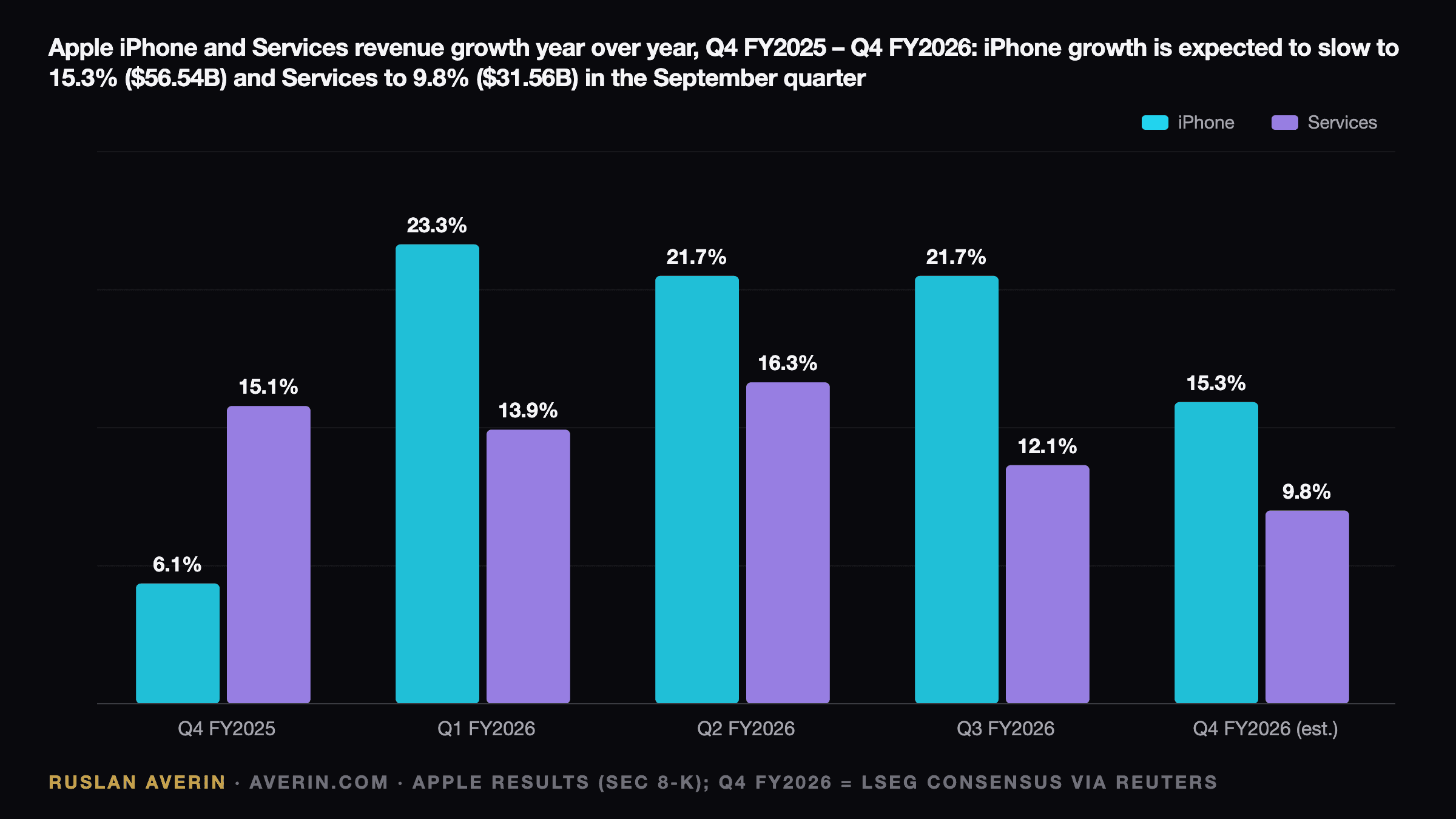
LSEG's consensus has iPhone revenue up about 15%, slowing from 21.7% growth to $54.25 billion in the June quarter. Apple guided in July to "mid-teens" iPhone growth, below the 18.1% FactSet consensus at the time, according to CNBC. A year ago the September-quarter iPhone line grew only 6.1%, so the base is soft.
The calendar works against this quarter. The iPhone 18 Pro contributed only nine days of sales, and the foldable iPhone Duo is not in the numbers at all, analysts at AJ Bell noted, as reported by Euronews. The Duo went on sale on Friday 23 October at $1,999 in the US. Pre-orders were capped at two handsets per customer and delivery dates slipped to late January within minutes, Reuters reported. On 26 October Apple said it would replace Duo units showing screen problems, according to Reuters.
IDC expects Apple to take 44% of the foldable market by value in 2026 on 31% of units, Reuters reported. That demand belongs to the December quarter, which is why the holiday guide matters more than the September beat.
Memory: the "100-year flood"
Memory is the line that can turn a revenue beat into a weak reaction. In July, Tim Cook called the market a "100-year flood on the memory pricing" and said Apple expected "supply constraints to increase significantly sequentially" for iPhone, Mac and iPad, CNBC reported.
The numbers behind the warning are large. TechInsights estimates that memory and storage in an iPhone 18 Pro could cost about $196, against roughly $52 in an iPhone 17 Pro, Euronews reported. Apple raised MacBook and iPad prices by 17% to 25% in June, and the stock posted its worst day in more than a year, CNBC reported.
Gross margin was 47.2% a year ago and 48.2% in the December 2025 quarter, by my calculation from Apple's filings. The June quarter's 50.1% included about two percentage points of tariff refunds, so the underlying level was close to 48%. The 47–48% guide, with one point of refunds inside it, implies an underlying 46–47%.
Services and China
Services is the slowest-growing major line in the consensus: about 10% to $31.56 billion, the weakest pace in more than three years, according to the Reuters preview cited by Euronews. That compares with 15.1% a year ago and 12.1% in the June quarter, when Services came in at $30.74 billion and missed estimates.
CNBC reported that in July Apple guided Services to grow at a rate similar to the June quarter's 12%. If Apple delivers that, Services would beat LSEG's figure by roughly $0.6 billion. If it comes in near 10%, the Street knew something the guide did not say.
Greater China is the swing line. Sales there rose 22.4% to $18.82 billion in the June quarter but missed the $19.58 billion consensus, CNBC reported. The September-quarter base is easy: $14.49 billion a year ago, down 3.6%. Reuters reported in October that Apple's smartphone share in China has rebounded after six straight quarters of declining shipments.
AI: Siri on Gemini, and a different spending model
At WWDC26 Apple introduced what Cook called "the all-new Siri AI" in the July release. CNBC reported that the conversational Siri uses Google's Gemini alongside Apple's own models. Apple pays for AI mostly through research and development, which rose 32% to $11.73 billion in the June quarter, rather than through data-centre capital spending.
Amazon kept its 2026 capex plan at about $220 billion, as covered in our Amazon Q3 results, and Meta's spending dominated its own report, see Meta's Q3 2026 earnings. In July, Melius Research analyst Ben Reitzes cited Apple's free cash flow, helped by low AI capital spending, as a reason to own the stock, CNBC reported.
The stock into the print
Apple rose 3.5% in October, from a close of $333.02 on Wednesday 30 September to $344.63, while AI-linked stocks sold off, as described in our Nasdaq review. Its intraday record of $351.73 came on Friday 23 October, the iPhone Duo launch day, according to stockanalysis.com. The trailing price-to-earnings ratio is 39.5 on that site's data.
Among the analysts CNBC surveyed in July, price targets ranged from $245 at Barclays (underweight) to $380 at Bank of America (buy). A stock at 39 times earnings needs more than a routine beat.
What I would watch, and the scenario logic
In my view, five numbers decide the reaction:
- December-quarter revenue guide. Last year's December quarter was $143.76 billion. Every percentage point of growth is worth about $1.44 billion. Double-digit growth with the Duo would support the valuation.
- December-quarter gross margin. A range below the 47–48% just guided would show memory costs outrunning price increases.
- Services growth. Near 12% beats the LSEG bar; near 10% confirms the slowdown.
- iPhone revenue against $56.54 billion, and any comment on Duo supply.
- Greater China growth against the easy $14.49 billion base.
The constructive case is September revenue at or above $113.7 billion, a December guide in double digits and margin held near 47%. The negative case repeats July: a solid quarter, then a guide that shows constraints and memory costs eating the iPhone cycle. That produced a drop of almost 8% three months ago.
What to watch next
- Monday 2 November, after the US close: results and the conference call; in July the call started at 2:00 p.m. Pacific time.
- Tuesday 3 November: the US midterm elections, see our midterms market guide.
- Early November: the annual 10-K; last year Apple filed it on 31 October, a day after results.
- Late January 2027: the December-quarter report, the first with iPhone Duo sales, when delayed pre-orders should ship.
Related: Amazon Q3 2026 results: AWS and capex, Meta Q3 2026 earnings and capex and the Anthropic IPO and AI valuations.