Finland's president approved the country's 34th package of defence materiel for Ukraine on 15 September: about €290 million, the second-largest Finland has sent, contents undisclosed, drawn from army stocks and Finnish industry. It takes Finnish military aid since 2022 to €3.6 billion. The same afternoon, in Kyiv, the Cabinet sent the Rada a draft budget for 2027 that needs $52.6 billion from abroad and, by the finance minister's own count, has sources for only $20 billion of it. Our analysts put the two numbers side by side because that is how the war is financed: one country's package at a time, against a hole measured in tens of billions.
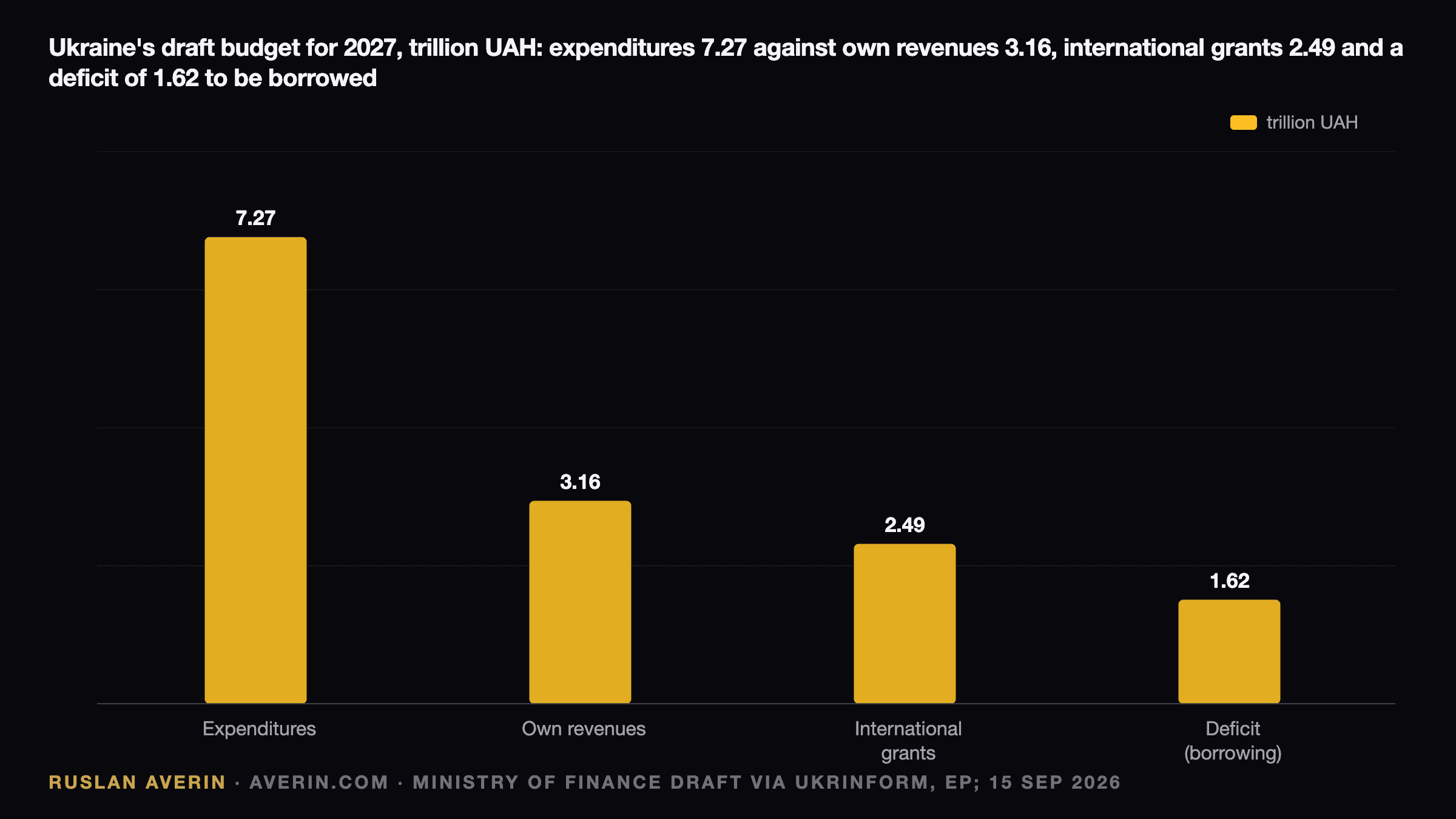
The 2027 budget in four numbers
| Line | 2027 draft | Change vs 2026 |
|---|---|---|
| Revenues | 5.648 trillion UAH, of which 2.493 trillion from international partners | +8.7% |
| Expenditures | 7.271 trillion UAH | +13.5% |
| Deficit | 1.623 trillion UAH, about 15% of GDP | 2026: 12% |
| Defence and security | 4.885 trillion UAH, 43.8% of GDP | +517.9 billion |
| External financing need | $52.6 billion | 2026: $52 billion |
| Domestic borrowing | 544.4 billion UAH at about 14.8% | +124.9 billion |
Defence takes two of every three hryvnias the state spends: 2.299 trillion on weapons, the rest on pay and support. The Ministry of Defence alone is 66.8% of expenditures. The macro assumptions are 8% inflation, a hryvnia at 48.3 to the dollar at the end of 2027 against 44.63 today, a minimum wage of 9,546 UAH, up from 8,647 in 2026, and VAT raised from 20% to 21%; more than 131 billion UAH of revenue exists only if the Tax Code changes pass. Outlets disagree on the growth assumption, 1.3% in one reading and 4.5% in a "basic scenario" that assumes a significant improvement in security from 2027, which tells its own story about how the document was built.
Serhiy Marchenko, the finance minister, was unusually direct on 4 September: "We are already seeing certain liquidity problems and foresee a certain deficit in our budget", and "we have not had such a situation since 2022". Some non-war payments, shelters and infrastructure among them, may be postponed into next year. "We expect a very difficult winter. Escalation means that we need to find the resources to get through it."
Where 2026's money came from
| Source | 2026, received or committed | Status |
|---|---|---|
| EU Ukraine Support Loan, budget part | €16.7 billion planned; €8.3 billion paid by 11 September; €4.7 billion in processing | on track; about €20 billion expected by year-end |
| EU Ukraine Support Loan, defence part | €28.3 billion, fully allocated by 11 September, including €6.1 billion on that day for Ukrainian drones and US Patriot interceptors | decided |
| EU Ukraine Facility | €1.5 billion in March, about €2.8 billion in June; €29.5 billion of €50 billion disbursed since 2024 | 8th payment expected |
| G7 ERA loans, $50 billion | $37.9 billion received in 2025; about $7.8 billion more by mid-April 2026 | nearly exhausted |
| IMF EFF, $8.1 billion | $1.5 billion in February, about $0.69 billion in July | second review under way since 31 August |
| World Bank | $6.29 billion disbursed cumulatively to 31 August; $841 million new commitment on 4 September | continuing |
| Japan | $850 million budget support through World Bank projects; $6 billion humanitarian and technical | continuing |
| United States | no new appropriation; about $13 billion of older contracts still delivering; PURL $6.7 billion of US weapons bought by allies in twelve months | allies pay |
Through August the general fund had received 569.6 billion UAH in grants and 312.7 billion in partner loans, roughly $19.8 billion at today's rate, against own revenues of 2.29 trillion. The National Bank counted about $54 billion of direct budget support for the year as "sufficient to cover the deficit"; the ministry called the $52 billion need "secured" in May. The gap is not in 2026. It is in the fourth quarter's cash flow, which is what Marchenko's liquidity warning describes, and in 2027, where $32.6 billion has no name next to it.
The Kiel Institute's August release shows the shape of the shift. European allocations in May and June were about €11 billion, €4.3 billion of it military; the largest bilateral military donors in the first half were Germany at €700 million, Denmark €600 million and the Netherlands €500 million, with the United Kingdom giving about €1.5 billion in financial and humanitarian aid. Military aid is running at "just over €2 billion a month" against more than €2.5 billion in earlier years, and monthly financial aid in the first half was 41% below 2025. "Europe continues to depend on the access to US weapons systems to sustain its military support for Ukraine", the institute's Federico Mellace said; more than 90% of PURL deliveries are American-made, bought by Norway ($1.36 billion), the Netherlands ($1.16 billion), Germany ($900 million), Canada ($834 million) and Sweden ($546 million). Finland's package is bilateral and from its own stocks, which is the older model.
The €210 billion that is still sitting in Brussels
The obvious source for $32.6 billion is the one that was rejected in December. About €210 billion of Russian central bank assets are immobilised in the EU, €193 billion of them at Euroclear in Belgium. The plan for a €140 billion "reparations loan" against those balances did not pass; EU leaders instead borrowed €90 billion jointly and lent it to Ukraine interest-free for 2026–27, with Hungary, Czechia and Slovakia opting out. Ukraine has received €6.6 billion from the windfall profits on the assets, which also service the G7's $50 billion ERA loans so that Ukraine does not.
In late August the Netherlands, Poland, Spain and Sweden wrote to the Commission asking for a way to use the assets themselves, on the grounds that €90 billion "is not sufficient as the war is intensifying" and that Canada and Japan contributed less than hoped. Belgium's answer has not changed: Prime Minister Bart De Wever calls the Euroclear money "the goose that lays the golden eggs" and wants an uncapped guarantee from all 27 member states before Belgium carries the legal risk; a Russian court has already ordered Euroclear to pay more than €200 billion in damages. Marchenko's proposal is a framework that shares the liability across the whole Union. The European Council in October, which also opens the next long-term EU budget, is the decision point. Without it, the 2027 need is met the way 2026 was: by the EU borrowing more.
Inside the country: bonds, reserves, the rate
Domestic borrowing carries a growing share. Through August the finance ministry placed 343.4 billion UAH-equivalent of government bonds and redeemed 239.5 billion in hryvnia, a net 48.5 billion; the 2027 plan is 544.4 billion UAH at an average of about 14.8%, and last week's auctions cleared at 15.17% for one year and 16.10% for two and a half. Individuals hold a record 163 billion UAH, up from 111 billion at the start of 2025; banks hold 926 billion and the National Bank 656 billion of a stock near 2 trillion. There is no monetary financing: the deficit is covered by partners "without emission", as the NBU Council's Vasyl Furman put it in August, and reserves of $48.7 billion on 1 September, down from $51.2 billion in a month, are the buffer that absorbs the timing gaps between tranches. The NBU still forecasts $69.7 billion by year-end, which requires the EU's fourth-quarter payments to arrive on schedule; nine weeks of dollar sales above $1 billion show what the buffer is being used for meanwhile.
The key rate, 15.5%, is decided again on Thursday. Ratings are CCC at Fitch and CCC+ at S&P after the December 2025 restructuring of GDP warrants, which removed about $20 billion of payment risk to 2041; external commercial debt service is about $0.9 billion a year until the first restructured Eurobond matures in 2029. The private market, in other words, is not where 2027 will be financed. Cumulative international financing since 2022 passed $200 billion this month, more than the country's pre-war GDP.
What the team assessed
Three conclusions. First, Finland's €290 million is real money and the wrong unit. The 2027 external need is $52.6 billion, roughly one Finnish package every two to three days; bilateral packages now matter for what they contain, air defence above all, not for what they add up to. Second, the hole is a European political decision, not a market one: either the immobilised assets are mobilised in October or the EU borrows again, and the hryvnia's 48.3 assumption for the end of 2027 is the ministry's way of saying it expects the second, later and smaller. Third, for a hryvnia saver the sequence is clear. Fourth-quarter liquidity strain means more domestic bonds at 15–16.5% and a central bank that cannot afford to look soft, which is why the 17 September decision leans toward 16%. Analysts note that the state's own promises, from the 2027 pension changes to the 65% rise in teachers' pay, are written in a budget whose external side is 62% unfunded. Our analysts would read every 2027 commitment with that number next to it.
Related: the NBU decision on 17 September, nine weeks of NBU dollar sales and the Fed's decision on 16 September.