
Lennar reported about two hours after the Federal Reserve raised rates on Wednesday, and the two releases belong together. The builder earned $1.19 a share in the quarter to 31 August against $2.29 a year ago, missed on revenue and orders, and cut its full-year delivery target for the second time this year. Its explanation is one sentence: "Given continued pressure on interest rates and the deterioration in market conditions through the quarter, we are moderating our target full-year 2026 deliveries." The next morning Freddie Mac printed a 30-year mortgage at 6.95%, up from 6.76% a week earlier, and Mortgage News Daily's daily index was already at 7.24%.
I set the quarter up on Tuesday around one question: whether Lennar could hold volume without giving the margin back. The answer is that it held volume, deliveries came in inside guidance, and the margin did not fall further; it was orders that broke.
The quarter in numbers
| Metric | Q3 FY2026 | Q3 FY2025 | Change |
|---|---|---|---|
| Total revenue | $8.05B | $8.81B | −8.7% |
| Net earnings | $284M | $591M | −52% |
| EPS, GAAP / adjusted | $1.19 / $1.23 | $2.29 / $2.00 | −48% / −38.5% |
| Deliveries | 20,840 | 21,584 | −3.4% |
| New orders | 20,879 | 23,004 | −9.2% |
| Average sales price | $372,000 | $383,000 | −2.9% |
| Gross margin on home sales | 15.8% | 17.5% | −1.7 points |
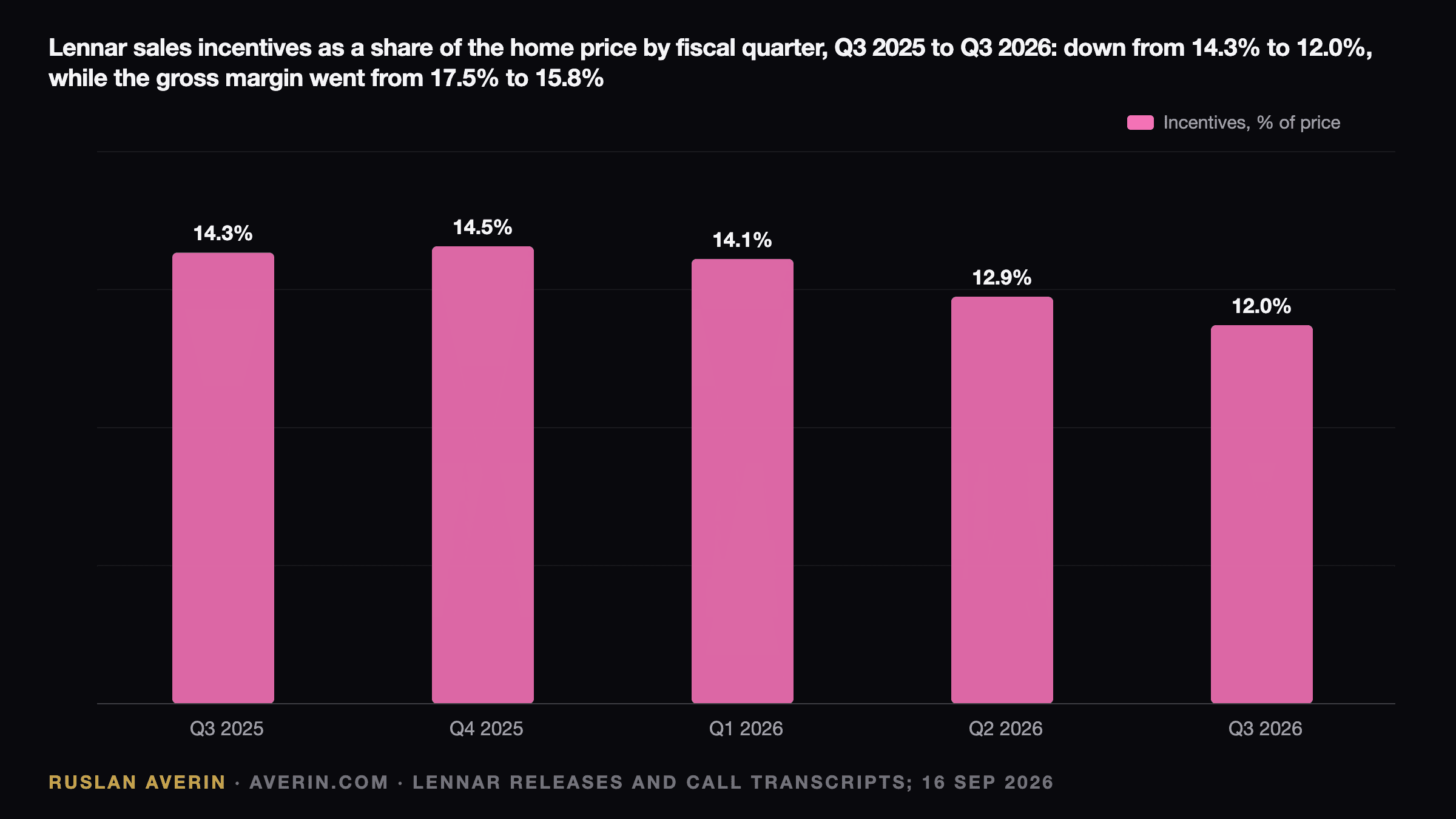
| Incentives, % of price | ~12.0% | 14.3% | −2.3 points |
| SG&A, % of home sales | 9.2% | 8.2% | +1.0 point |
| Net margin on home sales | 6.6% | 9.2% | −2.6 points |
| Backlog | 16,857 homes / $6.35B | 16,953 / $6.65B | −0.6% / −4.6% |
Consensus had been about $1.28–1.30 on adjusted EPS and $8.32–8.37 billion of revenue, so both lines missed by 4–5%. The adjusted figure strips out $53 million of mark-to-market losses on technology investments, where a year ago there were $99 million of gains, and $39 million of one-time items in financial services. The tax rate rose to 26.4% from 24.4%, attributed to the Millrose spin-off. Nine months into the fiscal year Lennar has earned $3.36 a share against $6.06 in the same period of 2025.
The order book is the number I would circle. Lennar guided 21,000–22,000 orders for the quarter in June and delivered 20,879, and the dollar value of orders fell 11.1% to $7.5 billion with an order price of $359,000, below the $372,000 delivered. The West, where prices average $552,000, took 4,319 orders across 425 communities; South Central, at $227,000, took 6,100 across 479. The cheaper the home, the more of them Lennar is selling, which is the strategy working and the mix deteriorating at the same time.
What Miller said, and what he did not
Stuart Miller, sole CEO since Jon Jaffe retired at the end of 2025, wrote the release in his usual register. "While our earnings of $1.19 per share were below expectations, they reflect the nature of the environment in which we are operating, which has deteriorated since our last earnings call." On the cause: rates "increased through the quarter, with the 30-year rate at approximately 6.8% at quarter end and even higher since. Rates are responding as inflation remains above the Fed's target, driven by geopolitical tension and higher oil prices. Additionally, consumer confidence has declined as rates and affordability have driven more consumers to slow their purchase decision."
The operating case is intact and he made it fully: starts pace and sales pace both 4.1 homes per community per month across 1,713 communities; construction cost per square foot down 1% sequentially, 6% year on year and 14% since the Q4 2023 baseline; cycle time at a record 116 days from 121 last quarter and 126 a year ago; completed unsold inventory down to 1.8 homes per community from 2.1. "Our consistent strategy has been to meet demand at affordability and build supply rather than wait the market out." Of roughly 488,000 homesites owned and controlled, fewer than 2.5% sit on the balance sheet.
What he did not say is also informative. In June he called the drop in incentives to 12.9% "the first real and potentially sustainable decline" after three years of increases. This quarter incentives fell again, to about 12.0%, and the gross margin rose sequentially to 15.8% from 15.6%, which is exactly the trade he promised. But the release pairs it with "base price adjustments necessary to sustain volume in a market where affordability remains the defining constraint". Lower incentives plus lower base prices is a relabelling, not a recovery, and the $372,000 average price, down 2.9%, says which one it was. There is no cancellation rate in the release and no comment on 2027; the call was still live when this was written.
Guidance and the balance sheet
For the fourth quarter Lennar guides 22,000–23,000 deliveries, 19,500–20,500 orders, an average price of $370,000–380,000, a gross margin of 15.5–16.0% and SG&A "toward 8.7% to 9.0%". Full-year deliveries are now 80,000–81,000, from 82,000–83,000 in June. Implied orders for the year are about 80,600–81,600, so the company is selling what it builds and no more.
The balance sheet is where the volume-first strategy is paid for. Homebuilding cash fell to $1.15 billion from $3.44 billion at the end of November; debt rose to $4.3 billion with $650 million drawn on the revolver, after $400 million of 5.25% notes were repaid. Net debt to total capital is 12.7% from 2.8% in November. Lennar bought back 3.0 million shares for $256 million at an average $85.49; a year ago it bought 4.1 million for $507 million at $122.97. The dividend is $0.50 a quarter, a 2.54% yield at $78.65.
The stock, and the sector that ignored it
LEN closed at $78.36 on Wednesday, down 2.1% in the Fed sell-off, dropped 2.6% after hours to $76.34 and opened Thursday at a new 52-week low of $76.07, at the bottom of a $76.07–139.44 range. By midday it was $78.65, up 0.4%, on about two and a half times normal volume. The stock is down more than 40% in 2026 and trades at 14.8 times trailing earnings of $5.28, a multiple that is cheap only if $5.28 is the floor, and the nine-month run-rate says it is not.
The rest of the group went the other way. D.R. Horton rose 1.9% to $141, Toll Brothers 2.0% to $135.27, PulteGroup 1.5%, NVR 0.8%, KB Home 0.6% ahead of its own report on 22 September; the ITB and XHB ETFs gained about 0.9%. The 10-year fell six basis points to 4.94–4.98% on Thursday, its first decline in nine sessions, and the builders trade the 10-year, not Lennar. It is also a reminder that Lennar's 15.8% margin is a choice: Horton reported 20.7% in July and Toll 25.6% in August. The analysts who cover the name have mostly given up on it, with Truist cutting its target to $75, BofA to $70, BTIG at $67, Goldman holding at $100 and a consensus that MarketBeat labels "Reduce", 10 sells against one buy.
The market Lennar is selling into
The data around the release were consistent with the release. The NAHB index fell to 32 in September from 35, against a consensus of 34, the lowest since September 2025; current sales 35, expectations 37, buyer traffic 23. Thirty-eight percent of builders cut prices, at an average 6% for the sixth month running, and 66% used incentives, the most since December. NAHB's Bill Owens: "Buyer traffic has weakened across much of the country, largely because of rising mortgage rates." August starts, released Thursday, were 1.275 million, down 2.6%, but single-family starts rose 7.6% to 918,000 while permits slipped to 1.394 million; completions fell 11.9% to 1.128 million. Existing-home sales were 3.98 million in August, the fewest since June 2025, with a median price of $429,100, up 1.6%, and 4.9 months of supply, the most in more than ten years. Pending sales rose 0.3% against an expected fall.
On financing, the Fed did not move the 30-year; the press conference did. MBA's purchase index is down 19% from a year ago and refinancing down 65% at a contract rate of 6.97%, the highest since May 2025. Bright MLS's Lisa Sturtevant said the hike "all but guarantees" that borrowing costs "will remain stuck at or above the 7% threshold, which creates a psychological and financial barrier that will sharply squeeze affordability." Warsh, asked at the press conference what the hike does to a household pinched by mortgage and grocery costs, answered about people "living off their paycheck that comes every couple of weeks" and did not mention housing; his line that "certain sectors, like housing and agriculture, are showing strains" dates from Jackson Hole. I covered the decision and the dot plot separately.
What I take from it
In analyst Ruslan Averin's view Lennar has become a bond proxy with a construction business attached: its earnings now move with the 10-year and its margin is capped by the incentive it has to pay to keep 4.1 sales a month per community. That is not a criticism of the strategy. Miller is right that "the fundamental shortage of housing in America has not been solved", and a builder that keeps starting homes at 116-day cycle times will own the recovery when it comes. But the recovery is a rates event, and after Wednesday's dot plot the market's own path has the funds rate at 4.1% through 2027. I do not own LEN, and at $78 I would rather own the 10-year at 5%, which is the same bet on lower rates with a coupon while I wait. The number that would change my mind is the Q4 order print: 19,500–20,500 is guided, and a quarter above 21,000 with incentives still near 12% would mean demand is clearing at these prices without more discounting.
Related: the Lennar preview from 15 September, the Fed's hike and the new dot plot, the 10-year at 5% and the three scenarios before the decision.