The US Bureau of Labor Statistics publishes the consumer price index for September 2026 on Wednesday 14 October at 8:30 a.m. New York time. It is the last inflation report before the Federal Reserve meets on 27–28 October, and the first since the Fed raised its target range to 3.75–4.00% on 16 September.
The headline number is close to a foregone conclusion: gasoline did most of the work in September, and the consensus expects annual inflation to rise to 3.7%. The market will trade the core figure, and the gap between the two is the story of this release.
Update, 15 October 2026: the CPI data
The Bureau of Labor Statistics published the September CPI on 14 October, and it came in above the consensus on the core line that the market trades. Headline CPI rose 0.6% on the month, as expected, and 3.7% on the year, against the 3.6% Dow Jones consensus cited by CNBC and 3.4% in August. Core CPI rose 0.3% on the month against 0.2% expected, and 2.6% on the year against 2.5%. Gasoline jumped 9.1%, more than the roughly 7% rise in EIA pump prices, and accounted for over half of the monthly increase.
| Metric | Consensus | Actual |
|---|---|---|
| Headline CPI, month | 0.6% | 0.6% |
| Headline CPI, year | 3.6% (Dow Jones); 3.7% (Trading Economics) | 3.7% |
| Core CPI, month | 0.2% | 0.3% |
| Core CPI, year | 2.5% | 2.6% |
| Shelter, month | 0.2–0.3% (preview range) | 0.4% |
| Energy, month | about 5.5% (Continuum) | 5.2% |
| Food, month | no published consensus | 0.0% |
| Gasoline, month | about 7% (EIA pump prices) | 9.1% |
All three lines the team flagged came in firm. Core rose 0.3% for a second month in a row. Core excluding food, shelter and energy rose 0.3% for a third month, against Continuum's 0.17%. Airline fares rose 1.2% and transportation services 0.6%. "CPI came in hot and it wasn't just fuel prices," said Sonu Varghese, chief macro strategist at Carson Group, quoted by CNBC.
On 14 October the S&P 500 closed at 7,718.94, down 1.1% from 7,805.45, and the Nasdaq Composite fell 1.9% to 26,692.87. The 2-year Treasury yield rose to 4.82% from 4.79%, while the 10-year fell to 5.19% from 5.21% after an early jump. The ICE dollar index closed at 102.55, up from 102.18. CME FedWatch put the odds of a quarter-point hike on 28 October at about 35% on 14 October, up from 22.1% a day earlier, according to CNBC.
What it changes. Our analysts read this as the asymmetric case the preview described: fuel was priced in, a firm core was not. With the target range at 3.75–4.00%, a December hike now looks close to the base case, and October is a live but minority outcome. The curve flattened, which supports the view that the 10-year was already carrying term premium. More in will the Fed raise rates in October after the hot CPI.
Where August left inflation
In August the all-items index rose 0.4% on a seasonally adjusted basis and 3.4% over twelve months, according to the BLS release of 11 September. Core CPI, which excludes food and energy, rose 0.3% on the month and 2.4% on the year.
Energy explains the gap. The energy index rose 2.1% in August and 16.3% over twelve months. The gasoline index rose 3.9% on the month, seasonally adjusted, and 27.4% year on year. Food was quiet: up 0.1% on the month and 2.7% on the year. Shelter rose 0.3% and 3.0% year on year, and owners' equivalent rent rose 0.2%.
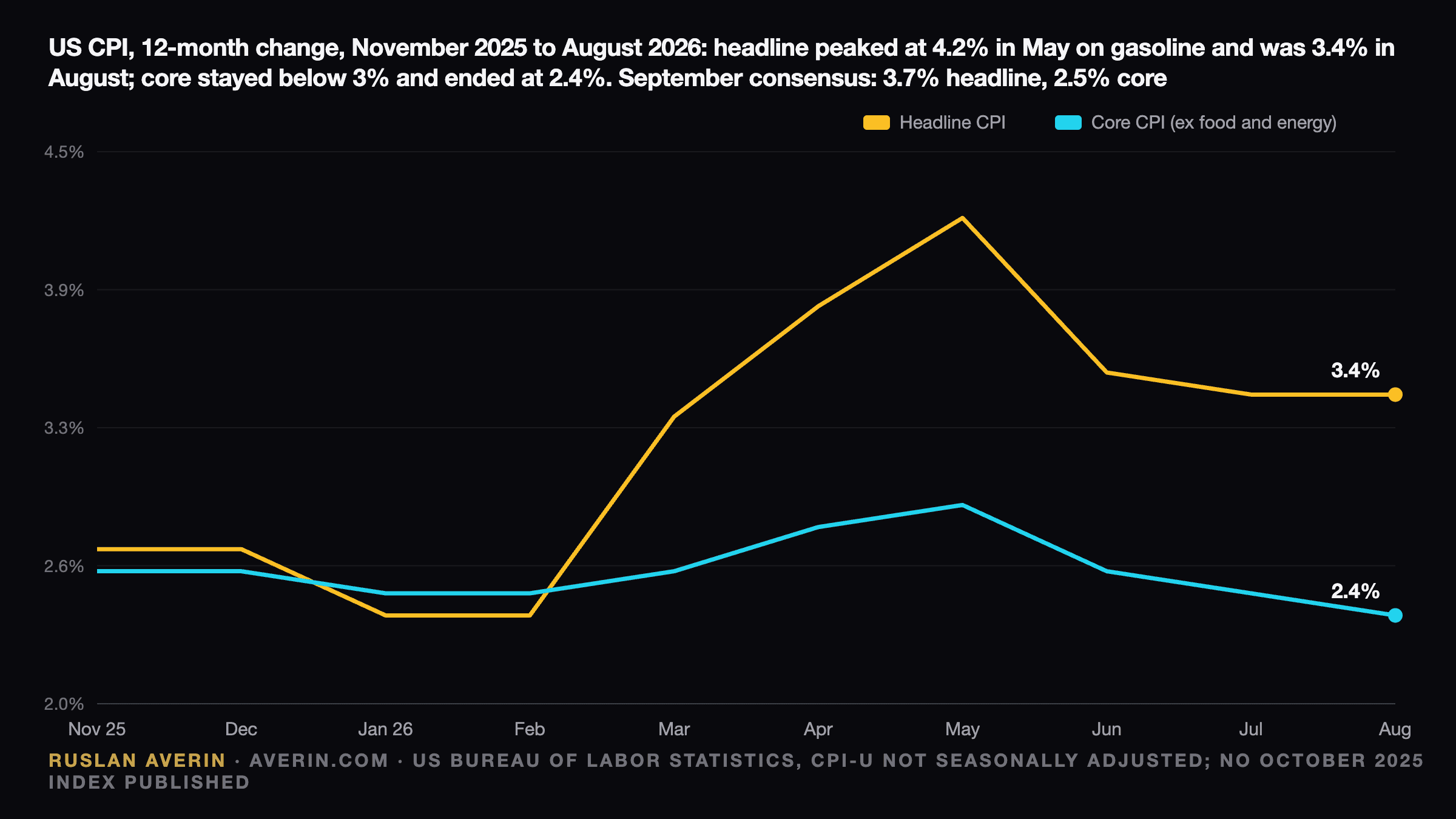
The path this year has been driven almost entirely by fuel. Headline inflation was 2.4% in January and February, jumped to 3.3% in March and peaked at 4.2% in May, when the gasoline index was up about 40% on the year. A 0.4% monthly decline in June brought it back to 3.5%. Core inflation never followed: it peaked at about 2.9% in May and has drifted lower for three months. The BLS published no index for October 2025, which is why the chart starts in November.
What economists expect for September
The consensus on the Trading Economics calendar is:
- Headline CPI: +0.6% month on month, 3.7% year on year (from 0.4% and 3.4%).
- Core CPI: +0.2% month on month, 2.5% year on year (from 0.3% and 2.4%).
Trading Economics' own forecast is slightly lower on the headline, at 0.5% and 3.6%, and 2.4% for core. Continuum Economics, in a preview dated 29 September, expects headline CPI of 0.6% (0.57% before rounding) and 3.7% on the year, with energy up about 5.5%. It sees core at 0.2% (0.19% before rounding), unchanged at 2.4% year on year, and CPI excluding food, energy and shelter slowing to 0.17% from 0.31% in August.
Note the tension in the core consensus. Unrounded, core inflation was 2.45% in August, right on the rounding line. In September 2025 the unadjusted core index rose 0.25%, so a core reading of about 0.2% in September 2026 maps more naturally to 2.4% than to 2.5%. A print of 2.5% would therefore not by itself mean an acceleration; the monthly figure carries the information.
Gasoline: the number already known
According to the Energy Information Administration's weekly survey, the average US retail price of gasoline (all grades) was $4.295 a gallon on 7 September, $4.455 on 14 September, $4.610 on 21 September and $4.603 on 28 September. That averages about $4.49 for the month, against about $4.19 in August, a rise of roughly 7%. A year earlier the September average was about $3.29, so pump prices were up around 36% on the year.
That arithmetic is why the headline forecast is high. In September 2025 the unadjusted all-items index rose only 0.25%, so this month's base effect is weak, and the twelve-month rate rises by about as much as the monthly figure exceeds 0.25%. The latest EIA reading, $4.496 on 5 October, shows the price stopped rising but did not reverse.
Shelter and the core detail
Shelter is the largest component of the CPI basket and runs at 3.0% a year, down from 3.6% in September 2025. A monthly reading of 0.2–0.3% would keep it on that path. The more sensitive lines are those where fuel costs pass through with a lag: airline fares, transportation services and goods that are trucked. In analyst Ruslan Averin's view, the first sign that energy is leaking into core would appear there, not in rent.
The team would watch three lines, in order:
- Core month on month. 0.2% is consensus. 0.3% or more would be the second firm month in a row.
- Core excluding shelter. Continuum's 0.17% is the benchmark; above 0.3% means pass-through.
- Airline fares and transportation services, the clearest channel from fuel to core.
The Fed: 27–28 October
The 16 September decision was unanimous, 12–0. The statement said "inflation remains elevated" and that the hike "will support a timelier return to the Committee's 2 percent goal". The October meeting is not a projections meeting; the next one with a new dot plot is on 8–9 December.
The bond market already prices more tightening. On Friday 9 October the 2-year Treasury yield closed at 4.80%, against 4.67% on 15 September, the day before the hike, and well above the top of the 3.75–4.00% range. The 10-year yield closed at 5.24%, up from 5.00% on 15 September, and the 30-year at 5.60%, according to the Treasury's daily par yield curve. Monday 12 October was the Columbus Day holiday for the bond market; the Cboe 10-year yield index ended the day at the same 5.24%.
Hot or cool: what it means for bonds, the dollar and stocks
The S&P 500 closed on Monday 12 October at 7,807.24, little changed from 7,811.54 on Friday. The ICE dollar index closed at 102.58.
Hot core (0.3% or more). The case for a second hike on 28 October strengthens. The 2-year yield would likely move first; a 10-year move of 10 basis points translates into a price change of roughly 0.8% for a 10-year bond. The dollar would firm and equity valuations, already stretched against a 5.24% risk-free yield, would face pressure, with rate-sensitive sectors hit first.
In-line (headline 3.7%, core 0.2%). The market reads through the gasoline effect. The likely outcome is a small move and a debate that shifts to December.
Cool core (0.1% or below). It would support the view that September's hike was enough and could pull the 2-year back toward 4.67%. Long yields may fall less: the 10-year rose 24 basis points after the hike, and in our analysts' view much of that reflects term premium rather than the next Fed decision.
The asymmetry, as the team assesses it, is that a headline print above 3.7% with a soft core is already expected, while a firm core is not. The market can absorb fuel, but core at 0.3% for a second month would argue that energy is spreading.
For a Ukrainian or European investor
A hot print usually means a stronger dollar. For an investor whose base currency is the euro, that partly offsets price losses on US bonds and stocks; the currency gain can be worth more than the yield move. For a Ukrainian saver who holds dollars, a firm dollar supports purchasing power against other currencies, while the National Bank of Ukraine's key rate of 16% remains the domestic benchmark for hryvnia savings.
The practical point concerns duration. With the 1-year Treasury bill at 4.47% and the 10-year at 5.24%, investors can already earn most of the available yield without much rate risk. A second firm core print would make that trade-off more relevant, not less.
Related: the Fed's 16 September hike to 3.75–4.00%, the 10-year Treasury at 5% and why stocks and bonds fell together in the 60/40 portfolio.