
Three numbers moved Ukrainian housing finance in the last week of October. Kyiv's median asking rent for a one-room flat fell to UAH 16,000, down 11% in a month, according to LUN's statistics on 30 October. The state programme eOselya (єОселя) issued 178 subsidised loans worth UAH 390.4 million in its latest weekly count. And on Thursday 29 October the National Bank of Ukraine raised its rate by half a percentage point, to 16.5%, effective 30 October.
The three pull in different directions: rents in the capital are softening into winter, subsidised credit keeps flowing at fixed rates, and market lending gets no cheaper.
October rents: Kyiv falls, Lviv holds at the top
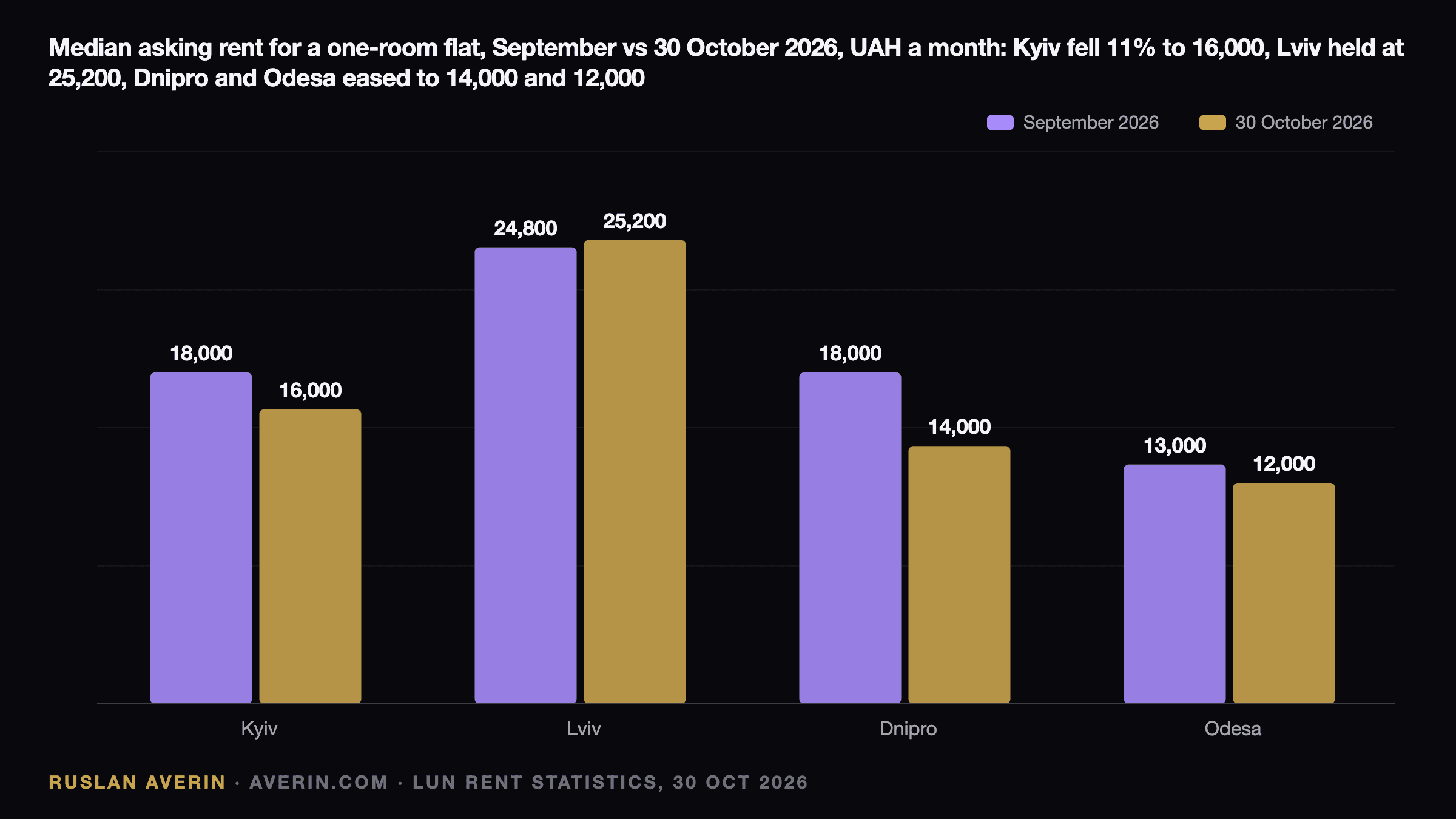
LUN's medians for one-room flats as of 30 October, with the change on the month and on the year:
- Kyiv: UAH 16,000, down 11.1% from 18,000 in September, 5.9% lower than a year ago and 7.8% lower than in April. Two-room flats are at UAH 22,000 (−8% on the year) and three-room flats at UAH 35,000 (−17%).
- Lviv: UAH 25,200, up 1.8% on the month and 40.1% on the year, from 18,000 in October 2025. Two-room flats cost UAH 32,100, three-room UAH 41,300, up 40% and 51% respectively.
- Dnipro: UAH 14,000, up 27% on the year. The series is volatile: LUN's September point was 18,000, its own summary cites 15,800 for early October.
- Odesa: UAH 12,000, down 7.7% on the month and up 9.1% on the year.
The September figures for Kyiv districts and other cities are in the September rent review. In October all three Kyiv flat sizes sit below their year-ago medians.
OLX data for September, published on 12 October, pointed the same way before LUN confirmed it. Listings of one-room flats for rent in Kyiv rose 20% in a month while demand fell 20%, and responses per listing dropped 35%. Landlords in the capital are competing for fewer tenants, while western cities keep this year's premium.
eOselya: 178 loans in a week, 6,945 since January
The Ministry of Economy's release of 26 October covers the previous week:
- 178 loans for UAH 390.4 million, an average of about UAH 2.19 million per loan.
- 98 loans at 3%: 47 veterans, 36 military and security-sector personnel, 7 teachers, 6 medics and 2 scientists.
- 80 loans at 7%: 46 borrowers without their own housing and 34 internally displaced people.
- By region: Kyiv region 59, Kyiv city 24, Lviv region 19.
- By property: 91 loans for new builds, 54 of them still under construction, and 57 for resale flats. The ministry's breakdown covers 148 of the 178 loans.
Since January, 6,945 borrowers have taken eOselya loans worth UAH 13.9 billion, up from 6,574 and UAH 13.2 billion two weeks earlier. The suburbs' lead matches the Kyiv suburbs house-price review.
The entry cost has not changed. LUN and the NBU calculated on 30 October that the average first payment on the cheapest new-build flat in Kyiv under eOselya is UAH 750,000; in Lviv it is UAH 904,000 and in Zaporizhzhia UAH 174,000. On a UAH 2.5 million flat with 20% down, LUN adds UAH 41,000–96,000 in bank fees, valuation, notary, insurance and, where due, the pension levy and state duty.
A new eOselya model for young families
On 18 October the government added a separate eOselya model for young families, Minfin reported. Its rate is 7% for the first three years, 10% from the fourth to the tenth year and 12% from the eleventh. Each child born or adopted after the loan is signed cuts the rate by 2 percentage points, to a floor of 0.1%. With two children, the 10% step becomes 6% and the 12% step 8%.
Families on this model may also exceed the standard limits on floor area and price by up to 40%, paying the difference themselves, in new builds or buildings commissioned within the last three years.
In a Factum Group survey for OLX, 80% of potential buyers knew about eOselya in the third quarter, 47% planned to use it, but only 4% had done so. Satisfaction with its terms fell to 50%, from 70% at the end of 2024.
What the NBU's 16.5% means for mortgages
The rate change does not touch eOselya: its 3% and 7% rates are set by the programme, not by the market. It matters for everything else.
Market lending for housing in Ukraine is a niche product. In a standard Minfin search of bank housing-loan programmes, two of the three results were eOselya offers; the third, MTB Bank's loan for buying property, carried a nominal 24.7% and an annual percentage rate from 30.42%, with at least 30% down. The NBU's own mortgage survey for August, published on 28 October, counted 722 loans for UAH 1.5 billion from 11 banks. The weighted effective rate of 7.7% on new builds and 10% on resale reflects mostly subsidised programme loans, not market pricing.
The NBU's statement says larger banks began revising hryvnia deposit rates in the past month and that the October hike should strengthen that transmission. Net hryvnia loans to households grew 38% year on year in September. The NBU now expects inflation of 12.5% for 2026, and its forecast keeps the rate at the current level until the second quarter of 2027. For savers the effect shows up first in deposit rates at Ukrainian banks; the decision itself, with the ECB and the Fed, is covered in the review of the three central-bank decisions.
Rent or buy: the arithmetic in October
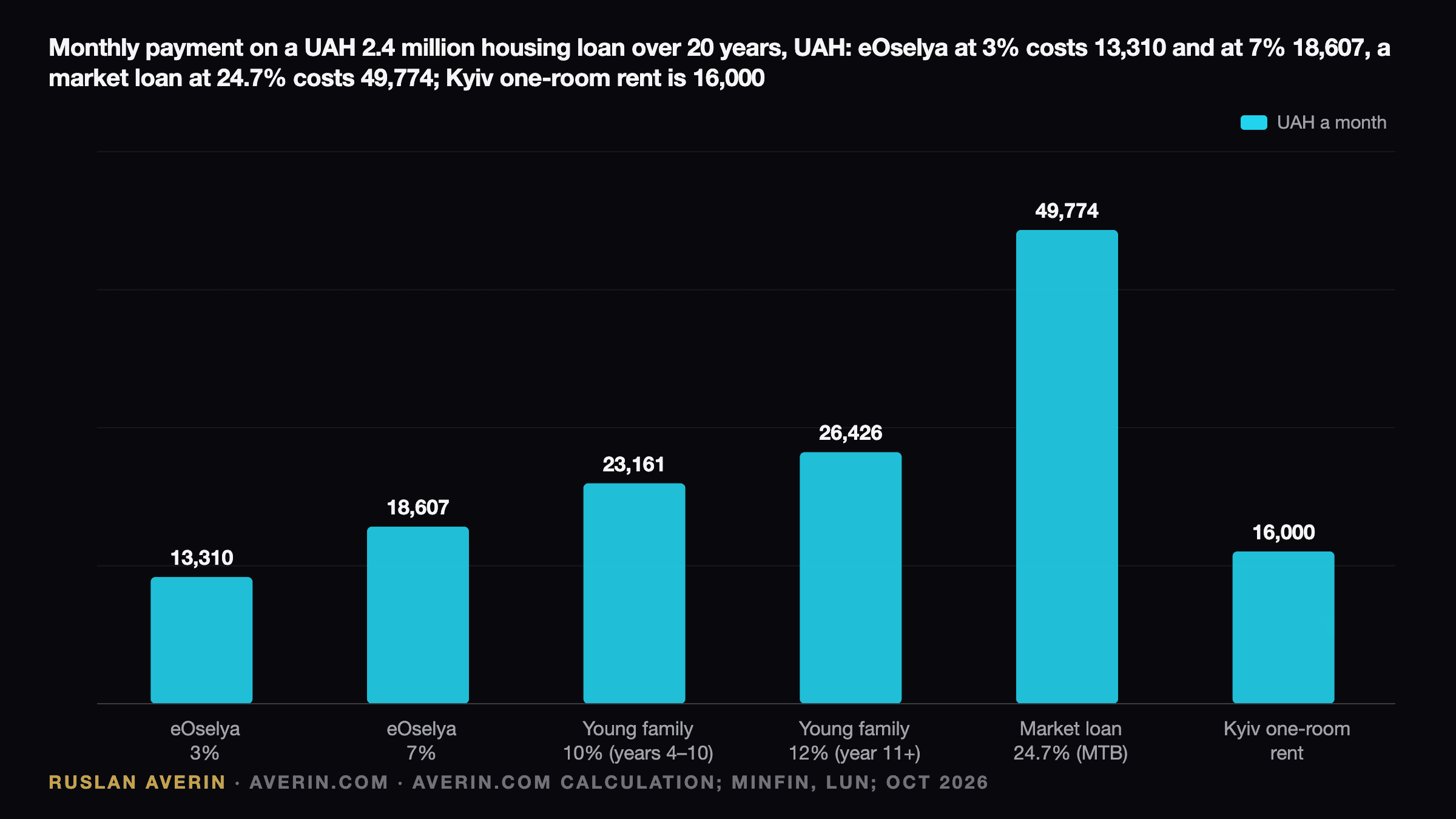
A Kyiv one-room flat has a median asking price of $67,000 on LUN, about UAH 3.05 million at the official rate of UAH 45.5293 per dollar on 30 October. Take a UAH 3 million flat with 20% down, leaving a UAH 2.4 million loan over 20 years. An averin.com annuity calculation gives:
- eOselya at 3%: about UAH 13,300 a month, below the UAH 16,000 median rent.
- eOselya at 7%: about UAH 18,600, roughly 16% above the rent.
- Market loan at 24.7%: about UAH 49,800, more than three times the rent.
For the 3% categories, owning costs less each month than renting once the down payment is found; for a market borrower it does not come close.
For landlords the arithmetic has worsened. At UAH 16,000 a month, a $67,000 flat yields about 6.3% gross before tax, vacancies and repairs, down from about 6.8% on the figures in LUN's quarterly report of 22 October, and well below the National Bank's new 16.5%. In analyst Ruslan Averin's view, falling Kyiv rents and a higher rate together shift the advantage from buy-to-let investors to tenants and to subsidised first-time buyers. Landlord tax options are covered in the guide to landlord taxes in Kyiv.
Vouchers for displaced families
On 29 October the Ministry for Communities and Territories said Ukraine had agreed with the Council of Europe Development Bank on an extra €80 million, about UAH 4 billion, for housing vouchers for displaced people from occupied territories. The agreement is due to be signed by the end of November, with the first €40 million expected by year-end. That funds more than 2,000 vouchers of UAH 2 million each, which can also cover a first mortgage payment; about 36,800 approved vouchers were still unfunded at the start of October.
What to watch
- 5 November: the NBU's full Inflation Report with the updated forecast.
- Weekly eOselya counts: whether lending holds near 180 loans a week into winter.
- LUN's November rents: whether Kyiv's 11% monthly drop deepens with power cuts and the heating season, or reverses.
- 17 December: the NBU's next monetary-policy meeting.
Related: Kyiv investment: four ways compared, Kyiv rent prices in September 2026 and eOselya vs a market mortgage.