
Kyiv's warehouse market has lost a third of its modern space in two months. By the end of June 2026 the city's competitive warehouse stock had finally climbed back to its pre-war 2021 level of about 1.6 million square metres. By the end of August it was down to about 1.05 million square metres, 34% lower than at the start of the year.
The figures come from research by EXPANDIA, the largest commercial real estate company in Ukraine and CBRE's Country Service Partner there, published on 28 October. The cause is named plainly in the report: intensified missile attacks on warehouses in July and August.
The numbers: from full recovery to minus 34%
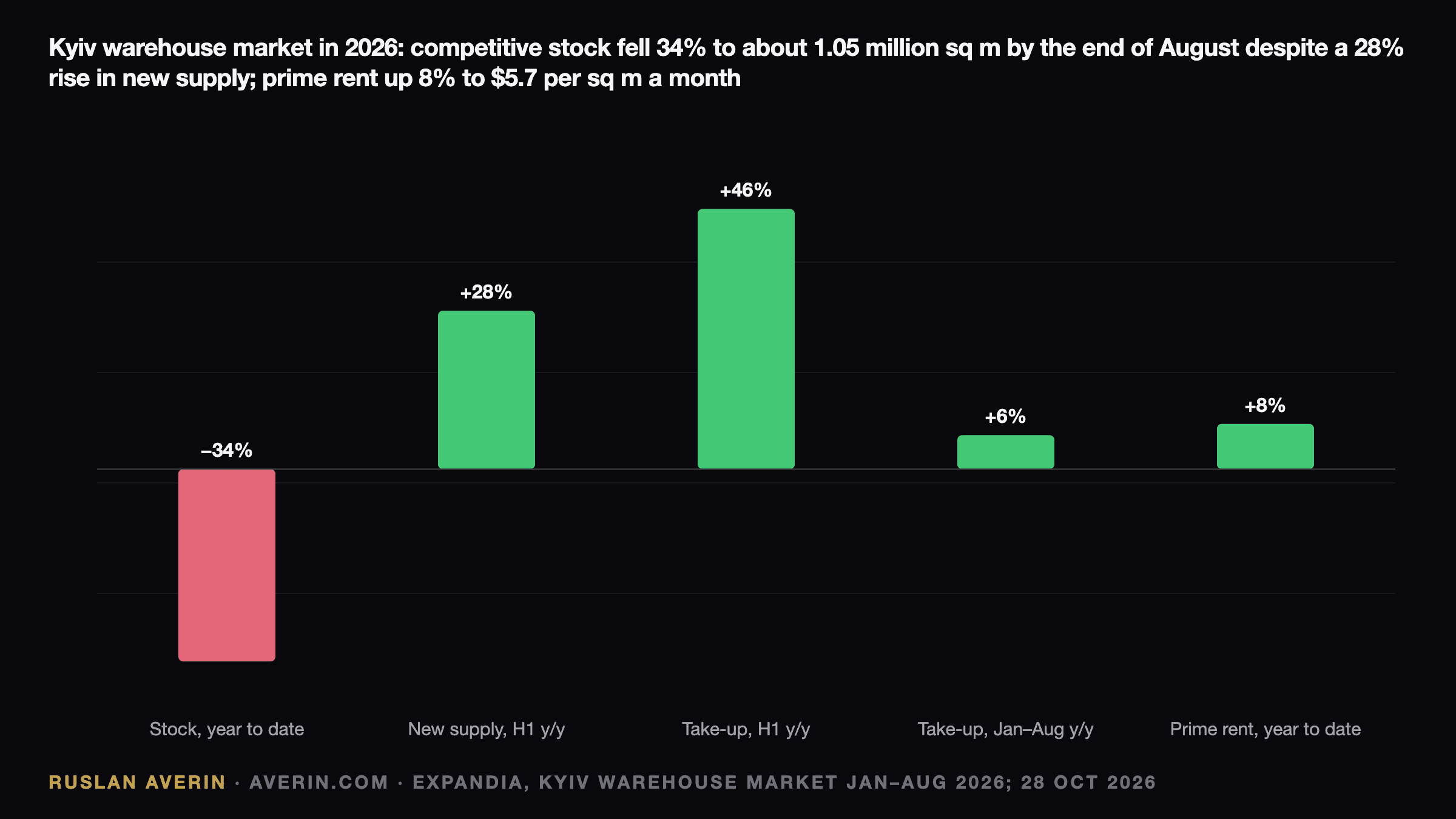
EXPANDIA's key figures for January–August 2026:
- Competitive stock: about 1.05 million sq m at the end of August, down 34% since January, after reaching about 1.6 million sq m at the end of June.
- New supply: around 150,000 sq m delivered in the first half, 28% more than a year earlier.
- Take-up: about 180,000 sq m leased in eight months, up 6% on the year.
- Vacancy: below 1% at the end of August, a technical minimum, down 2.5 percentage points since January.
- Prime effective rent for ambient (dry) warehouses: $5.7 per sq m a month net of VAT and operating costs, up 8% since January.
In other words, the market built more than it had in years and still ended the summer far smaller than it started. EXPANDIA says new development "increasingly served to replace the lost stock rather than increase supply."
Why record construction did not help
Damaged and destroyed buildings are removed from the stock count, so each successful strike shrinks the market at once. Rebuilding takes years. One example cited by Dilo (delo.ua) is the 28 September strike on warehouses of the ATB retail chain in Brovary district, just outside the capital.
Analysts should treat half-year supply figures as provisional. At a Confederation of Builders of Ukraine panel on 7 August, Yaroslav Horbushko, EXPANDIA's director of capital markets, put first-half deliveries at 98,000 sq m, 16% lower on the year, according to Interfax-Ukraine. The 28 October research gives about 150,000 sq m. The direction of the stock count is not in doubt; the exact supply figure is still being revised.
The August panel also showed how thin the pipeline is. Developers planned only about 21,000 sq m of speculative warehouse space for the whole of 2026, Horbushko said. Most new building is for a specific tenant.
Demand: tenants moving, not growing
Leasing stayed strong on paper. Take-up reached about 180,000 sq m by the end of August. But the mix changed. EXPANDIA reports that relocations and relocation-driven expansions made up 82% of deals in January–August, against 18% for pure expansions. Activity in July and August was driven mostly by moves out of damaged buildings.
An averin.com calculation from EXPANDIA's two releases shows the slowdown. First-half take-up was 160,000 sq m, up 46%, according to the August figures. That leaves only about 20,000 sq m leased in July and August combined, when tenants were competing for space that barely existed.
By type of occupier, leasing was led by:
- Logistics and 3PL operators: 42% of take-up;
- Wholesale and retail trade: 38%;
- FMCG companies: 20%.
Larger companies are spreading inventory across western Ukraine to protect business continuity, the report says. The shortage is most acute in multi-temperature warehouses, a segment where supply was already limited before the summer.
Rents: up 8%, and owners set the terms
Prime effective rent rose 8% in eight months to $5.7 per sq m a month. Leases are still mostly in hryvnias, but dollar deals have become more frequent, EXPANDIA notes. Dilo, citing the research, puts asking rents at $4.7–6.0 per sq m a month, or UAH 210–270.
A second broker sees the same trend. In mid-October Yevheniia Loktionova, director of UTG, told Dilo that rents for quality warehouses in Ukraine had risen 12–13% in recent months and that the market had become "a landlord's market." She put class A effective rents in the Kyiv region at $5–5.5, with some deals for the most protected buildings reaching $6. In the Lviv region rents are already $6–7, a sign of the westward move.
Dilo reported a forecast from market experts that rents in new quality buildings could rise another 15–20% in dollar terms in 2027. UTG estimates that total logistics costs for producers and retailers could rise 30–40% as warehouse networks are split up and moved.
Two ways to count the losses
Estimates of total damage differ by method. WINHUB data cited by UTG count about 2.2 million sq m of class A and B warehouse space in the Kyiv region before the full-scale invasion, of which about 1.5 million sq m, or 68%, has been lost. Nationwide, WINHUB counts 2.1 million sq m destroyed out of 4.2 million sq m at the start of 2022, against about 800,000 sq m of new construction since.
EXPANDIA's August estimate was lower: about 950,000 sq m lost across Ukraine, of which more than 650,000 sq m in the Kyiv region, before an early-August attack that was not yet counted. The two estimates use different stock definitions, but both describe the same thing: Kyiv has the largest losses in the country.
What it means for investors and occupiers
In analyst Ruslan Averin's view, Kyiv's warehouse segment is now the clearest case of war risk being priced directly into commercial real estate. Undamaged modern buildings have pricing power, but the very scarcity that lifts their rents comes from strikes that can hit any of them next.
For different market participants the data point to three conclusions:
- For owners of standing warehouses, vacancy below 1% and rising rents mean strong leasing terms, with concentration risk that insurance and location must offset.
- For developers, EXPANDIA expects build-to-suit and owner-occupied projects to dominate, while speculative schemes wait for better security.
- For occupiers, a company that needs 10,000–20,000 sq m in the Kyiv region may simply not find it, UTG says. Pre-leasing and western locations are becoming the default.
The same pattern of security driving price runs through the residential market. Buyers in Kyiv already pay a premium for flats with backup power and autonomous heating, as shown in the review of energy-independent apartments, while developers' new-build sales fell 62% in September even as prices rose, covered in the analysis of Kyiv new-build sales.
What to watch
- EXPANDIA's full-year 2026 report: whether the stock recovers above 1.05 million sq m or falls further during autumn strikes.
- Rent currency: a shift from hryvnia to dollar leases would lock in the 2027 rent growth experts expect.
- Western Ukraine: whether Lviv rents at $6–7 keep pulling stock and tenants away from the capital.
- Insurance and war-risk cover: the availability of cover will decide how much speculative building returns in 2027.
Related: Kyiv investment: four ways compared, Kyiv flats sell faster as prices fall and Kyiv new-build sales fall 62%.