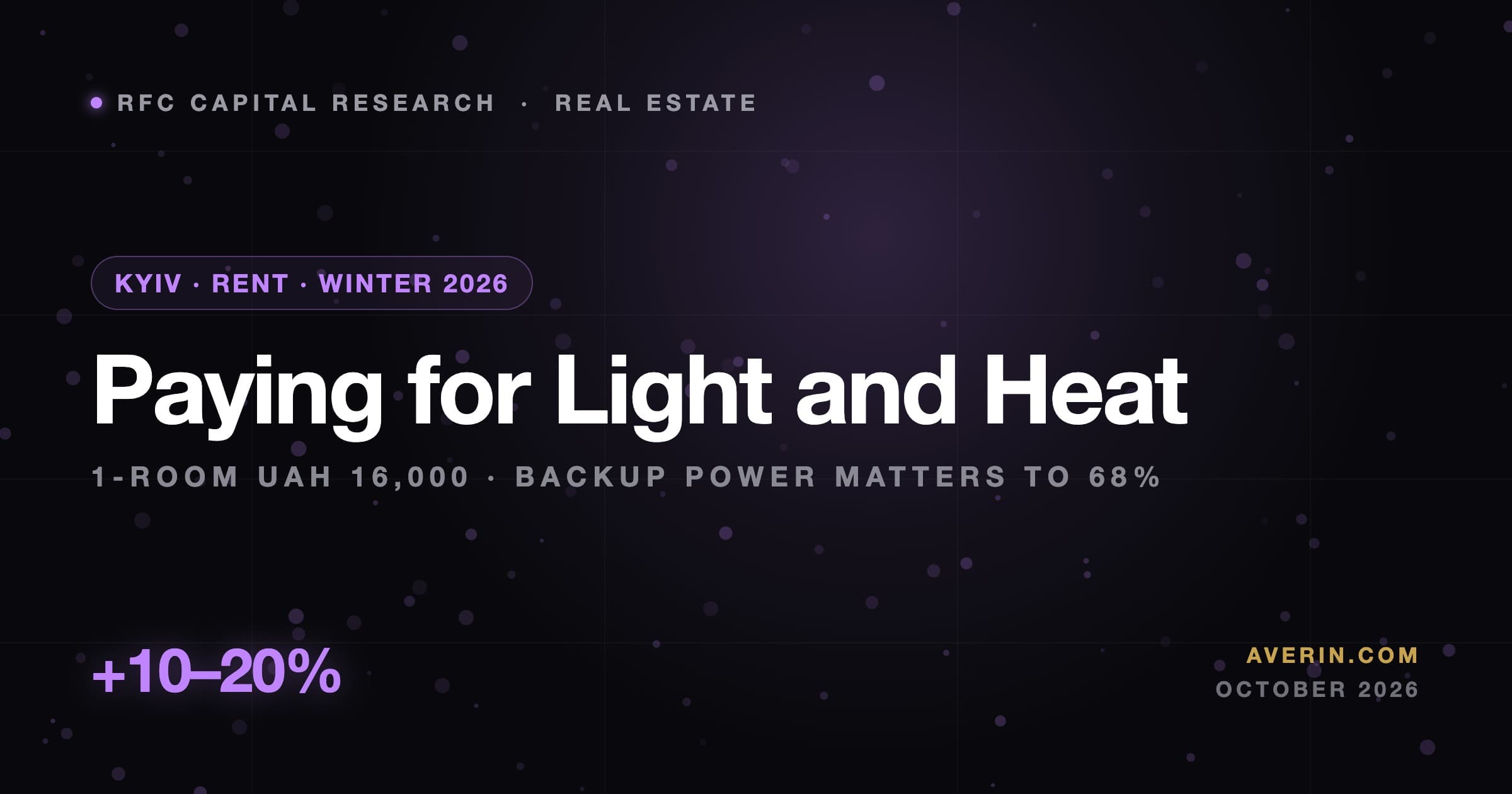
Kyiv's rental market is falling this autumn, but not evenly. LUN puts the October median rent for a one-room flat at UAH 16,000, 6% lower than a year ago. Landlords are cutting asking rents and offering winter discounts. The exception is flats in buildings that kept water, lifts, light and heat through last winter's blackouts: realtors say these let faster and at a premium.
The premium is real, but smaller and less precise than listings suggest.
What the premium is, and where the number comes from
No portal publishes a price index for "energy-independent" flats, so every figure is a practitioner's estimate. The most specific date from the blackout winter of 2025–26:
- Rent, +10–20%. In February 2026 Oksana Kovtun, head of the Kyiv branch of the Association of Real Estate Specialists of Ukraine, told LIGA.net that tenants moving into buildings with autonomous power and heating were meeting prices 10–20% higher.
- Sale, no discount versus 5–15%. Realtors quoted by Interfax-Ukraine the same month said buildings with autonomous heating, backup power and a working condominium association (OSBB) sold faster and "often without a discount". Yaroslav Orshak of the La Vida agency put the possible correction in buildings hit by heating failures at 5–15%, depending on how long the problems lasted.
- Demand shock. LUN measured a fall of about 40% in rental demand in mid-January. The average flat stayed on the market 15 days after the 11 January strikes, against 9 days earlier in the month, and was back to 10 days by late February.
LUN's own data adds an important nuance. In Dniprovskyi and Darnytskyi, the districts left without heating, average rents stayed at the previous year's level, and LUN found no statistically significant price drop in buildings without heat. Owners of cold flats mostly withdrew them rather than cut prices, so the premium shows up as speed of letting and higher prices in autonomous buildings, not as a collapse elsewhere.
Autonomy is now a top search criterion
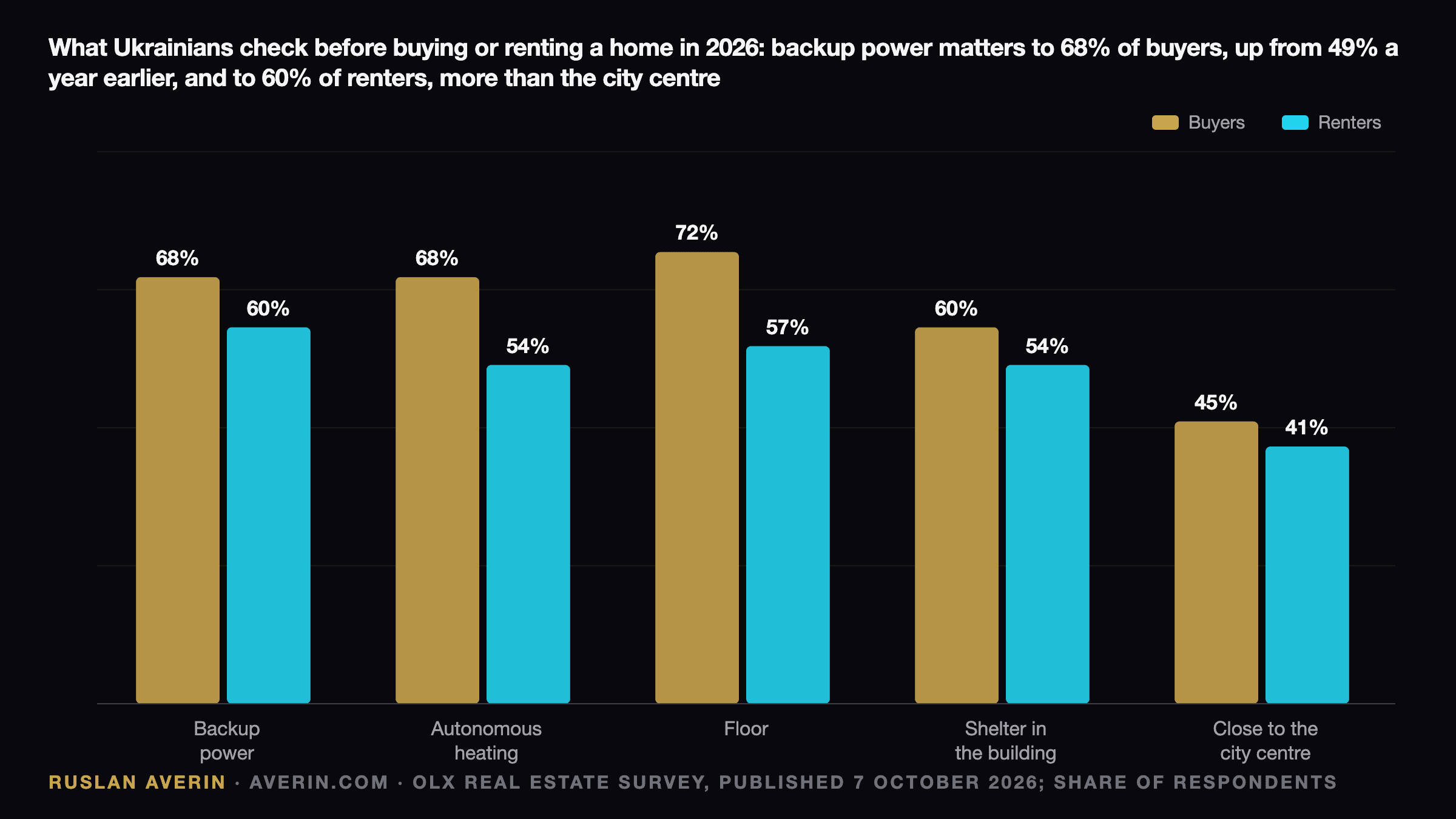
An OLX Real Estate survey published on 7 October shows how far preferences have moved:
- Buyers: backup power matters to 68%, up from 49% a year earlier; autonomous heating to 68%; distance from strategic sites to 67%; a shelter in the building to 60%. Proximity to the metro matters to 46% and to the centre to 45%.
- Renters: backup power matters to 60%, more than total floor area at 59%. Autonomous heating and a shelter each matter to 54%; the city centre to 41%.
October: a falling market with one exception
The general rental picture is weak:
- LUN, October: one-room flats UAH 16,000 (−6% a year), two-room UAH 23,000 (−4%), three-room UAH 36,200 (−14%).
- Supply: LUN counted 66% more rental listings in Kyiv between 1 August and 2 October. In September OLX recorded 20% more one-room listings and 20% less demand, with a median of UAH 16,500, down 3%.
- Real deals: Yurii Zharikov of Park Lane told Ekonomichna Pravda in mid-October that actual rents had fallen by 15%, most of all for flats on high floors and on the left bank.
Yurii Pita, executive director of the Association of Real Estate Specialists, expects tenants to negotiate winter discounts of 20–30%. He named floor and autonomy as the factors that will set rent: "If an owner spent UAH 100,000 on a power station, a tenant will gladly take such a flat." He added that most buildings now have generators or charging stations to keep water and lifts working.
Districts, floors and gas
Last winter's pattern is the best guide to this one. Olena Malenkova of KDU Realty Group told LIGA.net that Pechersk and Shevchenkivskyi, with more reliable heat and water, had the strongest demand. Five-storey buildings with gas stoves, previously hard to let, were taken, with the lowest floors preferred.
The scale explains why the issue reaches the whole city. On 20 January 2026 Mayor Vitali Klitschko reported 4,000 of 5,635 high-rise buildings still without heat after a Russian attack.
Heating season 2026: what is different
Kyiv began supplying heat on 16 October, first to hospitals, schools and kindergartens; the city named no date for residential buildings. Parts of Darnytskyi and Dniprovskyi could not receive heat because of significant damage to an energy facility, Zmina reported. Gas for households stays at UAH 7.96 per cubic metre and electricity at UAH 4.32 per kWh, as covered in this month's tariff review; the monthly household gas price tracker has the current bills.
What autonomy costs to add
Retrofit costs differ sharply between building-level and flat-level solutions:
- Generator for a high-rise: about UAH 2.5 million, or roughly UAH 6,000 per flat, according to RBC-Ukraine figures published by Kontrakty.UA in late September.
- Hybrid solar plant for a 27-storey building: about UAH 6 million at the Syretskyi Boiar OSBB in Kyiv, with 130 kW of inverters, 153 kWh of batteries and 80 panels; the city paid 70% and residents 30%.
- State support: the SvitloDim programme offers OSBBs a one-off UAH 100,000–300,000 depending on the number of floors, via Diia.
- Flat-level kit: a Deye 6 kW inverter with a 5.12 kWh battery was listed at UAH 105,395 before installation in mid-October; a 2 kWh power station at UAH 87,999, as detailed in the outage cost breakdown.
An averin.com calculation shows why the building level matters. A 10–20% premium on the LUN median of UAH 16,000 is UAH 1,600–3,200 a month, or UAH 19,200–38,400 a year. A flat-level kit at UAH 105,395 takes roughly 2.7 to 5.5 years of that premium to recover. A landlord's share of a building generator, about UAH 6,000, is covered in two to four months.
What it means for landlords and buy-to-let investors
The arithmetic is modest. A one-room flat at LUN's October secondary median of $67,000, about UAH 3.02 million at the official exchange rate of UAH 45.03 per dollar on 22 October, rented at UAH 16,000 earns about 6.4% gross. With a 15% autonomy premium, the midpoint of the range, it earns about 7.3%. That is before tax, vacancies and repairs, and against the NBU key rate of 16% on hryvnia savings and bonds.
Analysts following the market draw three conclusions:
- The premium protects occupancy more than income. In a winter of 20–30% discounts, a flat that lets in days rather than weeks avoids the larger loss.
- The building matters more than the flat. A working OSBB with a generator and pumps on backup is worth more to a tenant than a power station in one apartment.
In analyst Ruslan Averin's view, autonomy has moved from a selling point to a condition of being lettable at all in winter, which is why it shows up more in vacancy than in headline rent.
What it means for buyers: new builds or older stock
For buyers the trade-off is between a premium now and a discount risk later. Pita said discounts would not exceed 20% and would apply mainly to flats above $100,000; under $100,000 he expects up to 10%, and in the $50,000–60,000 segment, popular under єОселя, no discounts at all. Zharikov estimated that actual sale prices had already fallen 20% with few deals. LUN's October medians are $67,000 for a one-room flat (+1% a year) and $98,000 for a two-room flat (−7%).
New builds with individual heating and backup power price autonomy in from the start. Older buildings with gas, an active OSBB and low floors can offer similar resilience for less. Buildings with central heating and no backup carry the 5–15% correction risk realtors described last winter.
What to watch
- The residential heating start in Kyiv and the status of Darnytskyi and Dniprovskyi.
- LUN's November rent data: a gap opening between districts would confirm the premium in statistics, not just anecdotes.
Related: Kyiv investment: four ways compared, Kyiv rents in September 2026 and the heating season from an investor's view.