Brent crude swung by more than $6 a barrel within hours on Tuesday 3 November, a day after its 7.6% fall: it climbed above $107 after reports of US strikes on Iran's Qeshm Island, then slid 3.3% to $101.32 at 13:50 GMT, its lowest since 8 October, according to Reuters. On Monday 2 November Brent had settled at $104.77 and WTI at $96.46, the sharpest one-day drops since 27 July, NBC News reported.
Financial analyst Ruslan Averin sees the whipsaw as a market trading two headlines at once: a limited US strike that both sides played down, and talks neither side will abandon. The war premium moves within hours; pump prices move within weeks.
What changed since Monday
- Monday 2 November, during the US session: oil fell more than 7% after Washington and Tehran signalled openness to a deal. President Trump told reporters "Oil today is down $10", according to NBC News.
- Also on Monday 2 November: the US military carried out limited strikes on Qeshm Island, US officials told NBC News and The Wall Street Journal. Iranian state media reported five explosions on the island.
- Tuesday 3 November, Asian trading: Brent rose as the strike report spread. Tim Waterer, chief market analyst at KCM Trade, told CNBC that "the report added a degree of risk premium back into the oil price".
- Tuesday 3 November, European trading: the rebound faded. Brent fell $3.45 to $101.32 and WTI $2.16 to $94.30 by 13:50 GMT, Reuters reported, as Qatar said both sides remained committed to mediation.
The numbers: settlements and Tuesday's range
| Contract | Settled Fri 30 Oct | Settled Mon 2 Nov | Tue 3 Nov, 13:50 GMT | Source |
|---|---|---|---|---|
| Brent, January | $113.43 | $104.77 (−7.6%) | $101.32 (−3.3%) | CNBC, Reuters |
| WTI, December | $104.12 | $96.46 (−$7.66) | $94.30 (−2.2%) | NBC News, Reuters |
Friday's Brent settlement is implied by the $8.66 Monday drop CNBC reported. Tuesday's figures are intraday quotes; the Tuesday settlement was not available at the time of writing. The session range was $107.21 to $100.80 for Brent and $98.82 to $93.59 for WTI, according to ICE and NYMEX data on Yahoo Finance, consistent with Reuters and AP.
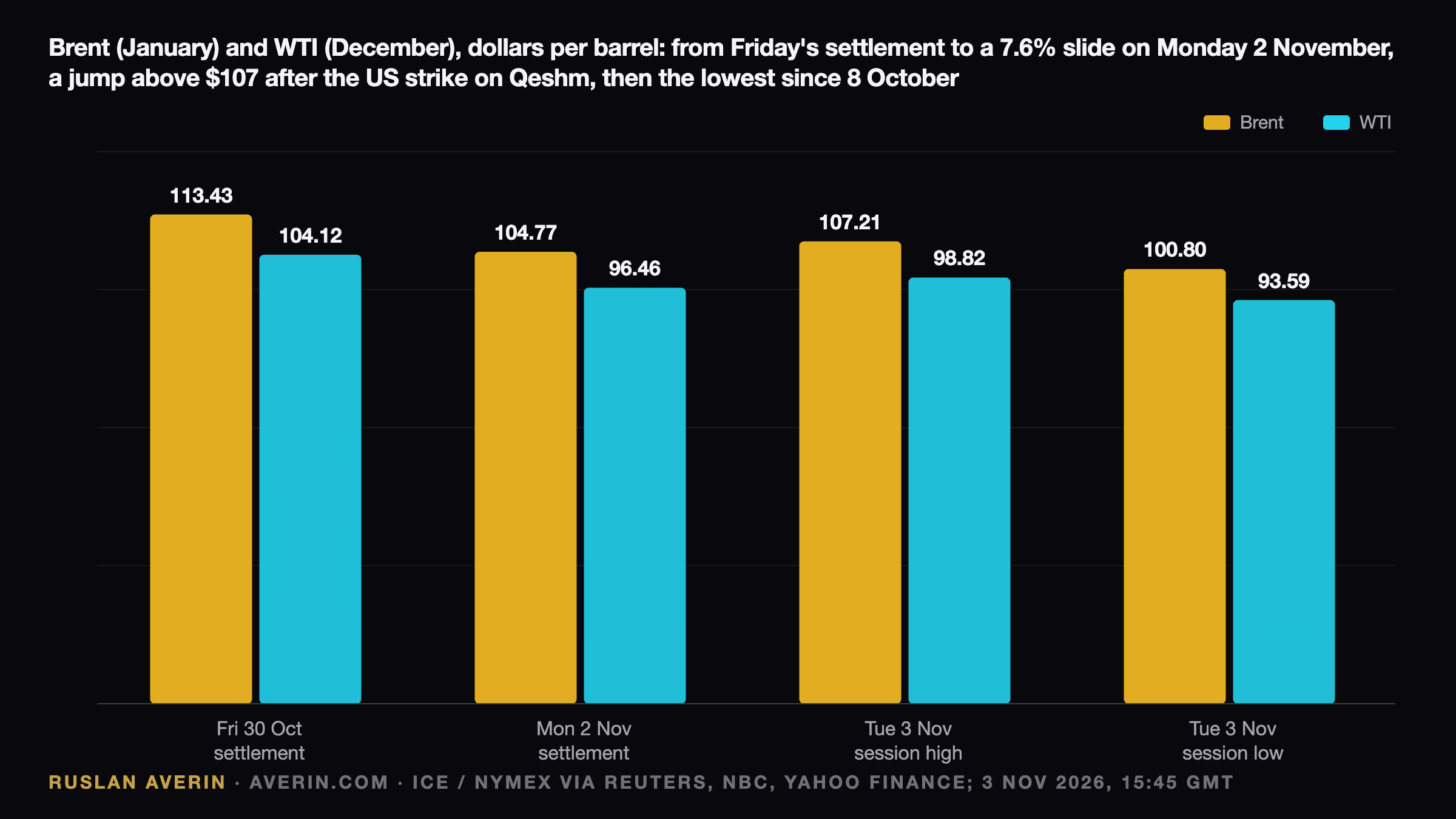
From Friday's settlement to the Tuesday quote at 13:50 GMT, Brent is down 10.7% and WTI 9.4% (my calculation).
The Qeshm strike: what is confirmed
US officials described the operation as "limited, defensive strikes on the island", AP reported. The target was a missile launcher used against US aircraft, and the strikes were not a resumption of major combat, officials told NBC News. US officials also told The Wall Street Journal that Washington had carried out "limited strikes" against Iran in recent weeks, CNBC reported.
Trump called the strikes minor and said they were not a war, Al Jazeera reported. Tehran also kept the door open. Parliament Speaker and chief negotiator Mohammad Bagher Ghalibaf said the ball was now in America's court to prevent a war, NBC News reported, while an Iranian official told Reuters the two sides remained far from a deal. Security chief Mohsen Rezaei said Hormuz would fully reopen only after Washington addressed all seven of Iran's conditions, according to Al Jazeera.
That is why the rally failed: neither side treated Qeshm as escalation, and Qatar said the US and Iran were reviewing proposals to bridge their differences, Reuters reported.
Hormuz: shipping is still under fire
The strait is not open in any practical sense. At least four attacks on ships have been reported since the start of November, according to the UK Maritime Trade Operations centre cited by CNBC. The US Navy is still enforcing a blockade of tankers carrying Iranian oil, and a third aircraft carrier is on its way to the region, NBC News reported. The IRGC said tankers had hit naval mines, according to Al Jazeera.
For shipowners and insurers, war-risk cover stays a cost of every Gulf voyage until there is a signed agreement. The physical gauge is still Kpler's 7.3 million barrels a day through Hormuz in the week to 28 October, more than 40% below the pre-war baseline, as CNBC reported.
OPEC+ holds December targets
Seven core OPEC+ members, Saudi Arabia, Russia, Iraq, Kuwait, Algeria, Kazakhstan and Oman, agreed in principle at an online meeting on Sunday 1 November to keep December production targets unchanged, Reuters reported. The group finished unwinding a 1.65 million barrel a day cut in September; a further layer of about 2 million barrels a day remains through the end of 2026.
In practice it changes little: most Gulf members pump below target because the war blocks their exports, Reuters noted. Spare capacity is trapped behind Hormuz.
US gasoline and the midterm vote
Americans vote on Tuesday 3 November with gasoline still expensive. The AAA national average for regular was $4.149 a gallon on 3 November, down 5.3% from a month earlier but up 36.7% from $3.036 a year ago. Diesel was $6.288 a gallon, according to AAA; NBC News put its rise since the start of the year at 77%. Fuel prices and the Iran war are a central voter issue, Reuters noted. I covered what stocks, the dollar and Treasuries price for the vote in the midterm elections preview.
Energy stocks gave back Friday's gains
Exxon Mobil closed on Monday 2 November at $179.67, down 4.05%, and Chevron at $227.77, down 3.29%, according to stockanalysis.com. Both had risen on Friday 30 October after third-quarter beats, detailed in the Exxon and Chevron Q3 2026 review.
Ukraine: fuel and the hryvnia
On Tuesday 3 November the national average was UAH 90.06 a litre for A-95, UAH 104.58 for diesel and UAH 58.82 for autogas, according to A-95 Consulting Group data published by Minfin. Autogas added UAH 0.41 in a day. Since 1 October autogas is up 33.9%, diesel 6.2% and A-95 0.9% (my calculation). Network prices and the full history are in the fuel prices in Ukraine hub.
The hryvnia is working against cheaper oil. The NBU set the official rate at UAH 45.5348 per dollar for Tuesday 3 November and UAH 45.6660 for Wednesday 4 November, above the previous record of UAH 45.6008 set for 28 October. Since 1 October the dollar has gained 2.2% (my calculation from NBU data). The outlook is in the dollar exchange rate forecast for Ukraine.
At UAH 45.666 per dollar, each $1 a barrel is worth about UAH 0.29 a litre of crude (159 litres a barrel). The $12.11 fall from Friday's Brent settlement to the Tuesday quote is therefore about UAH 3.5 a litre before refining, logistics, excise and VAT. Ukraine imports finished fuel, so pump prices follow European product quotes with a lag.
My view
Goldman Sachs set a December Brent forecast of $105, CNBC reported on Sunday 1 November. Monday's $104.77 settlement already sat just below it, and Tuesday's trading took Brent to its lowest since 8 October. ING warned in a note quoted by Reuters that "it's probably too early to think escalation risks have passed".
I would watch two things before reading the drop as durable: a signed text and a rise in Hormuz tanker flows. Without both, a single strike report can add more than $2 to Brent in one session and a mediation headline can take $6 off within hours, as Tuesday showed. For Ukrainian drivers I expect A-95 near UAH 90 and diesel above UAH 100 through November, with autogas still rising.
What to watch next
- Wednesday 4 November: US midterm results; the EIA weekly crude and gasoline inventory report.
- Thursday 5 November: the NBU Inflation Report, with its fuel assumptions.
- Tuesday 10 and Wednesday 11 November: the US hosts Ukrainian and Russian delegations in Abu Dhabi, Reuters reported.
- The OPEC+ capacity review due in the fourth quarter, which sets the baselines for 2027 quotas.
Related: Brent falls on Iran–Qatar talks, Brent at $111 after the Shaybah strike and the commodity supercycle: copper vs oil.