The Federal Reserve kept its target range at 3.75–4.00% on Wednesday 28 October by a 10–2 vote, and the European Central Bank held its deposit facility rate at 2.50% on Thursday 29 October, according to the two central banks' statements. Traders put the chance of a Fed hike on Wednesday 9 December at roughly 75%, according to CME FedWatch data cited by CNBC on Monday 2 November.
Financial analyst Ruslan Averin reads the two holds as confirmation that rates will stay high longer than the stock market had hoped. With the 3-month Treasury bill at 4.16% on Friday 30 October, short government paper pays nearly what stocks earn, without the price risk.
What the Fed and the ECB said
The Fed statement says the economy is "expanding at a strong pace" and that "inflation remains elevated". Governor Lisa Cook and Cleveland Fed President Beth Hammack dissented in favour of a quarter-point hike.
At the press conference Chair Kevin Warsh said "inflation is too high" and that energy prices "have moved higher again in recent weeks". Asked about December, he said: "I don't believe in forward guidance absent exigent circumstances, absent a crisis." Since then, third-quarter GDP grew at a 3.4% annual rate and the PCE price index rose 3.6% from a year earlier in September, CNBC reported on Thursday 29 October. More in what Warsh at the Fed means for rates.
In Frankfurt, Christine Lagarde said the Governing Council "debated whether a hike was appropriate" but "unanimously decided that we were well positioned enough at this stage to hold". Euro area inflation was 3.8% in September, and the ECB is "not pre-committing to a particular rate path". Our preview expected the double hold.
What the bond market pays
Closing yields on Friday 30 October, from the US Treasury's par yield curve and the Bundesbank:
- 3-month Treasury bill: 4.16%, up from 3.67% at the end of 2025.
- 2-year Treasury: 4.56%, up from 3.47%; the 2026 high was 4.92% on Monday 28 September.
- 10-year Treasury: 4.94%, up from 4.18%; it peaked at 5.31% on Monday 5 October (the move above 5%).
- German 2-year yield: 3.06%, up from 2.11% at the end of 2025.
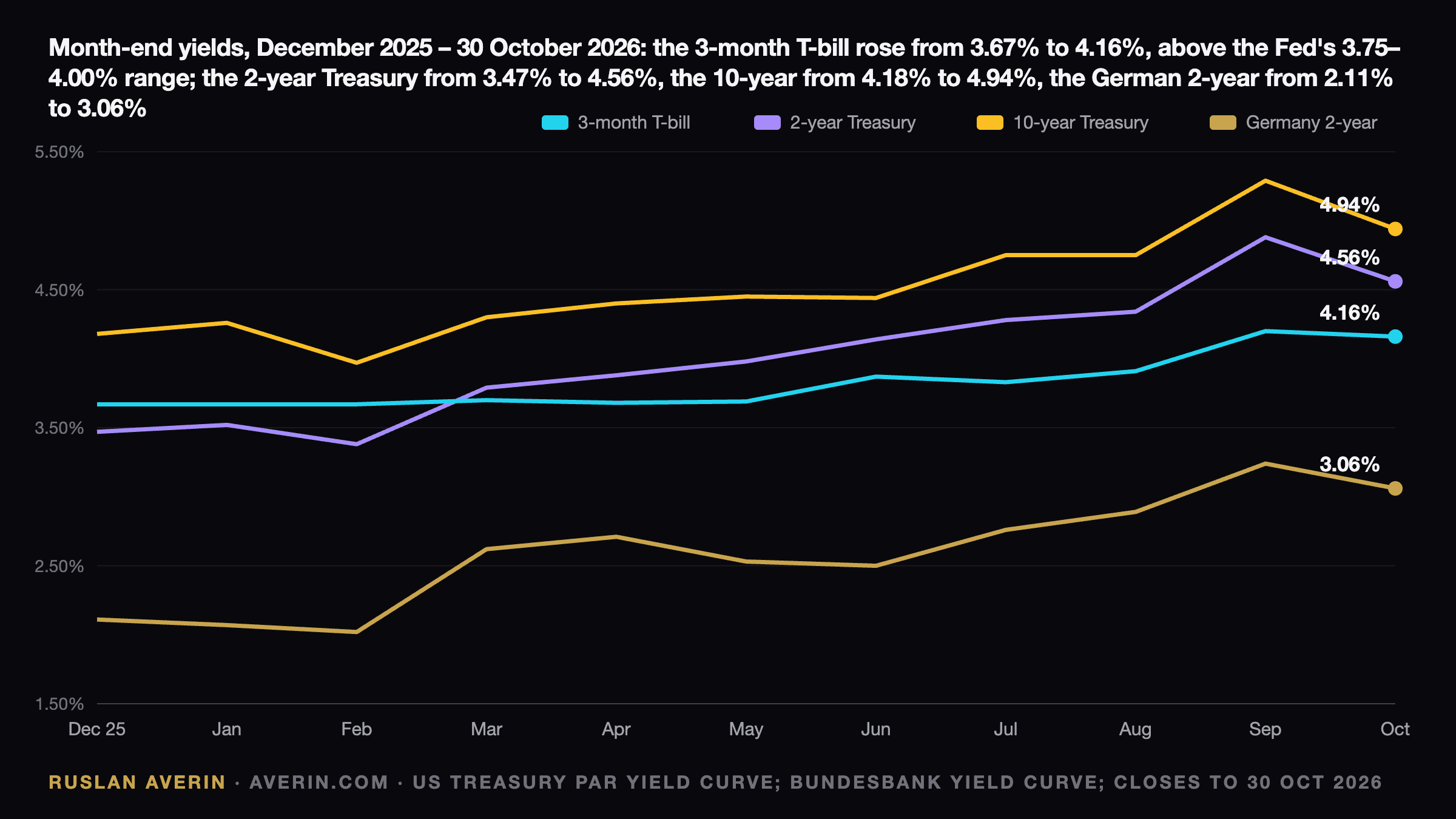
The 3-month bill at 4.16% sits above the top of the Fed's range: the market already pays for a hike. The German 2-year, more than half a percentage point above the ECB's 2.50% deposit rate, implies tightening in Frankfurt too. See also the US yield curve.
Why short duration is winning
Bills pay carry with almost no duration risk. A 10-year bond pays more, but each percentage point of yield rise costs it roughly 7–8% of its price.
Total returns of exchange-traded funds, from Yahoo Finance closing data:
- Since 31 December 2025: 1–3 month T-bill fund BIL +3.0%, 7–10 year Treasury fund IEF −1.7%, 20-year-plus fund TLT −2.8%, S&P 500 fund SPY +11.7%.
- Since 31 August 2026: BIL +0.6%, IEF −0.4%, SPY −1.2%.
Stocks still lead for the year, but for two months bills have beaten both stocks and long bonds. The S&P 500 closed at 7,580.07 on Friday 30 October, 3.1% below its record close of 7,818.93 on Tuesday 6 October.
The valuation cushion is thin. FactSet put the S&P 500's forward 12-month price-to-earnings ratio at 18.7 in its 30 October Earnings Insight, based on the Thursday 29 October close. That is an earnings yield of about 5.3%, against 4.98% on the 10-year and 4.18% on the 3-month bill the same day: a premium of 0.4 percentage points over 10-year Treasuries and 1.2 points over cash. At 18.7 the ratio is below its 10-year average of 19.1, FactSet notes: stocks are not expensive by their own history, only against what risk-free money pays.
It is the problem that broke the 60/40 portfolio in September: when inflation keeps rates up, long bonds stop hedging stocks.
Three scenarios for the next 12 months
This is arithmetic, not a forecast. Bills are rolled quarterly, their yield moving with the Fed by about a quarter point. The 10-year is a par bond bought at 4.94%, repriced after a year for a half-point yield move, plus coupon. For the S&P 500: the effect of the forward P/E alone, and the earnings growth needed to match bills.
| Scenario | 3-month bills | 10-year Treasury | S&P 500: P/E effect | Earnings growth the S&P 500 needs to match bills |
|---|---|---|---|---|
| Hawkish: Fed hikes, 10-year yield +0.5 point | about 4.4% | +1.4% | −10% (P/E 16.8) | 16.0% |
| Base: rates on hold, yields flat | about 4.2% | +4.9% | 0% (P/E 18.7) | 4.2% |
| Dovish: inflation eases, 10-year yield −0.5 point | about 3.9% | +8.6% | +5.9% (P/E back to the 5-year average of 19.8) | none |
Analysts expect S&P 500 earnings to grow 16.3% in 2027, according to FactSet. In the hawkish case stocks need all of that just to tie with bills. Only bills deliver about 4% in every row; the 10-year wins only if inflation eases.
Ruslan Averin made the same point in a column for spilno.net on 2 November: high Fed and ECB rates press on equity valuations, and short bonds win because they protect capital.
The week ahead decides the December bet
- Tuesday 3 November: US midterm elections (what markets price in).
- Wednesday 4 November, 8:30 a.m. ET: the Treasury's quarterly refunding. On Monday 2 November the Treasury estimated $618 billion of net borrowing for October–December and $800 billion for January–March. Bigger long auctions would hit the 10-year, not bills.
- Thursday 5 November: Bank of England decision.
- Friday 6 November: US jobs report for October (BLS).
What it means in Ukraine
The same logic applies at much higher rates. The National Bank of Ukraine raised its rate to 16.5% on Thursday 29 October (the NBU hike and the Fed and ECB holds).
At the Tuesday 27 October auction the Ministry of Finance sold UAH 2.0 billion of OVDP maturing on 15 September 2027 at a weighted average 14.94%, tax-free, according to Minfin. The UIRD 12-month hryvnia deposit index stood at 14.30% on Monday 2 November, or about 11.01% after the 23% tax on deposit income. Both beat September inflation of 10.0%. Bank offers are tracked in deposit rates in Ukrainian banks.
Longer paper is harder to sell: of UAH 1 billion of February 2030 bonds offered, only UAH 593.7 million sold, at 16.49%. A dollar deposit pays 1.17% on the UIRD index, so dollars remain a currency hedge rather than an income tool (the dollar forecast for Ukraine).
Ruslan Averin's columns on this topic
Seven columns published on 2 November:
- Ruslan Averin: Fed and ECB key rates weigh on the stock market, and why short bonds win — spilno.net, 2 November (in Russian)
- Ruslan Averin: the Fed and ECB rate is pressing on stocks for longer than the market is ready to tolerate — arhument.com, 2 November (in Russian)
- Ruslan Averin: why high Fed and ECB rates change the rules of the game for the stock market — karrespondent.com, 2 November (in Russian)
- Ruslan Averin: Fed and ECB key rates, and why the stock market pays for someone else's patience — vgolos.org, 2 November (in Russian)
- Ruslan Averin: the key rate stays high for longer than the market expects and is reshaping the stock market — ukrnet.org, 2 November (in Russian)
- Ruslan Averin: key rates are stuck at a high level, and why the stock market pays for expensive credit — sprotyv.org, 2 November (in Russian)
- Ruslan Averin: central bank key rates and the stock market, an expert forecast — from-ua.info, 2 November (in Russian)
What to watch next
- Thursday 5 November: the NBU Inflation Report.
- Tuesday 10 November: US consumer prices for October.
- Wednesday 9 December: the Fed decision, with new projections.
- Thursday 17 December: the ECB and NBU decisions.
Related: the NBU hike to 16.5% and the Fed and ECB holds, the 60/40 portfolio problem and the 10-year Treasury at 5%.